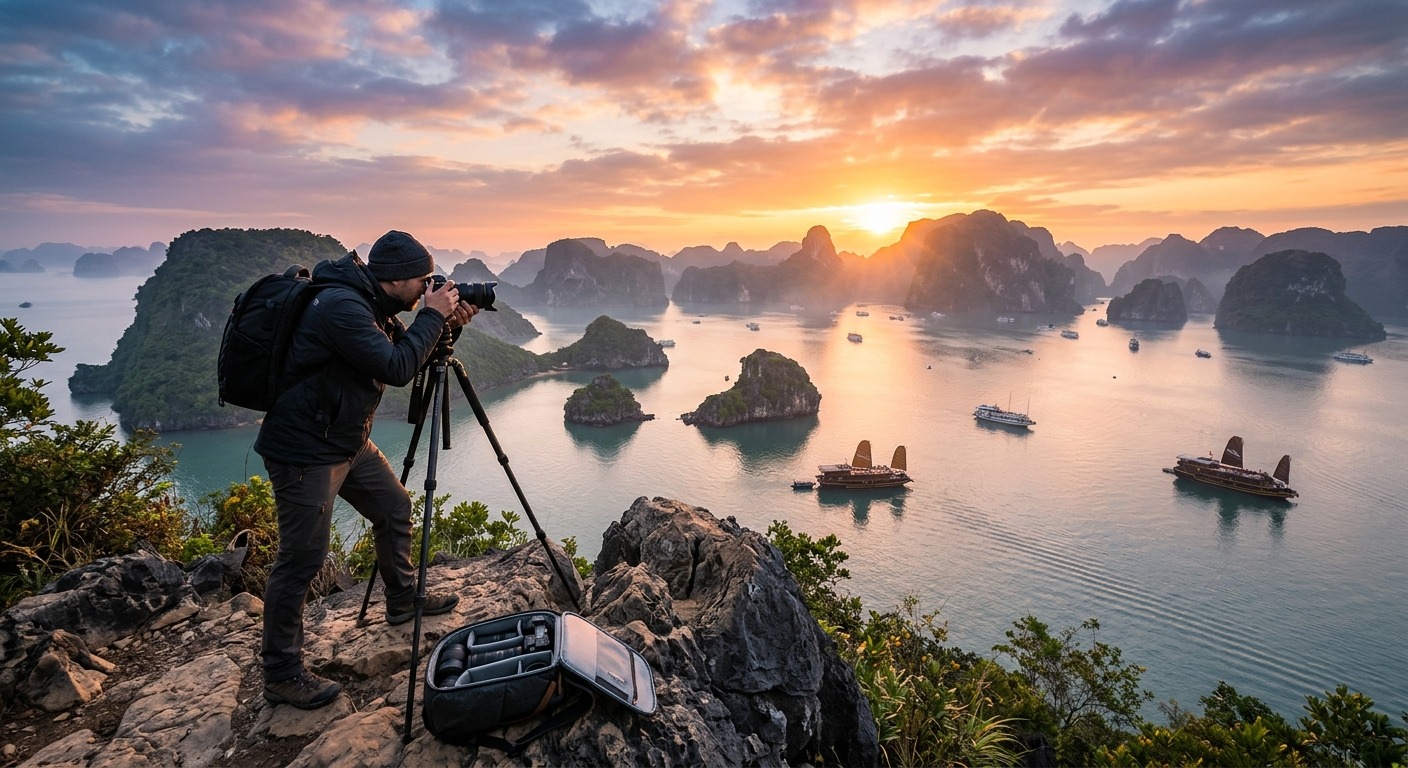
The alarm goes off at 4:30 a.m. The boat rocks gently beneath you. Outside the porthole, Ha Long Bay is still pitch dark, the limestone towers invisible against a charcoal sky. You pull on a fleece, grab your camera bag, and head up to the sundeck. Nobody else is stirring yet. The bow light cuts a thin path across the water, and somewhere in the distance, a rooster crows from one of the floating villages. This is where the real work begins, and it is worth every minute of sleep you traded for it.
Before You Lift the Camera: Key Conditions at a Glance
- Get on deck at least 45 minutes before sunrise to claim your position and set up your tripod
- Telephoto lenses in the 200mm to 400mm range compress karst towers into dramatic layered stacks
- The mist window typically opens 30 to 60 minutes after sunrise and can close in under 20 minutes
- A circular polarising filter cuts water glare and deepens sky tones on calm, still mornings
- October through March delivers the cool, fog-draped atmosphere that defines the bay’s signature look
The Pre-Dawn Ritual on the Sundeck
Every overnight junk boat on Ha Long Bay runs a version of the same quiet ceremony. Crew members start the engine well before first light. The smell of coffee drifts up from the galley. If you have done your homework, you are already on the upper deck, tripod legs spread wide, lens pointed northeast toward the first pale suggestion of blue in the sky.
Position is everything. The sundeck of most traditional junk boats offers a near-180-degree view, but the best foreground changes depending on where the captain has anchored overnight. Ask your guide the evening before what the morning anchorage will look like. If you can see a cluster of karst towers to the east with a clear water line in front, you have a usable composition waiting before you even go to sleep.
Bring a headlamp with a red mode so you can check your settings without killing your night vision. Mount your camera on a tripod the moment you step on deck. The boat shifts constantly, and handheld shots in the pre-dawn murk will lose you frames you cannot recover.
Stacking the Karst Towers with a Telephoto Lens
Ha Long Bay holds more than 1,600 limestone islands and islets, a landscape so striking it has been formally recognised as a UNESCO World Heritage listing for both its exceptional natural beauty and outstanding geological values. For photographers, the sheer density of those towers is not just scenery. It is a compositional tool you need to learn to use deliberately.
A wide-angle lens at 24mm will show you a large bay with many rocks scattered across it. A telephoto at 300mm or longer will compress those rocks into stacked silhouettes, each layer slightly lighter than the one in front of it. That compression is the classic Ha Long Bay shot. It creates depth, scale, and a sense of atmosphere that wide frames simply cannot replicate.
To maximise the stacking effect, look for an anchorage position where multiple islands are aligned on roughly the same axis as your shooting direction. Even a 15-degree shift in your standing position can bring three or four towers into alignment. The bow of the boat is often the best vantage point because it puts clear water in your foreground and opens up a clean line of sight down the channel.
Reading the Morning Mist and the Reflection Window
Mist is the defining quality of a great Ha Long Bay sunrise image. It softens the hard edges of the karst, wraps the towers in gradients of grey and violet, and creates the layered atmosphere that makes the scene feel ancient. The catch is that mist behaves unpredictably and burns off fast.
On most mornings between November and February, a low layer of mist sits over the water after sunrise. It forms during the night when cool air meets the relatively warmer surface of the bay. As the sun climbs, warmth disperses it. Your shooting window can be as short as 20 minutes. Know that going in, and do not spend those 20 minutes adjusting settings. Shoot first, refine later.
Reflections are a separate opportunity. On mornings when the water is genuinely calm, usually before any boat traffic stirs the surface, you will see near-perfect mirror images of the towers stretching toward you. This window is even shorter than the mist window. It closes the moment a passing vessel creates a wake, or when the wind picks up even slightly. Shoot reflections the instant you see them. Do not wait for better light.
Exposure Settings for Sunrise on Open Water
The light changes radically in the 90 minutes around sunrise. You will need to adapt your settings constantly, and having a solid starting point helps you spend less time in menus and more time looking through the viewfinder.
In the pre-dawn blue hour, begin with ISO 800 to 1600, a wide aperture around f/2.8 to f/4, and a shutter speed long enough to gather light without blurring the boat’s gentle movement. If the boat is at anchor and the water is calm, you may be able to use exposures of one to three seconds with a sturdy tripod and a remote shutter release.
As the golden light appears on the horizon, drop your ISO toward 400 and tighten your aperture to f/8 for better front-to-back sharpness. The telephoto shots of stacked karsts look best at f/8 to f/11, which keeps middle and background towers sharp and retains the atmospheric depth in the scene.
Using a Circular Polariser on Open Water
A circular polarising filter is one of the most useful pieces of glass you can carry on this shoot. Rotate it to cut the glare off the water surface, and suddenly you can see colour and depth in the bay that was invisible before. The sky picks up saturation. The mist takes on warm pink and amber tones rather than appearing washed out and flat.
Be aware that polarisers reduce incoming light by roughly 1.5 to 2 stops. In the low light of early morning, that cost is real. Use it selectively. Once the sun is fully up and you have enough exposure latitude to spare, the polariser earns its place permanently on the lens.
Curating and Licensing Your Best Frames After the Shoot
After a sunrise session on the bay, you may come back to your cabin with 400 to 800 raw files. Editing all of them is not the goal. Curating ruthlessly is. This process works well for keeping the haul manageable:
- Do a ruthless first pass. Flag any frames with obvious motion blur, missed focus, or blown highlights that cannot be recovered. Delete them immediately without sentiment.
- Group by moment type. Sort remaining shots into clusters: mist shots, reflection shots, telephoto karst stacks, and wide-angle deck frames. Work within each cluster to identify the strongest two or three images.
- Fix white balance first. Ha Long Bay sunrises often read cool on camera. Nudging the colour temperature toward 5,800 to 6,200 K brings out the warmth trapped in the morning haze.
- Lift shadows carefully. Raise shadow detail gently to reveal texture in the dark tower faces, but protect the silhouette contrast. That tonal drama is what makes telephoto karst shots compelling.
- Verify at 100 percent before export. Export your top five to ten frames at full resolution and review them at pixel level. Atmospheric haze can hide soft focus that only becomes obvious at full crop.
Once you have a polished set of images, consider that a shoot like this carries genuine commercial value. Travel and nature photographers regularly offset expedition costs by licensing their work through a reputable stock photo platform. Sunrise shots of Ha Long Bay with strong mist layers, clean reflections, or dramatic telephoto karst stacks perform consistently well as travel editorial and destination marketing imagery. Submitting your best frames as soon as you return home means the licensing clock starts before the trip has fully faded from your memory.
What to Pack for Boat-Based Photography on Ha Long Bay
Shooting from a moving or anchored vessel introduces challenges that dry-land photography does not. Salt haze, boat vibration, limited deck space, and rapidly changing light all demand specific gear choices. The items below genuinely earn their weight on this shoot:
- Telephoto zoom (70-200mm or 100-400mm): your primary lens for karst compression shots and mist-layer work
- Wide-angle prime or zoom (16-35mm): for boat deck context shots and broad panoramic frames during the blue hour
- Sturdy travel tripod with a ball head: carbon fibre saves weight; quick-release plates save critical time in fast-changing light
- Circular polarising filter sized for your telephoto: step-up rings let one filter fit multiple lens diameters and save space
- Weatherproof camera cover or dry bag: morning humidity, mist, and occasional spray are hard on electronics and lens coatings
- Extra batteries and memory cards: cool mornings drain batteries faster than you expect, and card changes mid-shoot cost frames
- Remote shutter release or intervalometer: removes camera shake during long exposures at anchor and allows hands-free timelapse sequences
- Microfibre lens cloths in a sealed bag: salt haze coats front elements silently; clean your glass between shots or contrast will suffer
The Months When Ha Long Bay Earns Its Reputation
Ha Long Bay is photogenic throughout the year, but not every season delivers the atmospheric conditions that produce its most recognisable images. The peak photography season runs from October through March, driven by northeast monsoon winds that bring cooler temperatures and a reliable morning mist layer over the water. This is the window that serious photographers plan expeditions around, often booking overnight cruises specifically to catch the bay before the day’s boat traffic begins.
Summer months from June through August bring warmer temperatures, stronger light, and significantly less fog. The bay is vivid and colourful in summer, and the longer days extend your shooting hours, but the soft layered mist that defines the bay’s visual identity is largely absent during this period. The look shifts from atmospheric and painterly to bold and graphic. Both are valid aesthetically, but they are fundamentally different subjects.
April and October sit in a productive middle ground, offering a balance between stable weather and some residual atmospheric haze. October in particular can produce spectacular mornings when early-season cool air meets the still-warm surface water, generating mist that can last well past 8 a.m.
- October to March: peak season for mist, fog layers, and calm-water reflections; dress warmly for pre-dawn deck time
- April and late September: shoulder months with occasional mist, generally stable conditions, and fewer vessels on the water at sunrise
- May through August: vivid colours, long days, and clear skies; mist is rare, but strong wide-angle and drone opportunities remain where flying is permitted
What the Bay Gives to Those Who Wake Before It Does
Ha Long Bay does not hand out its best light. You have to claim it. The photographers who come home with truly memorable frames are the ones who set the alarm, climbed the stairs in the dark, and spent 90 minutes in the cold working a scene that changed by the minute.
The telephoto stacks, the mirror reflections, the mist burning off the towers at 6:15 a.m. , these moments last perhaps half an hour in total across an entire trip. But they are the moments that matter. They are the reason you booked the boat, packed the filters, and dragged yourself out of a comfortable bunk before anyone else on board stirred.
Plan your anchorage position the night before. Know your seasonal window before you book. Show up early and stay patient. The bay will do the rest.