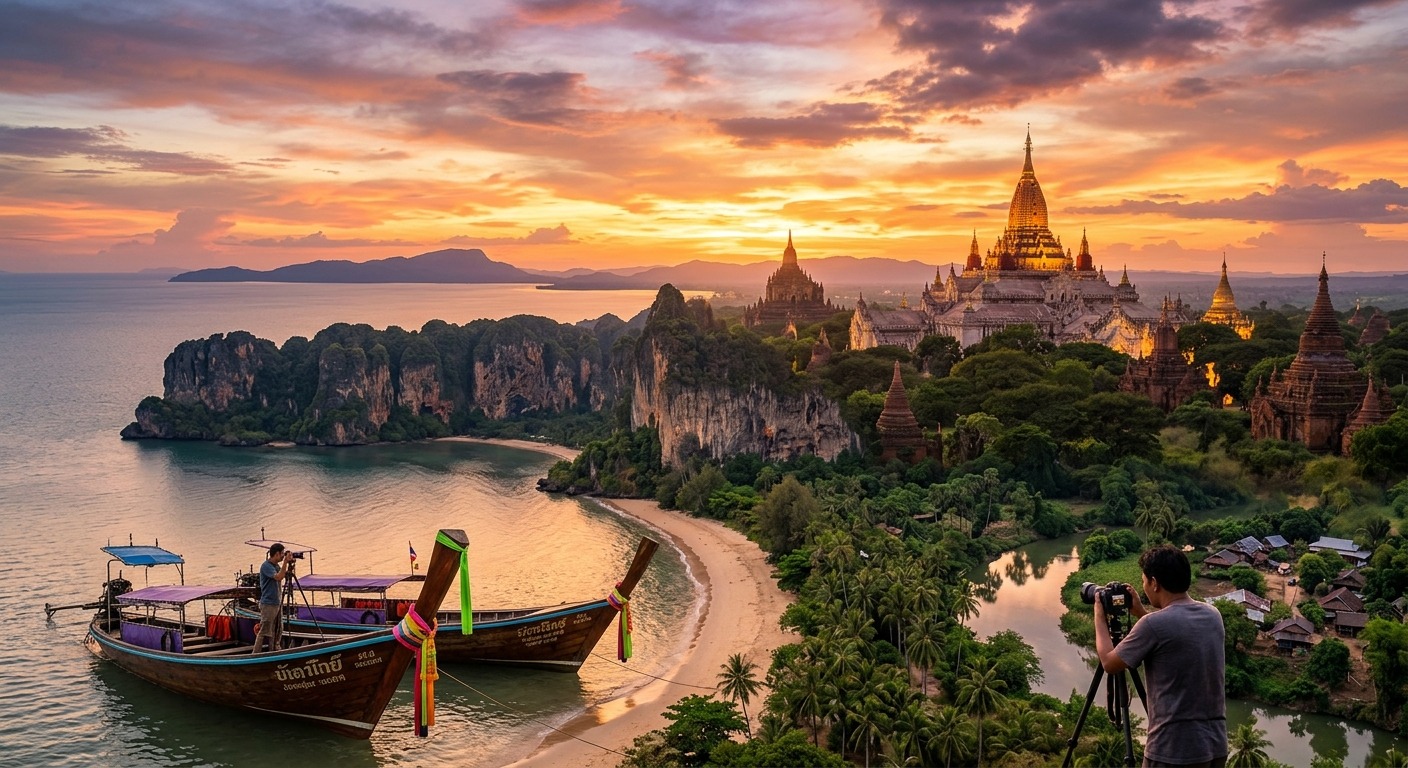
You are standing on the upper ridge at Tegallalang at 5:28 in the morning. The rice terraces fall away below you in dark, stepped tiers. The air is cool and carries the faint smell of wet earth and something faintly floral from the banyan trees behind you. Then a thin orange band appears over the volcanic rim to the east. It widens fast. The terraces catch the light from the top down, the highest rows turning warm amber while the lower steps stay blue-grey in shadow. You have nine minutes before the whole field floods with flat, hard light. You shoot.
That nine-minute window is not an accident. It is geography working at its most precise. At 8 degrees south of the equator, the sun rises steeply and fast. There is no long, lazy dawn. The light arrives on its own schedule, and if you have not done the math before you arrived, you will miss it.
Across Vietnam, Thailand, and Indonesia, golden hour windows shift dramatically by latitude and season. Monsoon patterns close and open entire destinations for months at a time. Agricultural haze can turn a crisp December morning in Chiang Mai into a flat, washed-out scene. Fog in Sapa’s valley floors at harvest time lasts exactly as long as it lasts, and not a minute more. Planning an itinerary around these conditions is the difference between a trip that delivers images you are proud of and one that does not.
Golden Hour Field Notes: What to Know Before You Go
- Near the equator, your golden window shrinks to 20 to 30 minutes, so plan your setup time with that constraint in mind
- Vietnam’s north and south run on opposite dry seasons, meaning each region needs its own timing strategy
- Haze in Thailand and East Java is not always a liability; it can produce extraordinarily rich sunset tones
- Cross-referencing civil twilight start times against your hotel’s travel distance to the shoot location is essential before you confirm any booking
- Monsoon shoulder weeks often deliver dramatic skies and manageable showers, not blanket rain
Why Latitude Changes Everything About Your Golden Hour
The length of your golden hour window is a direct product of where you are on the planet. This is not a matter of opinion. It is simple geometry between the earth’s surface and the path the sun travels across the sky.
Near the equator, the sun rises and sets at a near-vertical angle to the horizon. The light transitions quickly from darkness to full daylight. At 8 degrees south, like Bali, your golden hour can be as short as 20 minutes from first warm tones to harsh glare. At 21 degrees north, like Hanoi, the sun takes a shallower arc, particularly in the winter months, and your warm-light window stretches to 40 or even 50 minutes. That extra half-hour gives you time to recompose between shots without racing the clock.
The direction of sunrise also shifts by season. Earth’s axial tilt means the sun rises further north in June and further south in December. At locations close to the equator, this shift is subtle. In northern Vietnam, it is enough to move your sunrise point significantly along ridge lines, which changes how light falls across rice terraces and mountain folds entirely. NOAA publishes a precise solar position calculator that lets you verify sunrise azimuth and altitude for any coordinate and date, which is useful when you are deciding which direction to face on a specific morning.
The practical takeaway is this: the further north you go in Southeast Asia, the more latitude-friendly your golden hour becomes. Destinations like Sapa, Ha Giang, and Chiang Rai reward winter visits partly because the longer soft-light window gives you more time to work.
Reading the Seasons Before You Book
Southeast Asia runs on two broad rhythms: wet and dry. Neither is uniform. The dry season in northern Vietnam runs from October through April. Southern Thailand around Krabi peaks between November and March. Bali’s driest months span April through September, though July and August can bring haze from agricultural burning on neighboring islands. Knowing these windows in advance shapes every accommodation and transport decision you make well before departure.
Vietnam: Timing Around Fog, Rice, and Terraced Light
Vietnam offers some of the most photographically layered terrain in the region, and the country operates on two nearly opposite seasonal calendars across its length.
In Sapa and Ha Giang in the north, the rice harvest window opens in September and October. The terraces turn gold before the stalks are cut. Morning fog settles into the valleys and burns off slowly across the first two hours of daylight. You get a layered scene, with warm amber light on the upper terraces and cool mist pooling in the valley below. The window is forgiving because the terrain creates its own atmospheric effects even when the sky is partly overcast.
Move south to Hoi An and the central coast, and the best light arrives in February and March. The air is clear, the sun’s morning angle is low, and the ancient town’s streets face broadly east. The lantern reflections in the Thu Bon River at civil twilight are among the finest available-light scenes in Southeast Asia. Arriving 20 minutes late means the reflection has shifted from gold to flat white.
Thailand: Managing Haze and the Dry Season Window
Chiang Mai and the north face a well-documented haze problem between February and April. Agricultural burning across the border fills the air with fine particles. Visibility drops below five kilometers on the worst days, and air quality becomes genuinely uncomfortable.
For some photographers, this is a reason to book November or December instead, when the air is at its clearest and midground contrast is sharp. For others, haze is a working tool. Sunsets over Doi Inthanon in late February can produce extraordinarily saturated purples and deep oranges that a perfectly clear sky would not deliver. The trade-off is sharpness in detail and midrange contrast. Decide which outcome matters more before you commit to dates.
Railay Beach and Krabi offer a completely different proposition. The limestone karst formations create natural frames and silhouettes at both sunrise and sunset. The best window runs from December through February. Arrive by longtail boat before 5 a.m. to position on the beach before the first tourists appear at the water’s edge.
Bali and Java: Volcanic Silhouettes and Equatorial Speed
Bali’s equatorial position means fast sunrises and an unforgiving pace of light change. You cannot rely on the soft transition you might find further north. Set up in the dark. Know your composition before the light arrives.
Mount Agung and Mount Batur both create strong silhouettes at dawn. Agung, rising above 3000 meters, sits high enough to remain in shadow while the lower paddy fields are already lit. The layered effect, warm on the land and dark on the volcano, is one of the signature compositions of the island and it only holds for a few minutes.
East Java’s Bromo is best shot from the Penanjakan viewpoint. Arrive before 4 a.m. The light here comes fast and hard. In the dry months of June through September, volcanic ash in the atmosphere creates a natural diffusion layer that is particularly effective for telephoto compression shots across the caldera floor. Cold predawn temperatures at altitude are the main logistical challenge. Dress in layers you can strip off quickly once the sun clears the rim.
Cross-Referencing Light Data Before You Book Accommodation
Once you have a destination and rough travel dates in mind, the next step is getting exact light timing data for each location. Not just the time of sunrise itself. You need civil twilight times.
Civil twilight begins when the sun is 6 degrees below the horizon. At that point, the sky carries enough ambient light to expose for landscape without losing shadow detail in the foreground. For golden hour photography, you want to be in position before civil twilight ends and the sun fully clears the horizon. That narrow transition is often the best window you will have all day.
Before confirming any accommodation, checking sunrise times asia gives you exact civil twilight and sunrise data for your specific destination and travel dates. Note the time between civil twilight start and actual sunrise. Then calculate travel time from your shortlisted hotel to the target location and do the subtraction. A 40-minute transfer to Tegallalang sounds manageable until you realize civil twilight begins at 5:38 a.m. and you need to be in position by 5:15. Stay as close to your primary location as your budget allows. The cost difference between a hotel 10 minutes from your shot and one 45 minutes away is often trivial compared to what you will miss.
Reading Local Weather Patterns in the Days Before a Shoot
Regional meteorological services are more useful than generic weather apps once you are on the ground. Thailand’s Meteorological Department, Indonesia’s BMKG, and Vietnam’s meteorological agency all publish English-language forecasts that include cloud cover data and pressure trends specific to each province.
Satellite imagery is your sharpest short-term tool. A standard weather app tells you whether it will rain. A satellite loop tells you where cloud banks are sitting and how fast they are moving. A high-pressure system arriving from the northwest typically delivers the clearest mornings across northern Thailand and northern Vietnam within 12 to 18 hours. The day after a brief tropical shower often produces the best light of the week as residual clouds break apart and catch color at the horizon.
Watch for these atmospheric indicators in the 48 hours before any planned golden hour shoot:
- A passing cold front clears the sky within 12 to 18 hours of its passage and typically delivers sharp, clean mornings
- Cumulus clouds breaking apart in the afternoon point toward a clean horizon at the following sunrise
- High humidity combined with clear skies builds valley mist at dawn, which is an asset in Sapa and Ha Giang
- Steady offshore winds push coastal haze away from beaches and leave the low horizon clean over water
- Rising barometric pressure after rain almost always signals clearing conditions within 24 hours
Gear That Works for Golden Hour and Low-Light Conditions
Golden hour shooting in Southeast Asia requires a different configuration than midday travel photography. Light levels at civil twilight are low, particularly on overcast mornings when diffused blue-grey ambient light dominates before the first warm tones appear at the horizon.
A fast prime or zoom lens at f/1.8 to f/2.8 gives you the flexibility to shoot handheld at usable shutter speeds without pushing ISO into territory that damages fine detail in foliage and texture. A tripod is non-negotiable for anything requiring depth of field beyond f/5.6, for long exposures over still water or mist, or for scenes where both a close foreground and a distant ridge need to be sharp simultaneously. Carbon fiber tripods are the right call for this kind of travel. They are light enough to carry on a pre-dawn hike to Penanjakan or a terraced hillside in Ha Giang, and rigid enough to hold a longer lens without vibration.
Neutral density filters become genuinely valuable in the transition between civil twilight and full sunrise. A 3-stop ND lets you extend an exposure to blur moving water or smooth cloud movement while the light is still warm and directional. A 2-stop soft-edge graduated ND helps balance a bright sky against a darker foreground, particularly on Bali’s open terraced hillsides where the sky can run two to three stops brighter than the earth below it.
Pack these items for golden hour work across the region:
- A prime or zoom lens with a maximum aperture of at least f/2.8 for low-light flexibility without heavy ISO penalties
- A carbon-fiber tripod rated for your camera body with a ball head that locks firmly under torque
- A 3-stop and 6-stop solid ND filter in your primary filter thread diameter
- A 2-stop soft-edge graduated ND filter for open-horizon landscape scenes
- A remote shutter release or intervalometer to eliminate camera shake during long exposures
- A red-light headlamp that preserves your night vision while you set up composition in the dark
Where to Find Your Best Light: A Seasonal Overview
Different destinations demand radically different timing strategies. The table below maps the core golden hour variables across the main shooting destinations in Vietnam, Thailand, and Indonesia, giving you a baseline to plan against before you go deeper into location-specific research.
Golden Hour Conditions by Destination and Season
| Destination | Best Months | Main Challenge | Light Character |
|---|---|---|---|
| Sapa, Vietnam | September, October | Fog closes in fast and unpredictably | Warm and layered with valley mist below |
| Hoi An, Vietnam | February, March | Crowds arrive early at key spots | Low-angle, directional morning light |
| Chiang Mai, Thailand | November, December | Severe haze from February to April | Clean, high-contrast golden tones |
| Railay Beach, Thailand | December to February | Boat access limits pre-dawn setup time | Soft coastal light with karst silhouettes |
| Tegallalang, Bali | April to June | Golden window is very short at this latitude | Intense equatorial warmth, fast transition |
| Mount Bromo, East Java | June to September | Cold predawn temperatures at altitude | Volcanic ash diffuses light atmospherically |
| Ha Giang, Vietnam | September, October | Remote access requires early departure from town | Deep valley shadows with warm ridge-top light |
When the Light Finally Lands Exactly Where You Planned
There is a particular feeling that comes from standing in the right place at the right time. The terraces at Tegallalang turn the color you knew they would. The mist in Sapa’s valley is sitting exactly where the forecast said it would be. The volcanic rim at Bromo catches the first light and throws a long shadow across the caldera floor just like the reference images you studied three weeks before your departure.
That feeling is not luck. It is the result of checking solar angles before you booked your flights. It is the result of choosing a guesthouse 12 minutes from your target location rather than 45. It is the result of watching a satellite loop the evening before and knowing the front had already passed through.
Southeast Asia rewards photographers who treat the light itself as the destination, not just the backdrop. The temples, the terraces, the volcanoes, they are always there. The light that makes them extraordinary arrives on a schedule that does not adjust for late arrivals or missed alarms. Learning that schedule, country by country and season by season, is the single most useful preparation you can do before your plane touches down.