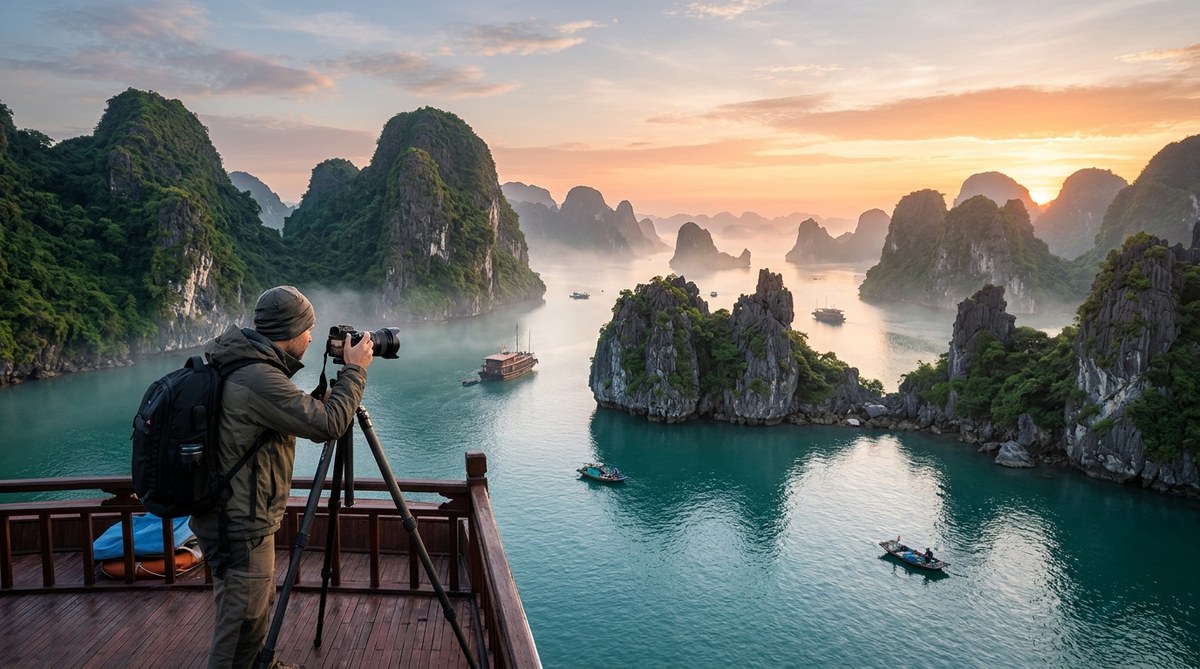
Ha Long Bay looks different every time the light shifts. One moment the limestone karsts rise like grey ghosts through a blanket of mist. The next, the sun breaks through the haze and turns the water into a mirror of emerald and gold. For a travel photographer, this UNESCO World Heritage site in northern Vietnam offers a rare mix of drama and stillness. You can stand on the deck of a junk boat at sunrise and feel like you have stepped inside a Chinese ink painting. The challenge is knowing how to bring that feeling home in your camera.
The best Ha Long Bay photos come from planning around the weather, not just the scenery. Misty mornings between October and March create the moody layers that make these karsts famous. Use a telephoto lens to compress distant peaks, and always expose for the highlights to keep the fog from blowing out. A circular polarizer and a sturdy tripod are non-negotiable.
Why 2026 Is a Great Year to Photograph Ha Long Bay
Tourism patterns in Ha Long Bay have settled into a more predictable rhythm after the changes of the past few years. The bay sees fewer massive cruise ships than it did in 2019, which means less wake on the water and more opportunities for clean, unobstructed shots. Many tour operators now offer smaller, photography-friendly junk boats that can slip into quieter coves. If you book a trip for early 2026, you will also catch the tail end of the cool, misty season that gives the karsts their iconic layered look.
The Best Season for Ha Long Bay Photography
Your choice of season will shape every image you capture. The bay has two main weather windows, and each one creates a different mood.
-
October to March (cool, misty season): This is the golden period for landscape photography. Morning fog sits low on the water, and the karsts appear to float in the air. The light is soft and diffused, which helps you avoid harsh shadows. Temperatures range from 60 to 75 degrees Fahrenheit, making it comfortable to stand on deck for an hour waiting for the perfect shot.
-
April to September (warm, sunny season): You get clearer skies and more vibrant greens, but the haze can be heavy during the middle of the day. Sunrises are more predictable, and the water is often calmer. The trade-off is that you lose the misty, atmospheric look that makes Ha Long Bay so distinct.
For most photographers, the sweet spot is late February or early March. You still get the morning mist, but the days are longer and the chance of rain is lower.
Gear Checklist for Shooting Karsts on the Water
You do not need a backpack full of L-series glass to get great results, but a few specific pieces of gear will make your life much easier. Here is a practical list organized by importance.
| Gear Item | Why It Matters | What to Look For |
|---|---|---|
| Circular polarizer | Cuts glare on the water and deepens the green of the karst vegetation | A slim-profile filter to avoid vignetting on wide lenses |
| Tripod | Essential for long exposures and sharp shots in low dawn light | Carbon fiber for weight savings; ball head for quick leveling |
| Telephoto zoom (70-200mm) | Compresses distant karsts into layered compositions | f/2.8 or f/4; image stabilization helps on a moving boat |
| Wide-angle zoom (16-35mm) | Captures the scale of the bay and dramatic skies | Keep the horizon straight; use the rule of thirds |
| Weather-sealed body | Salt spray and humidity are constant threats | A basic rain cover or a dry bag for your camera |
If you only bring two lenses, make them a 24-70mm and a 70-200mm. That range covers almost every composition you will encounter on a standard two-day cruise.
7 Pro Tips for Photographing the Dramatic Limestone Karsts of Ha Long Bay in 2026
These tips come from spending days on the water and making every mistake you can imagine. Follow them, and you will come home with images that stand out.
1. Shoot Into the Mist, Not Away From It
Most beginners try to get a clear, sharp image of the karsts. The best shots use the mist as a creative tool. Position yourself so the fog sits between you and the farthest peaks. This creates atmospheric perspective, where each layer of karst gets lighter and softer as it recedes into the distance. Expose for the highlights to keep the mist from turning into a white blob.
2. Use a Telephoto Lens to Stack the Layers
A wide-angle lens makes the bay look small. A telephoto lens compresses the distance between the front karst and the back karst, creating a stacked, painterly effect. Try shooting at 100mm or longer. Frame a foreground karst on the left, a middle karst in the center, and a faint background karst on the right. This three-layer composition is the visual signature of Ha Long Bay photography.
3. Plan Around the Junk Boat Traffic
The traditional junk boats are beautiful, but they also create wakes that ruin reflection shots. Check the cruise schedules for your departure day. Most large boats leave the main harbor between 8:00 AM and 9:00 AM. If you want glassy water, shoot before 7:30 AM or after 4:00 PM. Talk to your captain and ask if they can anchor in a quieter area during golden hour.
4. Master the Long Exposure on a Moving Boat
You can get sharp long exposures from a boat if the water is calm and the engine is off. Set your tripod on the deck, use a remote shutter release, and keep your shutter speed at 2 seconds or longer to smooth out the water. If the boat is rocking even a little, bump your ISO higher and use a faster shutter. A blurry long exposure is worse than a clean, sharp shot at 1/60th of a second.
5. Include a Human Element for Scale
The karsts are enormous, but a photo of a lone karst against the sky can feel abstract. Add a person to give the viewer a sense of scale. A fisherman in a rounded boat, a friend standing on the bow of the junk, or a local rowing a sampan all work well. Place them in the lower third of the frame so the karsts dominate the upper portion.
6. Protect Your Gear From Salt and Humidity
Salt spray is invisible until it dries on your lens. Keep a microfiber cloth in a zip-lock bag and wipe the front element after every shooting session. Store your camera in a dry bag when you are not using it. If you are shooting for several days, bring a small silica gel pack to absorb moisture inside your camera bag. This is not optional. Salt damage can ruin a lens in a single afternoon.
7. Scout Your Locations Before You Go
You cannot walk around Ha Long Bay and choose your spot like you can in a national park. Your composition depends on where your boat anchors and which route it takes. Look at recent photos on Instagram and Flickr to see which areas are producing the best light. Ask your tour operator specifically for a route that passes through the more remote parts of the bay, such as the area around Cong Do or the Vung Vieng floating village.
“The best advice I can give for Ha Long Bay is to treat the mist like a filter. Do not fight it. Use it to separate your foreground, midground, and background. That is the secret to making your photos look like they belong in a gallery.” — Tran Minh, landscape photographer based in Hanoi
Common Mistakes and How to Fix Them
Even experienced photographers make these errors when they first visit the bay. Here is a table of the most common problems and the straightforward fixes.
| Mistake | Why It Happens | The Fix |
|---|---|---|
| Flat, grey skies | Shooting in the middle of the day with no cloud texture | Shoot only during golden hour or use a graduated neutral density filter |
| Blurry images from boat movement | Using too slow a shutter speed while the boat is drifting | Turn the boat engine off, brace against a rail, or use a faster shutter |
| Overexposed mist | Metering on the dark karst instead of the bright fog | Use spot metering on the mist and underexpose by 0.7 to 1 stop |
| No sense of depth | Shooting everything at the same focal length | Switch between wide and telephoto to create foreground interest |
| Salt spots on the lens | Not wiping the front element after each session | Keep a clean cloth in a sealed bag and check the lens every 30 minutes |
How to Edit Ha Long Bay Photos for Maximum Impact
Your editing workflow should enhance the mood you captured on the water, not change it. Start by adjusting the white balance. Ha Long Bay light often leans cool and blue in the morning. Warm it up slightly to bring out the green tones in the karst vegetation. Use the dehaze slider in Lightroom or your RAW editor to cut through the remaining atmospheric haze, but do not overdo it. A little haze adds depth. If you remove all of it, the image looks flat and artificial.
Next, use a graduated filter to darken the sky if it is brighter than the water. This balances the exposure and draws the eye toward the layered karsts. Finally, increase the clarity on the midground karst by about 10 to 15 points. This sharpens the texture of the rock without making the mist look crunchy.
For a deeper look at how to handle tricky light conditions, check out this guide on mastering low light photography techniques in Asian landscapes. The principles for shooting in dim dawn light apply directly to the early morning sessions on the bay.
Putting It All Together for Your 2026 Trip
Ha Long Bay rewards patience and preparation. You cannot walk to a different viewpoint if the light is bad. You have to work with what the bay gives you. That is why the photographers who come home with the best images are the ones who plan around the weather, pack the right gear, and know exactly which compositions will work before the boat leaves the dock.
Book your trip for late February or early March of 2026. Bring a telephoto lens, a circular polarizer, and a tripod. Wake up early every morning and stay on deck until the last light fades. Shoot the mist, not the clear air. Include a person in your frame to show the scale. Protect your gear from the salt. And when you get home, edit with a light hand that preserves the natural mood of the bay.
If you want to refine your skills further before you go, read this article on 7 composition tips for stunning wide-angle landscape shots in Asia. It covers framing techniques that work perfectly for the karsts.
One Last Thought Before You Go
The best photo from Ha Long Bay is the one that makes you feel the cool morning air and the quiet stillness of the water. Technical skill matters, but it is your eye for mood and atmosphere that will set your images apart. Trust your instincts, shoot a lot of frames, and do not be afraid to delete the ones that do not work. Every great photographer has a memory card full of bad shots. What matters is the handful of images that capture the soul of the place. Go find yours.