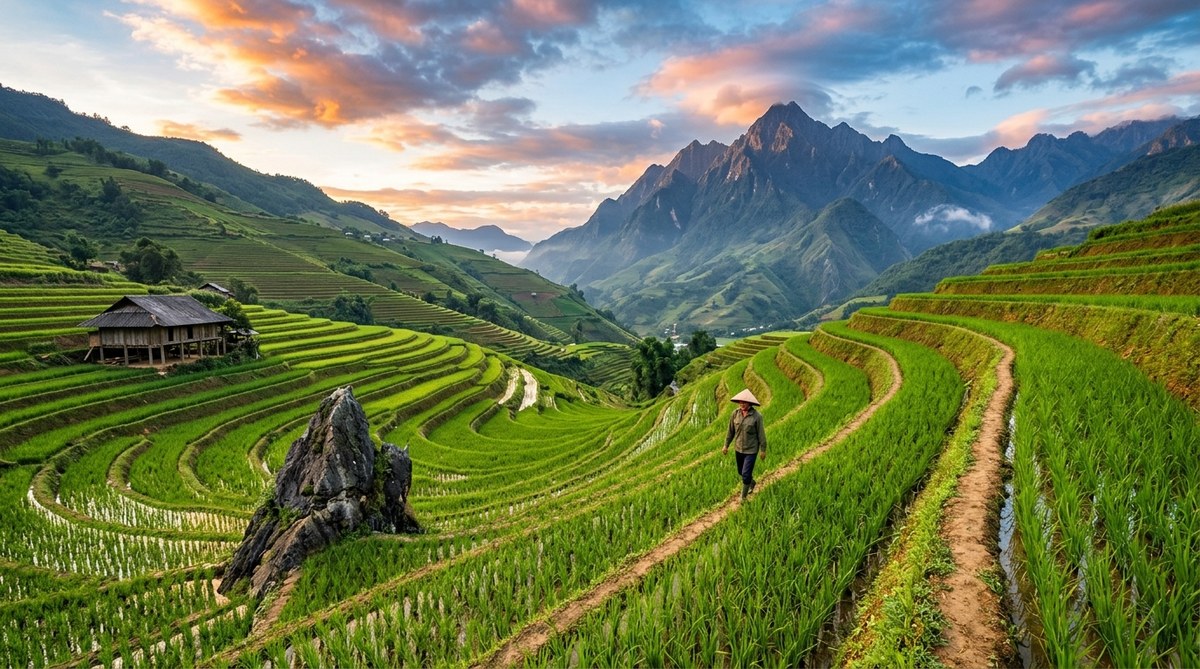
You’ve just arrived at a viewpoint overlooking the rice terraces of northern Vietnam. The scene stretches for miles. Green steps cascade down the hillside. You pull out your wide angle lens, attach it to the camera, and look through the viewfinder. But something feels off. The photo looks flat. The majestic scale you felt with your own eyes isn’t showing up in the frame. That’s the challenge of wide angle landscape photography. A wide lens includes everything, which means it can also dilute everything. To make your images sing, you need specific composition techniques. And nowhere is that more true than in the diverse landscapes of Asia, where layers, light, and culture create endless opportunities.
Wide angle landscape photography in Asia shines when you use leading lines, foreground interest, and careful framing to create depth. The seven tips below focus on composition techniques that turn a busy scene into a compelling image. Whether you shoot rice terraces, temples, or misty mountains, these methods will improve your results right away.
Why Wide Angle Lenses Need Special Composition
A wide angle lens exaggerates perspective. Objects close to the lens appear much larger, while distant elements shrink. That can be a superpower or a trap. Without a strong foreground, your image becomes a sea of tiny details. You lose the sense of immersion. In Asian landscapes, where scenes often pack dense foliage, intricate architecture, and dramatic topography, you must guide the viewer’s eye. The goal is to create a journey from front to back.
Think of a famous spot like the Batu Caves in Malaysia or the terraced fields in Yunnan. The magic isn’t just in the wide view. It’s in how you lead the eye upward or through the frame. Almost every professional wide angle shot uses at least one compositional technique to add depth.
7 Composition Tips for Wide Angle Landscape Photography in Asia
1. Use a Strong Foreground Element
The most important rule for wide angle landscape photos: find something interesting close to the camera. A rock, a flower, a puddle reflecting the sky, or a protruding temple spire. That foreground object anchors the shot and gives the brain a sense of scale.
In Asia, you’re surrounded by natural foregrounds. Try placing a cluster of lotus leaves at the bottom of a lake scene. Or a weathered wooden boat on a beach in Thailand. Even a single person or animal can work well. When you compose, get low and close. Fill the bottom third of the frame with that element. Then let the background stretch away.
2. Lead the Eye with Diagonal Lines
Leading lines are even more powerful with a wide angle lens. The distortion makes lines appear to converge dramatically. Use paths, rivers, fences, or rows of trees. In Japan’s bamboo groves, the stalks naturally create vertical leading lines. Shoot from a low angle to make them tower overhead.
In the Philippines, the curving walls of the rice terraces act as contour lines that guide the eye across the valley. Position yourself so the lines start in a lower corner and cut diagonally across the frame. This creates energy and movement.
3. Layer Your Composition
Wide angle scenes often have three distinct layers: foreground, middle ground, and background. To make the image feel three dimensional, compose so each layer is clear and separate.
A classic Asian example: a pagoda in the foreground, a misty lake in the middle, and distant mountains in the background. To achieve this, you may need to move your body or change your height. Crouch down to include more foreground. Step to the side so the middle ground isn’t blocked. The result is a photo where your eyes can wander from front to back.
4. Include a Human Element for Scale
Wide angle shots can make enormous landscapes feel abstract. The easiest fix? Put a person in the frame. A lone figure standing on a ridge, a monk walking through a temple courtyard, or a farmer in a field instantly tells the viewer how big everything else is.
In Mongolia’s Gobi Desert, a small silhouette against the vast dunes creates a powerful contrast. For top tips for capturing vibrant mountain landscapes in Asia's remote regions, using a person for scale can turn a good mountain shot into a great one. Just be respectful and ask permission when photographing locals.
5. Watch Your Horizon Placement
With a wide lens, the horizon can eat up half the frame or more. A centered horizon is often boring. Instead, try the rule of thirds: put the horizon on the upper or lower third line.
If the sky has dramatic clouds during golden hour, give it two thirds of the frame. If the foreground is the star, like a reflection in a lake, give it two thirds. This simple shift changes the mood of the image.
6. Frame the Scene with Natural Elements
Accordion to many pros, using natural frames adds depth and directs attention. Look for overhanging branches, cave openings, archways, or even rock formations. Shoot through them so they border the edge of your frame.
In Southeast Asia, tree trunks draped with vines make excellent frames for waterfall shots. In China’s karst mountains, hikers often shoot through limestone caves to frame the peaks beyond. For a deeper look at this style, see essential techniques for capturing stunning nightscape landscapes across Asia. (Framing works for day and night alike.)
7. Use the Sun or Moon as a Focal Point
Wide angles invite big skies. Place the sun or moon strategically in the frame, usually at an intersection of the rule of thirds grid. The wide perspective makes the celestial body appear smaller relative to the landscape, so ensure it’s not lost.
Shoot during golden hour for warm, soft light that complements the wide view. The combination of a low sun and a strong foreground can produce breathtaking results. For more on timing, read mastering the art of golden hour landscape photography in Asia.
Common Mistakes and How to Fix Them
Even experienced photographers stumble with wide angle lenses. Here are the most frequent errors and the fixes.
- Too much empty sky. If your sky is plain, tilt the camera down and include more foreground. Use a polarizer to deepen blues and reduce glare.
- Crooked horizon. Wide lenses make horizon tilt obvious. Use the camera’s level or check the electronic level on the LCD. Straighten in post if needed.
- Not getting close enough. A wide lens begs you to be bold. Step closer to your foreground subject. The exaggeration of perspective works best when you’re within a few feet of the closest element.
- Too many competing elements. A busy scene becomes chaotic. Simplify by moving or waiting. Let one or two strong subjects dominate.
- Forgetting hyperfocal distance. With wide lenses, you can get both foreground and background sharp if you focus about one third into the scene. Use hyperfocal apps for precise adjustments.
Technique vs. Mistake: A Handy Table
| What to Do | What to Avoid |
|---|---|
| Include a distinct foreground element | Letting the foreground be empty or blurry |
| Use diagonal leading lines | Placing lines that lead out of the frame |
| Compose with three distinct layers | Having a flat, two-layer image |
| Insert a human for scale | Shooting only empty landscapes |
| Place horizon on upper/lower third | Centering the horizon |
| Frame through natural elements | Placing distracting objects at edges |
| Use sun/moon as a compositional point | Overexposing the sky or blowing out highlights |
“The single best piece of advice I give to photographers using wide angle lenses in Asia is this: get lower. Crouch, kneel, even lie down. The lower your camera, the more the foreground dominates, and the more the viewer feels like they’re standing in the scene.” — Li Ming, landscape photographer based in Guilin
Equipment Tips for Wide Angle Shooting in Asia
Your lens choice matters, but composition matters more. A 16-35mm on a full frame camera or a 10-24mm on a crop sensor works well. For the Himalayas, a sturdy tripod is essential due to wind and uneven terrain. Check what gear do you need for landscape photography in the Himalayas for details.
Also carry a circular polarizer. It cuts haze in humid Asian air and boosts contrast. A graduated neutral density filter helps balance bright skies with darker foregrounds. And always bring extra batteries — cold weather drains them fast.
Putting These Tips Into Practice on Your Next Trip
You don’t need to memorize all seven tips at once. Pick two or three that fit the location you’re planning to visit. If you’re heading to the rice terraces of the Philippines, focus on leading lines and layering. If you’re shooting misty temples in Bagan, try framing through a window or arch.
Before you go, think about the light. Early morning and late afternoon offer the most dramatic shadows and warm tones. Study the weather and plan accordingly. When you arrive, spend the first 10 minutes just walking around. Look for foregrounds. Notice how the lines bend. Find a spot where the composition feels balanced.
The beauty of wide angle landscape photography is that you can capture the grandeur of Asia in a single frame. With these composition techniques, you’ll turn a snapshot into a story. So pack your lens, head to that viewpoint, and remember: get low, lead the eye, and layer the scene. Your next great shot is waiting.