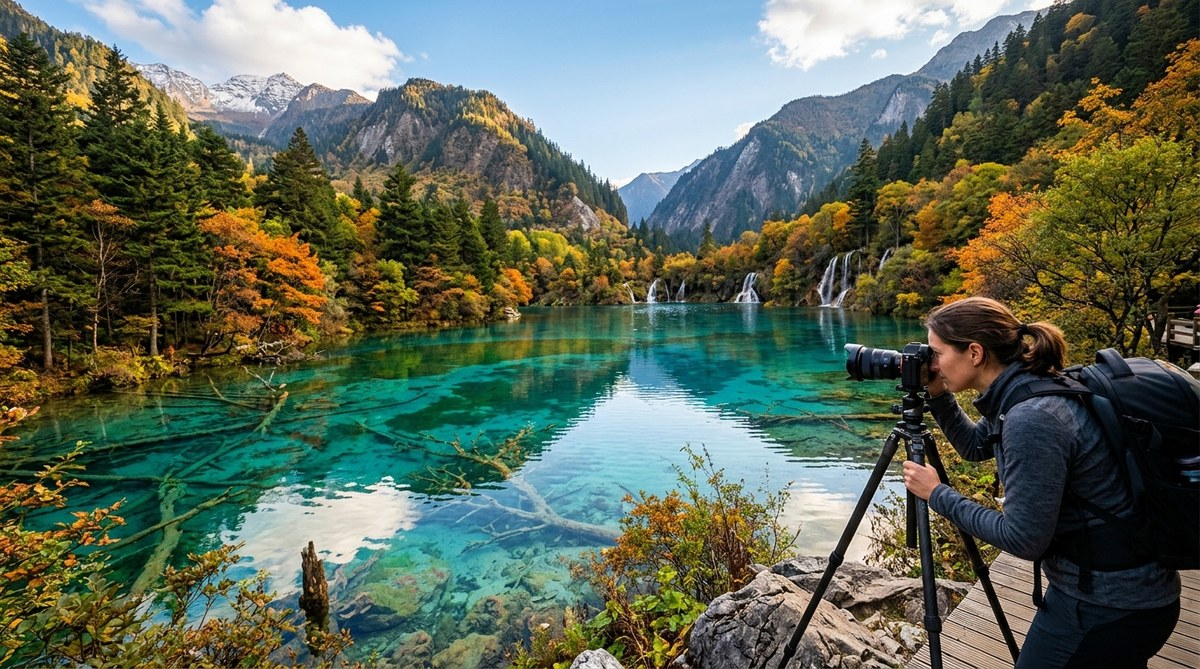
The turquoise waters of Jiuzhaigou look almost unreal, as if someone painted the lakes with a cosmic palette. For photographers, this UNESCO World Heritage site in Sichuan Province, China, offers a chance to capture some of the most vivid and surreal natural landscapes on Earth. The combination of crystal clear water, limestone deposits, and unique algae creates a range of blues and greens that seem to change with every angle of sunlight. But shooting these lakes well takes more than a lucky snapshot. You need to understand the light, the seasons, and a few technical tricks to bring home images that do justice to what your eyes see.
Jiuzhaigou’s turquoise lakes are a dream location, but capturing their magic requires planning. Visit in autumn or late spring for the most vibrant colors. Use a circular polarizer to reduce glare and boost saturation. Shoot early morning for calm reflections and soft light. Avoid midday harsh sun. And always bracket your exposures to preserve detail in the highlights and shadows.
Why Jiuzhaigou Turquoise Lakes Seem to Glow from Within
The science behind that otherworldly color is fascinating. The lakes sit on a bed of travertine a form of limestone deposited by mineral rich streams. Over millennia, calcium carbonate dissolved in the water settles out, creating natural dams and terraces. This white mineral floor acts like a mirror, reflecting sunlight back through the water. Meanwhile, microscopic algae and aquatic plants add subtle pigments. The result is a color palette that shifts from milky turquoise to deep emerald depending on the depth and sediment load.
Five Flower Lake is the poster child of this phenomenon. It looks like a stained glass window with patches of blue, green, yellow, and orange. Mirror Lake lives up to its name when the surface is still. Panda Lake and Arrow Bamboo Lake also offer stunning views. Each one has a slightly different character, so plan to spend time at several.
Best Seasons to Photograph the Turquoise Lakes
Choosing the right time of year changes everything.
- Autumn (late September to mid November) . This is the prime season. The fall foliage in oranges and reds contrasts beautifully with the turquoise water. The light is lower, casting warm tones. Crowds are biggest then, but the payoff is huge.
- Late Spring (May to early June) . The snowmelt fills the lakes with fresh water, making the colors exceptionally clear. Wildflowers bloom along the boardwalks. The weather is mild and the crowds are thinner.
- Summer (July to August) . Monsoon season brings frequent rain and higher humidity. The lakes remain beautiful, but light can be flat. You might get dramatic clouds and stormscapes if you are lucky.
- Winter (December to February) . Fewer visitors, frozen waterfalls, and some lakes freeze over. The snow covered landscape creates a whole different mood. The turquoise tones still show through in sections that don’t freeze. Pack warm gear.
Many photographers aim for the first two weeks of October. The colors peak and the weather is usually stable. Just be prepared for early morning crowds at the main viewpoints.
Essential Gear for Capturing the Perfect Lake Shot
You do not need a huge kit, but a few items make a real difference.
- A circular polarizer filter. This is non negotiable. It cuts glare on the water surface, letting you see the bottom of the lakes. It also deepens the blues and greens.
- A sturdy tripod. Jiuzhaigou has many boardwalks and platforms. A tripod lets you shoot long exposures for silky waterfalls and calm reflections. It also helps with bracketing.
- A wide angle lens (16 35mm or similar). You want to capture the expansive scale of the valleys and the surrounding mountains.
- A telephoto lens (70 200mm or more). Use it to isolate patterns on the lake surface or compress distant peaks with the foreground water.
- Neutral density filters (3 stop and 6 stop). These allow longer exposures even in bright light, which turns waterfalls into smooth ribbons.
- Lens cloths and a rain sleeve. The air near the lakes can be humid with spray from waterfalls. Keep your gear dry and clean.
4 Steps to Capture the Best Reflection Shots
Reflections are the hallmark of Jiuzhaigou photography. Follow these steps.
- Arrive before sunrise. The wind usually picks up by mid morning. Early calm gives you glass like surfaces. Set up at Mirror Lake, Rhinoceros Lake, or Five Flower Lake.
- Attach your polarizer and adjust it. Rotate the filter until the reflection becomes most vivid. You want to balance the surface detail with the underlying colors.
- Compose with a strong foreground. Include a rock, fallen leaf, or shoreline element to anchor the image. Use the rule of thirds, placing the horizon on the top or bottom third line.
- Bracket your exposures. The sky may be much brighter than the reflected lake. Take three shots at 0, +1, and -1 EV, then blend later in post processing. This preserves the full dynamic range.
Camera Settings and Composition: A Handy Guide
Use this table as a reference when you are at the scene.
| Scene | Recommended Aperture | Shutter Speed | ISO | Tip |
|---|---|---|---|---|
| Still lake reflection | f/11 to f/16 | 1/2 to 2 seconds (tripod) | 100 | Use a remote release to avoid shake |
| Waterfall with motion blur | f/16 to f/22 | 0.5 to 4 seconds (with ND filter) | 100 | Overcast days work best for even light |
| Vivid colors in Five Flower Lake | f/8 to f/11 | 1/60 to 1/250 (handheld) | 200 to 400 | Shoot with the sun at a 45 degree angle |
| Low light or dawn | f/8 | 1/15 to 1/60 (tripod) | 400 to 800 | Enable long exposure noise reduction |
| Autumn foliage and lake | f/11 | 1/30 to 1/125 (tripod or monopod) | 200 | Add a warming white balance (5500K) |
Common Photo Mistakes to Avoid
Even experienced photographers slip up. Watch for these.
| Mistake | Consequence | Solution |
|---|---|---|
| Overexposing the water | The turquoise looks washed out | Underexpose by 0.3 to 0.7 stops or use spot metering on the water |
| Forgetting a polarizer | Surface glare hides the lakebed colors | Always pack and use a circular polarizer |
| Shooting at high noon | Harsh shadows and flat reflections | Shoot during golden hours (early morning or late afternoon) |
| Ignoring the sky | Composition feels incomplete | Always include some sky or mountain framing to give context |
| Not checking weather | Rain can ruin a session or create mood | Check hourly forecasts; pack rain protection for gear |
Pro Tip: Embrace the Light
“The best light at Jiuzhaigou is the soft morning sun filtering through the pines. It creates a warm glow on the lakes that no filter can replicate. Arrive before the park opens, be the first at your chosen spot, and wait. Patience is your greatest tool here.” — Ren Chen, landscape photographer and Sichuan guide
This advice comes from years of shooting in the park. The crowds arrive by 9:30 am. By then the wind usually picks up, and the light becomes harsh. Use the early window wisely.
Practical Tips for Your Jiuzhaigou Photography Trip
The park is large. You enter through the main gate and take shuttle buses to different valleys. The most photographed areas are in the Rize Valley (Five Flower Lake, Mirror Lake, Panda Lake) and Zechawa Valley (Long Lake, Five Color Pond). Shuttle buses run frequently but can be crowded. Plan your route so you hit key spots early.
Permits are not required beyond the standard entry ticket. However, the park limits daily visitors to prevent overcrowding, especially in autumn. Book your ticket online at least a week in advance. The entrance fee is about 169 CNY (roughly 24 USD) plus bus fare.
Altitude is around 2,000 to 3,100 meters (6,500 to 10,200 feet). Most visitors feel fine, but if you are sensitive to elevation, take it easy the first day. Drink plenty of water. The air is thin and dry.
Boardwalks keep you on designated paths. Please stay on them to protect the fragile travertine formations. Do not step into the water or touch the limestone terraces. The ecosystem is delicate.
For more general landscape techniques, see our guide on Mastering the Art of Golden Hour Landscape Photography in Asia. That article covers light management in similar environments.
Editing Your Jiuzhaigao Photos for Maximum Impact
Back home, your raw files need careful processing. The turquoise tones can look muddy if you push saturation too hard. Instead, use the HSL (Hue, Saturation, Luminance) panels. Lower the luminance of blues slightly to add depth. Increase the saturation of aqua and green selectively. Watch the whites: the travertine lakebed should remain natural.
If you shot brackets, blend them manually with luminosity masks or use software like Aurora HDR or Lightroom’s HDR merge. This technique pulls detail from both the bright sky and the dark lake shadows. Our article on Mastering Asian Landscape Photography Edits for Stunning Results walks through the exact workflow.
Your Turn to Capture the Turquoise Magic
Jiuzhaigou’s lakes are a gift to any photographer willing to plan ahead. The colors, the reflections, the changing seasons all offer endless creative possibilities. Whether you go for autumn’s fiery palette or winter’s quiet monochrome, the key is to respect the light, use the right gear, and give each scene the time it deserves. Pack your polarizer, wake up early, and let the turquoise waters inspire your best work. The images you bring back will remind you why this place is a true photographer’s dream.