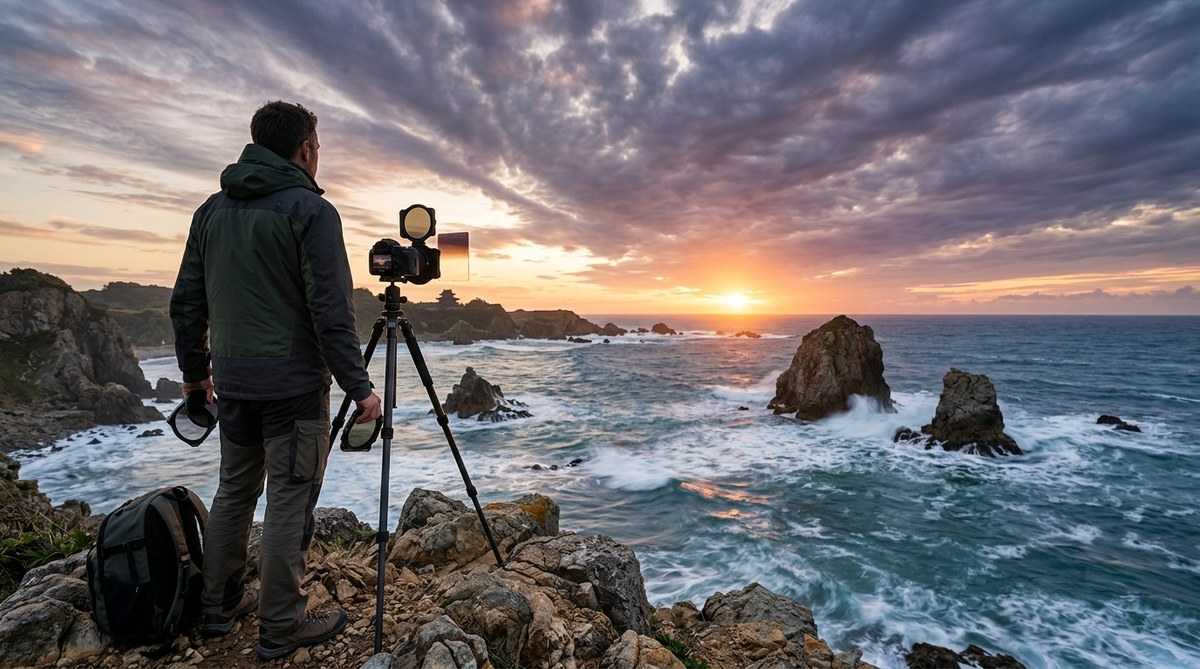
Imagine you are standing on the shore of Ha Long Bay. The sun is about to dip behind the limestone karsts. The sky is a mess of orange, pink, and purple. But your camera sees something else: a boring, washed-out scene. Why? Because your lens is not using the right tools. Without filters, even the most dramatic Asian skies can look flat. And the turquoise waters of places like Palawan or Bali will appear hazy instead of deep and rich.
That is where filters come in. They are not magic, but they are close. In this guide, we will cover the five filters you need for capturing Asia’s skies and seas. We will also talk about how to choose and use them. Whether you are shooting the sunrise over Bagan or the stormy coast of Hokkaido, these filters will change your photos.
The best filters for landscape photography Asia include a circular polarizer (CPL), a 3-stop and 6-stop neutral density (ND) filter, a 3-stop soft graduated ND, and an 8-stop or 10-stop ND for long exposures. These five filters let you control reflections, balance bright skies, and create motion blur in waterfalls and waves. Build your kit around these and you will be ready for any Asian coastline or mountain sunrise.
Why Filters Matter More for Asian Landscapes
Asia’s skies and seas are extreme. The tropical sun is harsh. The humidity creates haze. Reflections off water can be blinding. And the contrast between a bright sunrise and dark foreground can be too much for your camera sensor. You can fix some of this in post-processing, but not all. Highlights get blown out. Shadows lose detail. And reflections wash out the color.
A good filter solves these problems at the moment you press the shutter. It saves you time in editing and gives you a cleaner image. Plus, filters are cheap compared to upgrading your camera. For the price of a few meals out, you can dramatically improve your landscape shots.
The Top 5 Filters You Need for Asia’s Skies and Seas
Here is the shortlist. Every filter below is essential for shooting the dramatic light and water found across Asia.
- Circular Polarizer (CPL) – Reduces glare and reflections. Deepens blue sky and water. Essential for cutting through tropical haze.
- 3-Stop Neutral Density (ND) – Allows you to slow down your shutter to blur motion slightly. Great for moving clouds and gentle waves.
- 6-Stop Neutral Density (ND) – A stronger filter for dramatic cloud movement and smoother water. Works well for sunrise and sunset long exposures.
- 3-Stop Soft Graduated Neutral Density (GND) – Balances a bright sky with a darker foreground. Perfect for high-contrast scenes like sunset over Ha Long Bay.
- 8-Stop or 10-Stop Neutral Density (ND) – For very long exposures. Turns churning sea into glass. Ideal for foggy mornings in places like the moss gardens of Kyoto.
Now let us go deeper into each one.
The Circular Polarizer (CPL) Is Your First Buy
If you buy only one filter, make it a CPL. Asia’s waters are often filled with reflections from the sky, boats, or surrounding greenery. A polarizer cuts through that. It also darkens blue skies and makes clouds pop. In countries like Thailand or the Philippines, where the sun is harsh, a CPL reduces glare from wet rocks and leaves.
You rotate the filter to adjust the effect. Do not overdo it. Too much polarization can make the sky look unnatural or uneven. Aim for a moderate effect.
Tip: A CPL also works as a low-cost UV filter to protect your lens. But do not use both a UV and CPL at the same time. It causes vignetting.
Three Neutral Density Filters for Every Situation
ND filters act like sunglasses for your camera. They reduce the amount of light entering the lens, allowing you to use slower shutter speeds. This is how you create that dreamy, silky water effect in shots of Bali’s waterfalls or the rivers of Sapa.
- 3-stop ND: Good for getting a shutter speed of around 1/4 second in bright light. That smooths out small ripples. Use it for beach scenes where you want a little motion in the waves.
- 6-stop ND: This is the workhorse. With a 6-stop, you can typically get 1 to 4 second exposures in midday. Clouds streak, water flattens, and moving people disappear. Perfect for crowded temples or busy markets.
- 8-stop or 10-stop ND: Use this for exposures of 30 seconds or more. The sea becomes a misty plain. Clouds become long brushstrokes. Great for moody shots of volcano lakes in Indonesia or the endless beaches of Vietnam.
The Graduated ND for Balanced Exposures
Asian sunrises and sunsets often have a bright sky and a dark foreground. Your camera cannot capture both in one shot. A graduated ND filter has a dark top and clear bottom. You slide it in a holder so the dark part covers the sky.
A 3-stop soft GND is the most versatile. The transition is gradual, so it works well with uneven horizons like mountains or trees. Hard GND filters have a sharp line and are best for flat horizons like the ocean. For most Asian landscapes, soft is better.
How to Match Filters to Common Asian Scenes
Different locations call for different filters. Here is a table to help you decide quickly.
| Scene / Location | Recommended Filter | Reason |
|---|---|---|
| Sunset over Ha Long Bay, Vietnam | 3-stop Soft GND + CPL | Balance bright sky, cut haze, boost water color |
| Waterfall in Luang Prabang, Laos | 6-stop ND | Smooth water, remove tourists |
| Stormy coast of Hokkaido, Japan | 8-stop ND | Dramatic cloud movement, silky sea |
| Rice terraces of Bali at sunrise | CPL + 3-stop Soft GND | Reduce reflections, balance exposure |
| Angkor Wat at golden hour | 6-stop ND | Blur clouds, simplify foreground |
| Beach in Boracay, Philippines | CPL + 3-stop ND | Deepen blue water, slight motion in waves |
Common Mistakes When Using Filters in Asia
Many photographers new to filters make the same errors. Avoid these.
- Stacking too many filters. Vignetting increases, and image quality drops. Stick to two layers max (usually CPL + one ND).
- Forgetting to adjust white balance. ND filters can introduce a color cast. Shoot RAW and fix in post. Some brands (like Lee or NiSi) have less color shift.
- Using a cheap CPL. Cheap polarizers reduce sharpness and cause color shifts. Invest in a decent brand like Hoya, B+W, or K&F Concept.
- Not cleaning filters properly. Asian humidity and salt spray from the sea will leave spots. Carry a microfiber cloth and lens cleaner.
- Ignoring the sun’s position. Polarizers work best at a 90-degree angle from the sun. Pointing directly at the sun ruins the effect.
A Step-by-Step Workflow for Shooting Asian Skies and Seas
Follow these steps to get consistently good results.
- Set up your tripod. Long exposures need stability. Even with a CPL, a tripod helps get the sharpest images.
- Attach the CPL. Rotate until reflections are minimized and sky is deep. Do not rely on the LCD; preview on your camera’s live view.
- Evaluate the scene’s dynamic range. If the sky is much brighter than the foreground, add a soft GND. Slide it until the dark part covers the bright sky.
- Choose your ND strength. For water motion, start with a 6-stop. For more drama, use an 8-stop.
- Meter the exposure. Use aperture priority mode first to get a base reading. Then switch to manual and apply the filter factor. Most filters have a stop guide.
- Use a remote shutter or timer. Even the tripod shake from pressing the shutter can blur a long exposure. Use a 2-second delay.
- Check your histogram. Avoid clipping highlights on the right side. Adjust exposure compensation if needed.
- Take multiple shots. Bracket your exposures (one at base, one underexposed, one overexposed). Later you can blend them if the filter was not enough.
Expert advice: “For stormy skies over the South China Sea, I always reach for my 10-stop ND first. The dark clouds streak beautifully, and the waves turn into a soft blanket. But I also keep a CPL on to reduce glare from wet rocks. Two filters, that’s all I need.” – Tetsuya Kimura, landscape photographer based in Okinawa.
Building Your Filter Kit on a Budget
You do not need to spend a fortune. Here are practical tips for travel photographers.
- Start with a CPL. It’s the most versatile. Buy a decent one (around $80 to $120 for a 77mm).
- Get a 6-stop ND next. It covers 80% of your long exposure needs.
- Consider a 3-stop soft GND. You can hand-hold it in front of the lens if you do not have a holder. It’s not perfect but works in a pinch.
- Use step-up rings. If you have multiple lens sizes, buy a set of step-up rings to use the same filter on all lenses.
- Avoid variable ND filters. They are convenient but often cause uneven darkening (the “X” pattern) especially at wide angles.
Many photographers in Asia recommend brands like Haida, NiSi, and K&F Concept for good value. They make magnetic systems that are quick to swap, which is great when light changes fast.
Final Thoughts: Putting It All Together for Your Next Trip
The best filters for landscape photography Asia are not a mystery. A CPL, a 3-stop and 6-stop ND, a 3-stop soft GND, and maybe a 10-stop ND will cover you for almost any sky and sea condition. Pack them in a filter pouch that fits your backpack. Practice with them before your trip so you are not fumbling on location.
Asia’s landscapes are some of the most photogenic on Earth. With the right glass in front of your lens, you will capture the drama you see with your own eyes. Next time you watch the sun rise over the temples of Bagan or the waves crash against the cliffs of Nusa Penida, you will be ready. Grab your filters, set your camera, and make the shot you have been dreaming of.