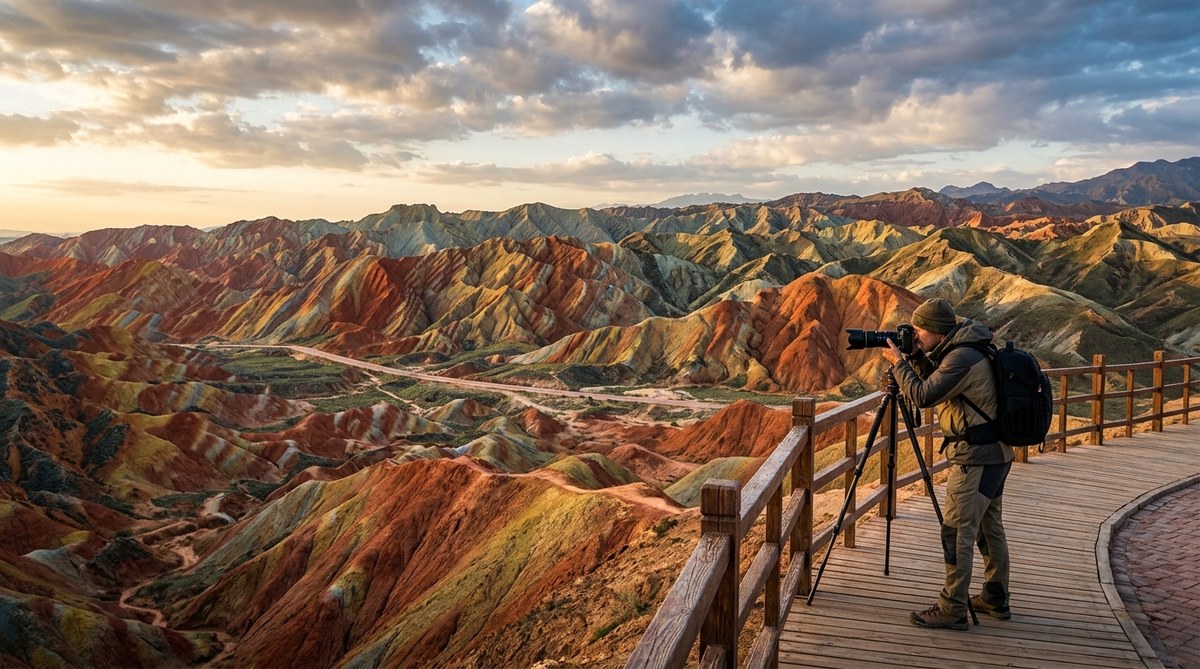
The first time you see a photo of the Rainbow Mountains of Zhangye, it feels like a trick of the light. The colors are so saturated, so deliberate looking, that your brain assumes someone turned up the vibrance slider to 11. But then you learn the truth: those stripes of crimson, ochre, teal, and sulfur yellow are real. They were painted by 24 million years of geological pressure, mineral deposits, and tectonic uplift. For a travel photographer in 2026, this place is not just a destination. It is a proof of concept that nature still holds secrets.
The Rainbow Mountains in Zhangye National Geopark offer one of the most surreal landscape photography opportunities on the planet. Success depends on timing your visit for the right season (late spring or early autumn), using a polarizing filter to cut haze, and shooting during golden hour to make the mineral bands pop. Avoid the midday flat light and tourist crowds by arriving at sunrise. This guide covers gear, composition, and post processing so you return with images that look as vibrant as the real thing.
Why the Rainbow Mountains Belong on Your 2026 List
Social media feeds are flooded with the same dozen locations. You have seen the Icelandic ice caves, the Antelope Canyon slots, and the lavender fields of Provence a hundred times. The Rainbow Mountains still stop the scroll. The Zhangye Danxia landform is a UNESCO World Heritage site that looks like a painter wiped a wet brush across the earth. For photographers chasing color, texture, and scale, this is a landscape that rewards patience.
Plus, 2026 is a great year to visit. China has been streamlining tourist access to western provinces. The high speed rail network now connects Zhangye to major hubs like Xi’an and Lanzhou more efficiently than ever. You can fly into Lanzhou, hop a train, and be at the geopark gates in under four hours.
The Best Time to Photograph the Rainbow Mountains
Timing is everything. The mountains do not change, but the light changes everything.
Late May through early June and September through early October are your windows. In spring, the air is cleaner after the winter dust settles. In autumn, the lower angle of the sun rakes across the rock faces, making each color band stand out like a contour line on a map.
Avoid July and August. The haze is brutal. You will fight atmospheric diffusion that flattens the colors into a pastel blur. Also avoid the Chinese national holidays (first week of October and the week around Lunar New Year). The boardwalks get shoulder to shoulder.
Sunrise vs. Sunset
| Factor | Sunrise (6:00 to 7:30 AM) | Sunset (5:30 to 7:00 PM) |
|---|---|---|
| Crowds | Thin. Most tourists arrive after 8 AM. | Heavy. Everyone wants the sunset shot. |
| Light quality | Soft, warm side light that sculpts the ridges. | Warm but often hazy. Dust kicked up during the day. |
| Color saturation | High. Morning dew reduces dust particles. | Moderate. Haze can mute the lower bands. |
| Wind conditions | Calm. Easier to keep a tripod steady. | Gusty in late afternoon. |
The winner is sunrise. You will have the viewing platforms mostly to yourself, and the low angle light will make the red layers glow like embers.
Gear You Should Pack for Zhangye
You do not need a suitcase full of gear, but a few specific items will make the difference between a snapshot and a portfolio image.
- A wide angle lens (16-24mm full frame equivalent). The scale of the mountains demands a wide perspective. You want to show the stripes receding into the distance.
- A telephoto zoom (70-200mm). This is the secret weapon. Compress the layers so the distant ridges stack tightly against each other. The colors become a striped fabric.
- A circular polarizer. This is non negotiable. It cuts the atmospheric haze and deepens the saturation of the red and orange bands. Without it, your images will look washed out by 10 AM.
- A sturdy tripod. For sunrise shooting, you will need longer exposures to keep ISO low. A lightweight carbon fiber model is fine, but make sure it can handle wind.
- Remote shutter release. Even mirror slap can blur a 1/4 second shot at 200mm.
For a full breakdown of what to carry into remote terrain, read our guide on choosing the perfect camera gear for capturing Asia’s stunning landscapes.
How to Compose the Shot: A Step by Step Process
Getting the composition right at Zhangye is about layering. The mountains are not a single wall of color. They are a series of ridges that recede into the horizon. Here is a numbered process that works every time.
- Find the foreground. Look for a ridge with a distinct S curve or a rock formation that leads the eye. Avoid empty sky. Use the mountain itself as the frame.
- Set your focal length. Start wide at 16mm to capture the full sweep. Then switch to 70mm or longer to isolate a single stripe pattern. Shoot both.
- Adjust your polarizer. Rotate it while looking through the viewfinder. Stop when the red bands turn deep crimson and the green bands turn emerald. Do not over rotate, or the sky will turn an unnatural dark blue.
- Check your histogram. The Rainbow Mountains are high contrast. The bright yellows can clip. Bracket three exposures ( -1, 0, +1 ) to blend later in post.
- Wait for a cloud. A single cloud casting a shadow over part of the ridge adds depth. Without shadows, the mountains look flat. Patience pays.
“The biggest mistake I see photographers make at Zhangye is trying to fit everything into one frame. The landscape is too big. Zoom in. Find a single stripe sequence. Let the colors be the subject.” — Chen Wei, landscape photographer and Zhangye guide.
Common Mistakes and How to Avoid Them
Even experienced photographers make errors here. The environment is deceptive. The colors trick your camera’s meter, and the scale tricks your eye.
| Mistake | Why It Happens | The Fix |
|---|---|---|
| Overexposed highlights | The yellow and white mineral bands reflect a lot of light. Your camera meters for the average and blows out the bright spots. | Use spot metering on the brightest band. Expose for the highlights. Recover shadows in post. |
| Flat colors at midday | The sun is directly overhead. No shadows means no texture. | Shoot only during the first 90 minutes after sunrise and the last 90 before sunset. Take a break from 10 AM to 4 PM. |
| Dust spots on sensor | The geopark is dusty. Changing lenses in the wind invites particles. | Change lenses inside a camera bag or use a weather sealed body. Clean your sensor every night. |
| Ignoring the boardwalk | Visitors are not allowed off the designated paths. If you step off, you damage the fragile rock and risk a fine. | Use a longer lens to crop out the boardwalk. Compose from a low angle to hide the railings. |
Editing Your Rainbow Mountain Photos
The goal in post processing is to enhance what is already there, not to invent colors that do not exist. The mountains are saturated, but they are not neon. Keep it natural.
Start with a basic raw adjustment. Lift the shadows slightly to reveal detail in the darker red bands. Pull down the highlights to protect the yellows. Increase clarity by about 15 points. This adds texture to the rock without creating halos.
Use the HSL panel to target specific colors. Boost the reds and oranges for warmth. Desaturate the blues slightly if the sky is competing with the mountains. Add a subtle vignette to keep the eye centered on the ridge.
For a deeper look at how to handle complex color landscapes, see our guide on mastering Asian landscape photography edits for stunning results.
Practical Logistics for a 2026 Trip
Getting to Zhangye is easier than you think.
Fly into Lanzhou Zhongchuan Airport (LHW). From Lanzhou, take the high speed train to Zhangye West Station. The ride takes about three hours. Book tickets in advance through a Chinese travel app like Trip.com or through your hotel concierge.
Stay in Zhangye city. It is a small city with decent hotels. The Zhangye Zhangye Hotel and the Jinan International are both solid choices. From the city, the geopark is a 40 minute taxi ride.
Buy your park tickets online. The geopark limits daily visitors during peak season. Purchase tickets at least three days ahead through the official WeChat mini program or a tour agency.
Bring cash. While mobile payments (WeChat Pay, Alipay) are standard, some smaller vendors at the park only take cash. Have about 200 RMB in small bills.
When the Weather Does Not Cooperate
Haze and overcast skies happen. Do not pack up. Cloudy conditions can actually help by diffusing the light evenly across the rock faces. Direct sunlight creates harsh shadows that hide details in the darker bands. Overcast light reveals the subtle blue and green mineral streaks that are usually lost in glare.
If it rains, wait. The wet rock becomes dramatically more saturated. The reds turn glossy. Just protect your gear with a rain cover and watch for slippery boardwalks.
Final Thoughts on Photographing the Rainbow Mountains
The Rainbow Mountains of China are one of those rare places where the reality outshines the Instagram hype. They are not a filter. They are not a post processing trick. They are 24 million years of earth science doing its best work.
Plan your trip for the right season. Wake up early. Bring a polarizer. Take your time with composition. And when you get home, edit with restraint. Let the geology speak for itself.
If you want to keep building your Asia landscape portfolio, check out our guide on 10 essential landscape photography techniques for capturing China’s karst mountains. The skills overlap, and the results are worth the effort.
The mountains are waiting. Go get your shot.