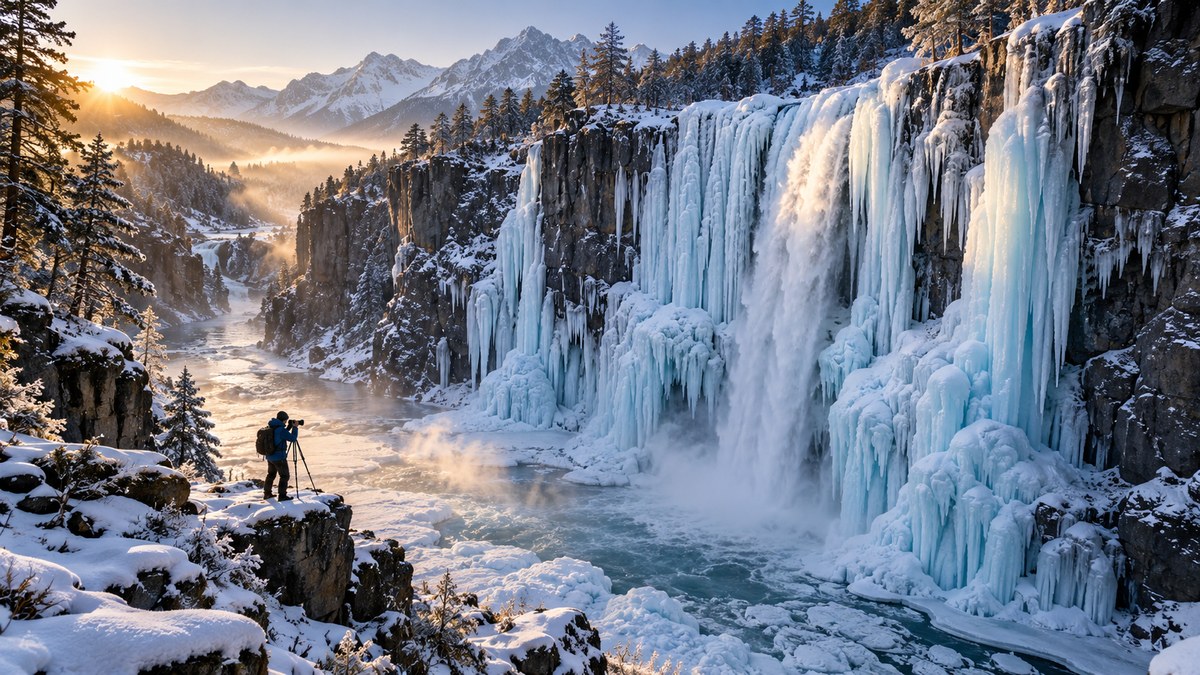
The first time you see a waterfall locked mid-plunge, it stops you cold. Not just from the temperature, but from the sheer impossibility of it. Water, that endlessly moving force, has been frozen in place. Icicles hang like organ pipes. The roar of summer is replaced by a deep, resonant silence. For a travel photographer or adventure-seeking nature enthusiast, this is pure gold. The frozen waterfalls of Northeast Asia offer a visual spectacle that rivals the northern lights in drama and far exceeds them in accessibility. This is not a niche subject. It is a phenomenon that demands your lens.
Frozen waterfalls in Northeast Asia are a top-tier subject for 2026 winter photography. Success depends on timing the deep freeze, using a tripod and polarizer, and understanding how light plays on ice. Locations like Japan’s Sounkyo Gorge and China’s Huanglong offer world-class scenes. Master your exposure compensation and dress for the cold.
Why Frozen Waterfalls Demand Your Attention
Frozen waterfalls are a paradox. They represent motion and stillness at the same time. The water has stopped, but the shapes it creates are dynamic. Curtains of ice, massive columns, and delicate needles all form in a single season. Northeast Asia is the perfect stage for this. The region’s cold, dry winters create conditions where waterfalls freeze solid, often for months. You get clear skies, low humidity, and consistent sub-zero temperatures. This is not a fleeting moment. It is a reliable, repeatable event.
The visual payoff is enormous. You can capture textures that do not exist in any other landscape. The ice acts like a natural prism, bending light into soft blues and greens. Shadows turn deep indigo. A well-composed shot of a frozen waterfall can look like an image from another planet.
The Science Behind the Scene: When Water Becomes Art
To photograph this well, you need to understand the freeze. It is not just about cold air. It is about the balance of flow, temperature, and time.
- Flow rate matters. A waterfall with a low volume of water freezes faster and more completely. High-volume falls may only freeze on the surface, leaving a dangerous torrent underneath.
- Air temperature is critical. You need sustained temperatures below 14 degrees Fahrenheit (minus 10 degrees Celsius). A single warm day can ruin the ice formations.
- Sun exposure changes everything. South-facing falls may thaw during the day and refreeze at night. North-facing falls stay frozen longer and maintain better clarity.
- Look for “ice dams.” These are sections where the ice builds up and creates a temporary barrier. The water then spills over the top, creating layered formations.
- Check for blue ice. Clear, dense ice appears blue because it absorbs red light. This is the sign of a deep, solid freeze. White, opaque ice has air bubbles and is less photogenic.
- Monitor the thaw. The last week of the freeze often produces the most dramatic shapes as the ice begins to crack and shift.
Top Locations for Frozen Waterfalls Northeast Asia Photography
You need to know where to go. These locations are proven winners for winter shoots.
- Sounkyo Gorge, Hokkaido, Japan. This is the crown jewel. The gorge has multiple waterfalls that freeze into towering blue and white pillars. The contrast against snow-covered rocks is stunning. The best time is late January to mid-February.
- Huanglong National Park, Sichuan, China. Known for its travertine pools, Huanglong transforms in winter. The flowing water freezes into terraced ice formations. The high altitude means consistent cold.
- Shirakami Sanchi, Japan. A UNESCO World Heritage site with deep snow and pristine waterfalls. The hike is tougher, but the reward is solitude and untouched ice.
- Baekdu Mountain, North Korea / China border. The waterfalls here are remote and massive. Access is limited, but for the adventurous, the scale is unmatched.
- Jigokudani (Hell Valley), Hokkaido, Japan. Not a waterfall in the traditional sense, but the steam vents and frozen streams create surreal, otherworldly scenes.
For a broader look at capturing water in motion, check out our guide on discovering the best techniques for capturing vibrant Asian waterfall landscapes. It covers the summer side of the equation, which is useful for understanding how the same locations change.
Gear Checklist for Shooting in Extreme Cold
Your gear needs to survive the cold as much as you do. Here is what works.
| Item | Purpose | Common Mistake |
|---|---|---|
| Tripod (carbon fiber) | Stability on ice. Carbon fiber is lighter and warmer to touch than metal. | Using a metal tripod without gloves. It will stick to your skin. |
| Camera with weather sealing | Prevents moisture from freezing inside the body. | Using a non-sealed body. Condensation can ruin the sensor. |
| Extra batteries | Cold drains lithium-ion batteries fast. Keep them in an inner pocket. | Leaving batteries in the camera bag. They will die in minutes. |
| Polarizing filter | Cuts glare on ice and enhances the blue tones. | Using a UV filter. It adds no benefit and can cause flare. |
| Lens cloth (microfiber) | Wipes away condensation and frost from the lens. | Breathing on the lens to clean it. That adds moisture. |
| Headlamp with red light | Setting up in the dark without blinding yourself. | Using a white light. It ruins your night vision and disturbs the scene. |
The Shooting Process: Step by Step
You have the location and the gear. Now you need a process. Follow these steps for consistent results.
- Arrive before sunrise. The best light on ice is the first hour of daylight. The low sun skims the surface, creating long shadows and warm highlights.
- Scope the ice. Walk the perimeter. Look for cracks, bubbles, and layers. Find a foreground element like a rock or a branch to add depth.
- Set your tripod low. A low angle makes the ice appear larger and more dramatic. It also helps you avoid including too much sky.
- Use a polarizer. Rotate it until the glare on the ice disappears. The blues will pop. The whites will become cleaner.
- Check your histogram. Ice is bright. It is easy to blow out the highlights. Expose to the right, but keep an eye on the whites.
- Shoot in RAW. You need the flexibility to adjust white balance later. Ice can look blue, white, or even pink depending on the light.
- Take a vertical panorama. Frozen waterfalls are tall. Stitch two or three vertical frames to capture the full height without distortion.
“The biggest mistake I see is photographers trying to use a fast shutter speed on a frozen waterfall. You want the opposite. A slow shutter speed, even in good light, will smooth out the ice and make it look like flowing silk. It creates a surreal contrast between the frozen and the fluid.” – Yuki Tanaka, Hokkaido-based landscape photographer.
Common Mistakes and How to Fix Them
A table is the clearest way to show this.
| Mistake | Why It Happens | How to Fix It |
|---|---|---|
| Overexposed ice | The camera’s meter is fooled by the bright white. | Use exposure compensation at -0.7 or -1.0. Check the histogram. |
| Blurry images | Cold hands cause camera shake. | Use a remote shutter release. Breathe slowly before pressing. |
| Condensation on the lens | Moving from cold to warm air. | Seal the camera in a plastic bag before entering a warm building. Let it warm up slowly. |
| Flat colors | No polarizer used. | Add a polarizing filter. Rotate until the ice has depth. |
| Too much sky | The waterfall is small in the frame. | Get closer. Use a longer focal length. Crop in post. |
Lighting and Composition: The Ice Whisperer’s Guide
Light is everything. On a frozen waterfall, the light is your paintbrush.
- Golden hour is king. The warm light contrasts with the cool blue ice. Shoot with the sun at your back or at a 45-degree angle.
- Overcast days are underrated. Soft, diffused light eliminates harsh shadows. The ice glows from within. This is perfect for capturing texture.
- Avoid direct midday sun. It creates harsh highlights and deep, distracting shadows. The ice will look flat and washed out.
- Use leading lines. Cracks in the ice, fallen branches, or the edge of the frozen pool can lead the eye to the main fall.
- Frame with ice. Use a foreground icicle or ice formation to create a natural frame. This adds depth and scale.
For more on working with natural light, read our guide on mastering the art of golden hour landscape photography in Asia. The principles apply directly to winter scenes.
Staying Safe While You Shoot
Safety is not optional. Frozen waterfalls are dangerous.
- Never walk on the frozen pool. You do not know the thickness. A hidden current can create thin ice.
- Watch for falling ice. As the day warms, icicles can break off. Wear a helmet if you are shooting directly underneath.
- Dress in layers. Your core needs to stay warm. Your fingers and toes need the most protection. Hand warmers are a lifesaver.
- Tell someone your plan. Cell service is often poor in these remote gorges. Leave a trip plan with a friend or hotel.
- Bring a thermos. Hot tea or coffee is not a luxury. It is a tool for keeping your core temperature up.
Editing Your Frozen Waterfall Images
Post-processing is where you bring out the magic. Focus on these adjustments.
- White balance. Ice can look too blue. Warm it up slightly. Aim for a natural white with a hint of cool tone.
- Clarity and texture. Increase these to bring out the cracks and bubbles in the ice. Be careful not to overdo it.
- Luminance. Lower the luminance on the blue channel to make the ice deeper and richer.
- Highlights. Pull them down to recover detail in the bright ice.
- Shadows. Lift them slightly to reveal texture in the dark crevices.
For a full workflow, our guide on mastering Asian landscape photography edits for stunning results walks you through the entire process from import to export.
The Emotional Payoff
You are not just capturing a frozen waterfall. You are capturing a moment of stillness in a world that never stops. The silence, the cold, the impossible shapes. These images will stand out in any portfolio because they show something rare. They show nature at its most sculptural.
When you share these photos, people will ask where they can see it for themselves. You become the guide, the storyteller. That is the real reward.
Make 2026 the Year You Chase the Freeze
The frozen waterfalls of Northeast Asia are waiting. They are not a secret. They are a destination. Plan your trip for January or February. Pack your gear. Watch the weather. And when you stand in front of a wall of blue ice, remember that you are seeing something that only happens here, in the deep winter of this remarkable region. Go capture it.