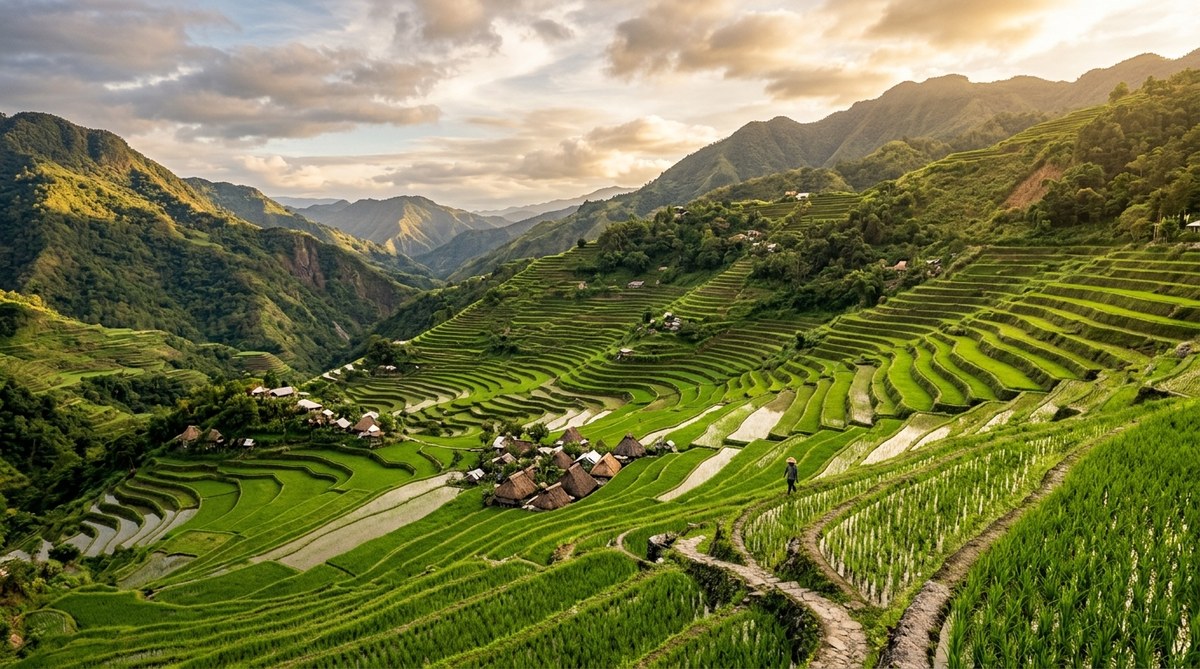
The rice terraces of the Philippines are not just a UNESCO World Heritage site. They are a living canvas carved into the mountains of Luzon. For any travel photographer looking to capture a landscape that blends human ingenuity with nature’s grandeur, the emerald steps of Ifugao should top your 2026 list. These ancient paddies shift color with the seasons and transform under every kind of light. Whether you are a seasoned pro or an enthusiast with a growing portfolio, this guide will help you plan a trip that yields stunning imagery.
To capture the Philippine rice terraces at their best, plan your visit between January and April for the greenest planting season. Arrive at sunrise or late afternoon for soft, directional light. Bring a wide-angle lens and a polarizer to manage glare off the waterlogged paddies. Respect local farming schedules and always ask permission before photographing people at work.
Why the Rice Terraces Demand Your Attention in 2026
Photographers often chase the new and undiscovered. Yet the rice terraces remain a perennial favorite because they change every single year. Each planting cycle, each harvest, and each weather pattern creates a unique palette. In 2026, with travel to remote regions becoming easier and infrastructure improving in places like Banaue and Batad, there’s no better time to capture these legendary slopes. The terraces are also gaining attention on social media, making them a smart addition to any portfolio focused on Asian landscapes.
If you want to improve your overall skill set while you are there, studying our guide on mastering the art of golden hour landscape photography in Asia will prepare you to get the most out of that precious window of light.
When to Shoot for Peak Beauty
Timing is everything in landscape photography, and the rice terraces are no exception. Here is a breakdown of the best months and times of day to shoot.
- January to April (dry season, planting phase): The paddies are freshly plowed and filled with water. They reflect the sky like mirrors. This is when you get the iconic emerald green shoots against shimmering surfaces.
- June to August (rainy season): Clouds can add drama, but frequent rain makes trekking muddy. The terraces are lush, but expect limited visibility at higher elevations.
- September to December (harvest season): The fields turn golden yellow. This offers a completely different color palette from the green season. Harvest time also shows more human activity, which can add life to your frames.
For the best light each day, shoot within the first hour after sunrise and the last two hours before sunset. The low angle of the sun wraps around the contours of the terraces, revealing texture and depth. If you are new to timing your shoots, the article on essential tips for capturing stunning Asia travel photos during golden hour breaks down exactly how to prepare.
Top Locations for Photographers
Not all rice terraces are created equal. Some offer easier access, others reward a hike with fewer crowds. Here are the three must-visit spots for Philippine rice terraces landscape photography in 2026.
Batad Rice Terraces
This amphitheater shaped site is the most photogenic. It requires a one to two hour trek from the main road, but the view from the Batad Saddle viewpoint is worth every step. Arrive early to avoid midday haze.
Banaue Rice Terraces
Often called the Eighth Wonder of the World, Banaue is more accessible. The main viewpoint gives you a broad panorama, but walk down the side trails for intimate shots of farmers at work.
Bangaan Rice Terraces
This village is less visited than Batad. The terraces cascade down to a small cluster of houses, offering a human scale that makes the landscape feel alive.
When you have your location picked, consider what gear you need. For high altitude treks like the approach to Batad, check out what gear do you need for landscape photography in the Himalayas for packing advice that applies here too.
Essential Gear for the Trek
The trails to the terraces can be steep, slippery, and hot. Your camera bag needs to be smart, not heavy.
- Camera body: A weather sealed body is ideal for humidity and sudden rain.
- Lenses: A wide angle zoom (16-35mm equivalent) captures the sweeping curves. A short telephoto (70-200mm) isolates details like a farmer planting rice or a water buffalo.
- Tripod: A lightweight travel tripod is essential for long exposures at sunrise and for HDR bracketing.
- Polarizing filter: Reduces glare off the water and enriches greens and blues.
- Spare batteries and memory cards: No power outlets on the trail. Bring at least two days worth of storage.
For a deeper look at choosing the right kit for Asian landscapes, read our guide on choosing the perfect camera gear for capturing Asia’s stunning landscapes.
A Step-by-Step Shooting Process
Follow this process to ensure you come back with keeper images.
- Scout the location the day before. Walk the trails, find the best foreground elements like a curved terrace edge or a stone wall. Mark your spot for sunrise.
- Set up 30 minutes before sunrise. Use your tripod. Compose with the rule of thirds, letting the terraces lead the eye into the frame.
- Take a test shot. Check your histogram. You want the highlights to be just below clipping point so you can recover detail in the water.
- Shoot a bracket of three exposures (one under, one normal, one over) to blend later for a balanced dynamic range. The bright sky and dark earthy terraces often exceed a single frame’s capability.
- Wait for the human element. A farmer walking by, a child waving, a group heading to work. Capturing people adds scale and story.
- Change your focal length. After you have the wide shot, switch to a telephoto to compress layers and create a more abstract composition.
This method works for any time of day. If you are planning to shoot at night, the guide on mastering low light photography techniques in Asian landscapes will help you capture the terraces under a starry sky.
Common Mistakes and How to Fix Them
Even experienced landscape photographers can stumble when faced with the complexity of the terraces. Here is a table of frequent issues and their solutions.
| Mistake | Why It Happens | How to Fix It |
|---|---|---|
| Overexposed sky | Bright clouds above dark green fields | Use a graduated neutral density filter or bracket exposures |
| Flat, boring water | No reflection or texture in mid day light | Shoot at golden hour when the water catches warm hues |
| Distorted perspective from wide angle | Placing the camera too low or too high | Level the horizon and use a vertical shift adapter if possible |
| Motion blur in people | Slow shutter speed with walking subjects | Increase ISO to 800 or higher to keep shutter above 1/125 |
| Lens flare | Strong sun hitting the front element | Use a lens hood and shade with your hand or hat |
Expert Advice on Composition
“When I photograph the terraces, I always look for leading lines. The contour of the rice paddies naturally draws the eye across the frame. Use a low angle to emphasize the curve of the topmost terrace. And never forget to include a person or an animal. Without scale, the viewer cannot appreciate the sheer size of these ancient fields.” — Maria Santos, National Geographic contributing photographer.
Maria’s tip about scale is crucial. Standing alone, a wide shot of terraces can look like a jumble of green lines. But a lone farmer in a conical hat standing at the edge of a wall instantly tells the story.
For more compositional strategies that work across many Asian scenes, explore top composition strategies for capturing authentic Asian cultural scenes.
Preserving the Experience Through Post Processing
Back at your computer, the real magic happens. Philippine rice terraces landscape photography often requires careful editing to bring out the contrast between the bright reflections and the deep greens. Start with these adjustments.
- Recover highlights: Pull down the whites slider to restore detail in the sky and water.
- Selectively brighten shadows: Use a brush or mask on the darker terraces to reveal texture in the mud and plants.
- Boost green saturation and luminance: But do it gently. Oversaturated greens look unnatural.
- Add a subtle vignette: This draws attention to the center of the frame where the layers converge.
If you are new to post processing landscape images from Asia, the guide on mastering Asian landscape photography edits for stunning results will walk you through software tools and techniques.
Your 2026 Shot List for the Terraces
To make the most of your trip, aim to capture these specific scenes.
- A panoramic stitch of the Batad amphitheater at sunrise, showing the entire bowl shape.
- A close up of a farmer carrying a bundle of rice seedlings, with terraced reflections in the background.
- An abstract pattern of ripples on a flooded paddy, using a polarizer to eliminate glare and reveal the soil beneath.
- A silhouette of a carabao (water buffalo) at dusk, with the terraces fading into deep blue tones.
- A nightscape shot where the Milky Way arcs over the ridges, requiring a clear sky and a fast aperture.
A Final Note on Respect
The rice terraces are not just a backdrop. They are a living agricultural system worked by the Ifugao people. Always ask permission before photographing individuals. Stay on marked trails to avoid damaging the walls. Support local guides and homestays. When you treat the place with respect, the images you bring home carry a deeper authenticity.
Now pack your bag, charge your batteries, and set your alarm for 4 AM. The terraces are waiting, and 2026 is your year to capture them.