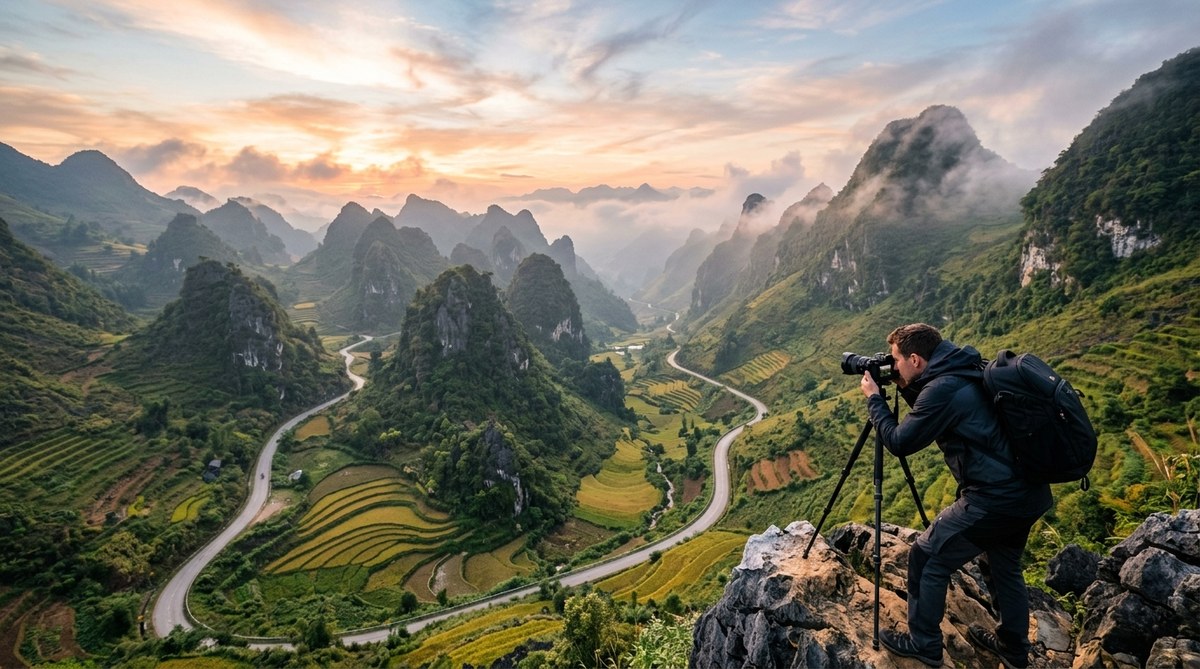
The limestone karsts rise like ancient sentinels from the morning mist. Rice terraces cascade down mountainsides in shades of green you did not know existed. A single motorbike rounds a switchback, its rider paused to absorb the silence. This is the Ha Giang Loop, and for travel photographers in 2026, it remains one of the most visually rewarding destinations on the planet.
If you have been searching for a route that delivers raw, unfiltered landscapes without the crowds of Sapa or the filtered perfection of Halong Bay, this is your place. The loop stretches roughly 300 kilometers through northern Vietnam, wrapping through high mountain passes, deep river valleys, and ethnic minority villages that have stood for generations. Every corner offers a new composition. Every shift in weather changes the mood entirely.
The Ha Giang Loop offers unmatched diversity for landscape photographers, from jagged karst peaks to terraced rice fields and misty valleys. Success depends on timing your visit between September and November for golden rice harvests or March and May for lush greenery. Pack a versatile zoom lens, a sturdy tripod, and prepare for unpredictable weather. The best shots come from waking before sunrise and waiting for fog to lift over the mountains.
Why Ha Giang Loop Photography Is Different
Most photographers visit Vietnam and shoot the same well known spots. The Ha Giang Loop changes that equation. This region sits far north, bordering China, and its remote nature means you get landscapes that feel genuinely undiscovered. The roads are carved into cliffs. The valleys drop away beneath your feet. And the light here behaves differently than anywhere else in Southeast Asia.
The loop passes through multiple geological zones. You get the jagged Dong Van Karst Plateau Geopark, a UNESCO Global Geopark that looks like a storybook mountain range. You get the Nho Que River cutting through Tu San Canyon, often called the deepest canyon in Southeast Asia. And you get sweeping viewpoints like Ma Pi Leng Pass, where the road clings to the cliff face hundreds of meters above the river below.
For a travel photographer, these are not just scenic stops. They are carefully arranged natural compositions waiting for the right light.
Best Times for Ha Giang Loop Photography
Timing matters more than gear on this route. The weather shifts dramatically between seasons, and the landscape changes color palette entirely.
-
September to November (autumn): This is the gold standard window. The rice terraces turn golden yellow, the skies are clearer, and the temperatures are comfortable. Fog often sits in valleys during early morning, giving you layered atmospheric shots.
-
March to May (spring): The hills turn bright green, flowers bloom along the roadsides, and the weather is warm without being oppressive. You get fewer tourists than autumn but more chance of rain.
-
December to February (winter): Cold and often cloudy, but this is when you can capture misty, moody landscapes with dramatic low clouds. Temperatures drop near freezing at higher elevations.
-
June to August (summer): Heavy rain and humidity make this the toughest time. Landslides are possible. But the payoff is intense green vegetation and dramatic storm clouds if you can work around the weather.
If you want the widest range of photographic opportunities, aim for late October 2026. The rice harvest will be in full swing, the light will be warm, and the mornings will offer that signature Ha Giang mist.
Essential Gear for the Ha Giang Loop
Packing light is critical because you will be on a motorbike for days. But you cannot compromise on the essentials. Here is what I recommend based on multiple trips to the region.
- A mirrorless or DSLR body with good dynamic range. The contrast between bright sky and shadowed valleys demands it.
- A standard zoom lens (24-70mm equivalent) for most landscape work. This covers wide shots of valleys and tighter frames of village scenes.
- A longer lens (70-200mm equivalent) for compressing distant mountain layers. This is especially useful at Ma Pi Leng Pass.
- A sturdy but compact tripod. Wind can be strong at higher passes, so carbon fiber helps.
- Circular polarizer filter to cut through haze and saturate greens and blues.
- Graduated neutral density filters for balancing bright skies with darker foregrounds.
- At least 3 fully charged batteries. Cold temperatures drain them faster than you expect.
- A weather sealed camera setup or rain covers. Sudden downpours are common.
For a deeper breakdown of what to bring, check out our guide on choosing the perfect camera gear for capturing Asia’s stunning landscapes.
Top Photography Locations Along the Loop
The Ha Giang Loop is not one single viewpoint. It is a series of spectacular locations connected by winding roads. Here are the essential stops for any landscape photographer.
Quan Ba Heaven Gate
This is the first major viewpoint when coming from Ha Giang city. The heaven gate sits at around 1,500 meters elevation and offers a panoramic view of the Twin Mountains, two perfectly rounded peaks that locals call the Fairy Bosom. Early morning light streams through the gap between them. Mist often fills the valley below. Use a longer lens to isolate the peaks against the sky or go wide to capture the full valley.
Yen Minh Pine Forest
A surprising detour. This forest features tall pines that feel more like the Pacific Northwest than northern Vietnam. The light filters through the trees in shafts, especially during late afternoon. It is an excellent spot for environmental portraits or atmospheric forest shots. Use a wide aperture to create separation between the trees and add depth.
Dong Van Old Quarter
Not strictly a landscape, but the old quarter offers incredible architectural and cultural photography. The Hmong and Tay communities live in traditional houses with yin and yang tiled roofs. Shoot here during golden hour when the warm light hits the stone walls. The local market on Sunday mornings is chaotic and vibrant, perfect for street photography.
Ma Pi Leng Pass
This is the crown jewel. Ma Pi Leng stretches about 20 kilometers of cliffside road with sheer drops into the Nho Que River below. The viewpoint at the top of the pass is the most photographed spot on the loop for good reason. Arrive before sunrise. The morning light paints the limestone peaks in warm tones while the river sits in shadow below. Use a telephoto lens to compress the layers of mountains fading into the distance.
For more on shooting at high elevations, read our guide on top tips for capturing vibrant mountain landscapes in Asia’s remote regions.
Tu San Canyon and Nho Que River
You can descend from Ma Pi Leng down to the river for a boat ride through the canyon. The limestone walls rise vertically on both sides, and the water reflects the cliffs in perfect symmetry on calm days. Shoot from the boat with a wide angle lens pointed upward to emphasize the scale. Or wait for the afternoon when the sun hits the canyon walls directly.
Lung Cu Flag Tower
At the northernmost point of Vietnam, Lung Cu sits on a small hilltop. The view stretches into China on clear days. The flag tower itself makes a strong foreground element against the rolling hills. Use a polarizer to reduce haze and bring out the blue in the sky.
Composition Techniques That Work Here
The landscapes of Ha Giang demand intentional composition. You cannot just point and shoot from the roadside. Here are specific techniques that will elevate your images.
| Technique | When to Use | Common Mistake |
|---|---|---|
| Leading lines | Use roads, rivers, or terrace edges to guide the eye through the frame | Centering the road instead of placing it diagonally |
| Frame within a frame | Shoot through tree branches, cave openings, or doorways in villages | Not checking focus on the frame element versus the distant subject |
| Rule of thirds with sky | On cloudy or dramatic sky days, give two thirds to the sky | Giving equal space to sky and land, making both feel weak |
| Layered depth | Use mist or fog between multiple mountain ridges | Using a wide aperture that blurs the middle layers |
| Symmetry | For reflections on the Nho Que River or flooded rice paddies | Not leveling the horizon perfectly |
“The Ha Giang Loop rewards patience more than any other location I have shot. I sat at Ma Pi Leng for three hours waiting for the fog to clear just enough to reveal the peak. That single frame became my most licensed image of the year.” — Marco Ferrarese, travel photographer
For more on working with natural light, read our guide on mastering the art of golden hour landscape photography in Asia.
Handling Weather and Light Challenges
The weather in Ha Giang is unpredictable. You can start a morning in bright sun and find yourself in thick fog thirty minutes later. This is not a problem. It is an opportunity.
Fog and mist create depth that flat blue skies cannot. When fog rolls in, shoot scenes with multiple layers. A foreground element like a tree or a house, a midground ridge, and a faint peak far in the distance. The mist naturally separates these layers and gives your image a three dimensional feel.
Rain creates its own mood. Wet roads reflect the sky and the surrounding green. Rice paddies become mirrors. Shoot from a low angle to emphasize the reflections. Use a faster shutter speed to catch raindrops hitting puddles.
Overcast days are ideal for waterfall photography and forest scenes. The diffused light eliminates harsh shadows and lets you capture detail in both highlights and shadows. Check out our guide on discovering the best techniques for capturing vibrant Asian waterfall landscapes for more specific advice.
Night Photography on the Loop
The Ha Giang Loop offers some of the darkest skies in Vietnam. Light pollution is almost nonexistent once you are away from the towns. On clear nights, the Milky Way arcs overhead in stunning detail.
For night photography, bring a fast wide angle lens (f/2.8 or wider). Use a sturdy tripod and set your shutter speed to around 20 seconds to avoid star trails unless you want them. Focus manually on a bright star using live view magnification. Compose with a foreground element like a limestone karst or a silhouetted pine tree.
The best night shooting locations are along the Ma Pi Leng Pass and near Lung Cu. Avoid full moon nights if you want the Milky Way to pop. New moon periods offer the darkest conditions.
For a complete guide, read our article on essential techniques for capturing stunning nightscape landscapes across Asia.
Practical Tips for a Smooth Shoot
A photography trip on the Ha Giang Loop requires planning beyond just camera settings.
- Rent a motorbike with a semi automatic or manual transmission. Automatic scooters struggle on the steep climbs.
- Pack your gear in a dry bag inside your backpack. Sudden rain is inevitable.
- Carry cash. ATMs are rare outside Ha Giang city, and many villages do not accept cards.
- Buy a local SIM card at the Hanoi airport or in Ha Giang. Data coverage is decent along the main loop.
- Learn basic Vietnamese phrases for asking permission before photographing people. A simple smile and gesture goes far.
- Allow at least 4 days for the full loop. Rushing means missing the best light.
What to Avoid on the Ha Giang Loop
Some mistakes can ruin your photography or your trip. Here are the biggest ones to avoid.
- Do not shoot only at midday. The harsh overhead light flattens the landscape and creates deep shadows in the valleys.
- Do not skip the small viewpoints. Some of the best compositions come from unmarked pull offs, not the main tourist stops.
- Do not ignore the local communities. The Hmong, Tay, and Dao villages are part of the landscape. Include them respectfully.
- Do not assume the weather will hold. Check forecasts daily, but prepare for anything.
- Do not leave your tripod behind. The low light conditions at sunrise and sunset require stability.
For more on working with local cultures, read our guide on top composition strategies for capturing authentic Asian cultural scenes.
Editing Your Ha Giang Photos
The raw files you bring back from the loop will need careful processing. The key is to enhance what is already there without overdoing it.
Start with white balance. The morning light in Ha Giang is cool and blue. The afternoon light is warm and golden. Match your editing to the mood you felt at the scene.
Boost contrast selectively using masks. The distant mountains often fade into haze. A gentle contrast increase on those layers can bring back definition without creating artifacts.
Saturate greens carefully. The rice terraces are vibrant, but oversaturation makes them look unnatural. Use the HSL panel to target specific greens rather than boosting overall saturation.
Add clarity to the midtones for texture in the limestone formations. But keep it subtle. Too much clarity creates halos around edges.
If you shoot in raw, take advantage of the latitude. The Ha Giang landscapes often have a wide dynamic range. Bring up shadows to reveal detail in the valleys while maintaining highlight detail in the sky.
For a full walkthrough, read our guide on mastering Asian landscape photography edits for stunning results.
Making the Trip in 2026
The Ha Giang Loop is more accessible in 2026 than ever before. Road improvements have smoothed out many of the rougher sections. Accommodation options have expanded, with homestays offering clean rooms and hot showers. But the landscape remains untouched.
The key is to go with intention. Do not just ride the loop. Photograph it. Wake up early. Stay late. Wait for the light. The Ha Giang Loop will reward you with images that stand apart from anything else in your portfolio.
Pack your gear, book your flight to Hanoi, and give yourself at least a week for the full experience. Your camera will thank you.