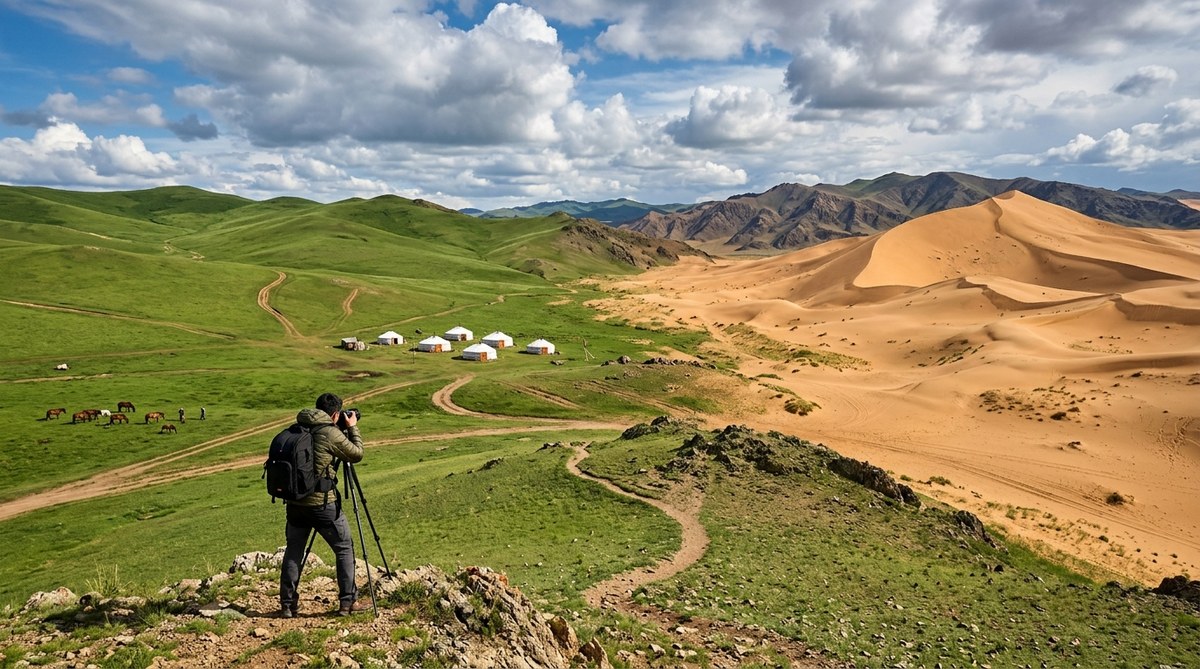
Imagine standing on a sea of green, with wild grasses swaying to the horizon. Then, just a day later, you’re surrounded by endless sand dunes and sunbaked rock. Mongolia offers that kind of whiplash for a photographer. From the lush steppe of the north to the bone-dry Gobi Desert in the south, the country is a living lesson in contrast. Learning to capture both extremes in one trip is a challenge, but it’s one that will push your portfolio to new heights. This guide is built for travel photographers and adventure seekers who want to bring home images that tell the full story of Mongolia’s dramatic landscapes. We’ll cover gear, timing, composition, and the mindset you need to handle two climates in one week.
To capture Mongolia’s stunning contrast between grasslands and desert, pack versatile gear that handles dust and temperature swings. Shoot during golden hours for the richest textures. Use leading lines and framing to emphasize the shift from green to gold. Plan your route around the changing seasons, and always carry extra batteries and dust protection. The payoff is a set of images that feel like two different planets.
Understanding the Two Worlds
The Mongolian steppe stretches endlessly under a wide sky. It’s green in summer, golden in autumn, and white in winter. The grass is tall enough to hide grazing horses, and the light changes with every passing cloud. In contrast, the Gobi Desert is a land of red cliffs, orange dunes, and salt flats. It’s not a sandy desert like the Sahara; it’s a rocky, semi-arid expanse with surprising pockets of life. The Gobi gets cold at night, even in summer, so temperature management is key.
Your photography strategy must shift between these two environments. In the steppe, focus on openness and movement. In the desert, texture and isolation take center stage.
Essential Gear for Mongolian Extremes
Mongolia’s climate can hit 40°C in the Gobi and drop to near freezing at night. Your gear needs to handle dust, wind, and temperature swings.
- Body: A weather-sealed camera body is a lifesaver. A smaller backup body (like an older mirrorless) can save you if dust kills your primary camera.
- Lenses: A wide-angle zoom (16-35mm) for sweeping landscapes, a mid-range (24-70mm) for flexibility, and a telephoto (70-200mm) for compressing distant mountains or isolating a single ger in the steppe.
- Tripod: Carbon fiber, lightweight, but stable against wind. For timelapse in the Gobi.
- Filters: Circular polarizer to cut glare on sand and water. A variable ND for longer exposures during midday.
- Dust protection: A blower brush, lens cloths, and a rain cover even if it doesn’t rain. The dust is fine and seeps everywhere.
- Power: Pack at least three batteries and a solar charger. Cold nights drain batteries fast.
If you are heading to higher altitudes in the Altai, check out this guide on what gear you need for landscape photography in the Himalayas. The same principles apply: layered clothing, backup storage, and protection against the elements.
Timing Your Visit for Maximum Contrast
The best window for both grasslands and desert is June through September. July and August offer the greenest steppe, but the Gobi is brutally hot. May and September bring milder temperatures and thinner crowds, though the steppe may be less vibrant.
Golden hour in Mongolia lasts longer than in lower latitudes. You get about an hour after sunrise and before sunset. That’s your prime shooting time for both biomes. For the steppe, golden hour creates long shadows across the rolling hills. In the Gobi, it lights up the sand dunes with a rich, warm glow.
Plan your schedule so you arrive at your shooting location at least 45 minutes before sunrise or sunset. Use apps to check the exact times. If you want to master those perfect light moments, see our guide on capturing dramatic Asian sunrise and sunset landscapes in 2026.
Techniques for Capturing the Contrast
Composition
Use leading lines to draw the viewer from foreground to background. In the steppe, a dirt track or a row of grazing sheep leads the eye. In the desert, the curves of the dunes create natural flow. Frame a section of green with a rocky outcrop to emphasize the two worlds in one image.
Exposure
The Gobi’s high dynamic range can be punishing. Midday sun creates harsh shadows and blown-out highlights. Shoot in RAW and bracket exposures when possible. For the steppe, an overcast day can be your friend – it evens out the light and lets the greens pop.
Focus on Details
Not all images need to be grand panoramas. Zoom in on the textures: a blade of grass against a sand dune, the crackled mud of a dry riverbed, the sweat on a horse’s coat. These details tie the landscapes together.
| Common Mistake | Why It Hurts | Solution |
|---|---|---|
| Shooting only wide shots | Loses the sense of scale and texture | Mix in telephoto shots of isolated features |
| Underexposing the sky | Sky turns white or blue but detail lost in clouds | Use graduated ND filter or bracket exposures |
| Ignoring wind | Dust on sensor ruins many frames | Change lenses carefully, use a blower before each new spot |
| Not bringing warm clothes in Gobi | Cold limits shooting time after sunset | Pack a down jacket and gloves for evening sessions |
| Shooting directly into sun without flare control | Lens flare can kill an otherwise great shot | Use a lens hood and your hand to block stray light |
A Practical Workflow for One Day
- Scout at dawn. Arrive at your spot 30 minutes before sunrise. Walk the area to find the best foreground interest. Set up your tripod and compose with one leading element.
- Shoot during the magic hour. Use a small aperture (f/11 to f/16) for deep depth of field. Shoot multiple frames at different exposures.
- Midday break. The sun is harsh. Review images, clean your sensor, and charge batteries. Find a shaded ger or your vehicle.
- Afternoon recon. Drive to the next location. The Gobi’s shadows start to reappear around 4pm. Scout for sunset compositions.
- Sunset session. Switch to a longer lens to compress the horizon. Use a polarizer to deepen the sky. Shoot until the light is gone.
- Post-sunset. If you are in the Gobi, stay for the blue hour and capture the stars. The night sky is incredibly dark.
Expert Advice from a Mongolia Photography Guide
“The biggest mistake I see is people trying to cover too much ground. They rush from the steppe to the desert in two days. Instead, spend at least three days in each region. Stay with a nomadic family. Let the landscape change slowly in your viewfinder. That’s where the real contrast lives.” – Batsaikhan T., photography guide based in Ulaanbaatar.
Editing for the Extremes
Post-processing is where you unify your steppe and desert images. The key is to maintain a consistent color temperature across your series. Warm up the desert images slightly, and cool down the steppe shadows. Raise the clarity slider a bit to emphasize texture, but don’t go overboard. Use the dehaze tool lightly on desert shots to cut through dust haze.
For the greens of the steppe, increase saturation in the yellow-green range without making them neon. For the desert sands, boost the orange and red tones. Keep the sky natural – avoid turning it purple or cyan. If you need a refresher on editing workflow, check our guide to mastering Asian landscape photography edits for stunning results.
Working with Local Communities
Mongolia’s grasslands and desert are home to nomadic herders. Ask permission before photographing people, and be respectful of their way of life. Offer a small gift like tea or snacks. Share your images with them if you can. Their knowledge of the land can lead you to secret spots that no guidebook covers.
When you’re photographing in a ger (the traditional tent), take off your shoes before entering. Keep a low profile. These encounters can produce some of the most authentic portraits of your trip.
Putting It All Together
Mongolia rewards planners and patient shooters. The contrast between its grasslands and the Gobi Desert is not just visual; it’s emotional. One day you are surrounded by endless green and the sound of wind through grass. The next you stand on a dune, feeling the silence of a landscape that has been mostly unchanged for millennia. Capture that feeling, and your photos will resonate long after you return home.
Start by picking one region, either the steppe or the desert, and spend quality time there. Then make the journey south or north. Let the change in terrain be part of your story. Use the gear we discussed, follow the timing tips, and don’t be afraid to break a few rules if the light is magical.
Your camera is your ticket to share this incredible place with the world. Get out there, shoot the contrast, and make images that no one will forget.