<title>Asian Lake Reflection Photography: Capturing Mirror Images</title>
<meta name="description" content="Learn Asian lake reflection photography with gear tips, timing guides, and composition tricks for perfect mirror images in places like Halong Bay and Lake Toba.">

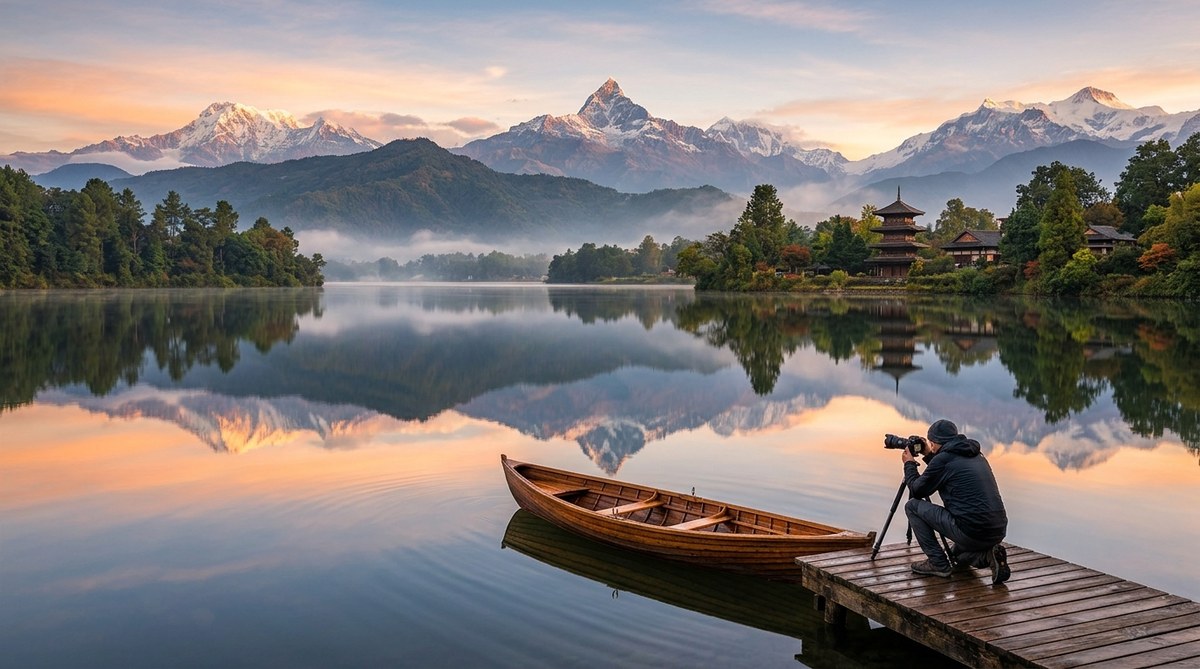
A still lake at dawn, a temple pagoda floating upside down on the water, your camera aimed at the boundary between two worlds. That is the promise of Asian lake reflection photography. Across the continent, from the crater lakes of Indonesia to the glacial tarns of the Himalayas, water acts as a living mirror. The best images feel like secret doorways. But capturing that perfect symmetry takes more than good luck. You need the right conditions, a solid technique, and a patient eye. Whether you are planning a trip to Inle Lake in Myanmar or the Li River near Yangshuo, these methods will help you bring home reflections that look almost too perfect to be real.

<div style="border:1px solid #c8b88a; background:#fbf7ea; padding:20px; border-radius:14px; margin-bottom:30px;">
  <div style="font-weight:700; margin-bottom:10px; color:#856404;">Key Takeaway</div>
  <p style="margin:0;">Mastering Asian lake reflection photography means controlling timing, light, and composition. Shoot during the golden hours when the wind is calm. Use a circular polarizer to manage glare without killing the reflection. Place your horizon dead center for perfect symmetry or break it with a foreground element. Scout locations like Halong Bay, Lake Toba, and Inle Lake for reliable mirrors. Post-process carefully to balance exposure and sharpness.</p>
</div>

## Why Asian Lakes Are a Top Destination for Reflection Photography

Asia holds some of the most photogenic bodies of water on the planet. The region's geography creates natural mirrors that rival any man made glass. The karst towers of Halong Bay in Vietnam, the rice terrace reflections of Tegallalang in Bali, the volcanic crater lake of Mount Pinatubo in the Philippines. Each spot offers unique colors, textures, and culture. What makes Asian lakes special for reflection work is the combination of still water and dramatic surroundings. Mountain peaks, temples, fishing boats, and misty forests all appear upside down with stunning clarity. The water is often darker due to volcanic minerals, which makes the reflection pop even more.

## When to Shoot for the Perfect Reflection

Timing is everything in landscape photography, but it becomes critical when you need a mirror surface. The ideal window is narrow.

- **Golden hour at sunrise**: The wind is usually calmest just before and after dawn. The light is soft and warm. Many lakes in Asia, such as Lake Toba in Sumatra, have a magical stillness during the first thirty minutes of light.
- **Avoid midday winds**: By 10 a.m., thermal winds often pick up. The surface ripples and your reflection disappears.
- **Check the forecast**: Look for days with no rain and low wind speeds. Apps like Windy or WeatherPro can show you wind direction and speed for your specific lake.
- **Season matters**: The dry season in Southeast Asia runs from November to April. That is your best bet for consistent calm water. In Japan, autumn mornings offer crisp air and colorful foliage reflections around lakes like Kawaguchiko.

## Essential Gear for Lake Reflection Photography

You do not need a truckload of equipment, but a few specialized items make a big difference. Here is what works best.

| Gear | Purpose | Common Mistake |
|------|---------|----------------|
| Circular polarizer | Reduces glare on the water surface, darkens water, and enhances color saturation | Overpolarizing kills the reflection; use subtle rotation |
| Tripod | Allows long exposures to smooth small ripples | Using a flimsy tripod in wind; invest in a sturdy carbon fiber one |
| Wide angle lens (16-35mm) | Captures the full scene and leads the eye from foreground to reflection | Going too wide can distort the horizon; compose carefully |
| Neutral density filter | Enables longer exposures (1-4 seconds) to turn ripples into glass | Using too strong an ND on a bright day; need to adjust ISO and aperture |
| Remote shutter release | Minimizes camera shake during long exposures | Forgetting to use mirror lock-up on DSLR |

If you are still deciding what to pack for your next trip, see our guide on [choosing the perfect camera gear for capturing Asia's stunning landscapes](https://naturesbestphotography.asia/choosing-the-perfect-camera-gear-for-capturing-asia-s-stunning-landscapes/). The same principles apply to reflection work.

## A Step by Step Process for Capturing a Stunning Reflection

Follow this workflow when you arrive at the lake. It saves time and reduces frustration.

1. **Arrive early and scout**: Walk the shoreline. Look for a clean foreground without trash or weeds. Find a spot where the reflection is uninterrupted by boats or swimmers. Position yourself so the sun is at your back or to the side.

2. **Set up the tripod low**: Extend the legs so the camera is at knee height or lower. A lower angle compresses the distance between the foreground and the reflection, making the mirror appear larger. Level the head carefully.

3. **Attach the polarizer and adjust**: Screw on the circular polarizer. Look through the viewfinder or use live view. Rotate the filter until the glare on the water is reduced, but stop **before** the reflection becomes weak. You want a slight darkening, not total elimination of the mirror.

4. **Focus one third into the scene**: Autofocus on a point about a third of the way into the water, where the reflection is sharpest. Then switch to manual focus. Do not focus on the far mountain because the reflection will be soft.

5. **Set exposure for the highlights**: Meter on the brightest part of the reflection or the sky. Check the histogram. You may need to underexpose by 0.7 to 1 stop to avoid blowing out the light tones. Bracket your shots if the dynamic range is high.

6. **Shoot with a 2 to 4 second exposure**: If there is any ripple, use an ND filter to lengthen the shutter speed. Start at 2 seconds and adjust. Use the remote release. Take five frames to cover focus variants.

7. **Review and adjust composition**: Look at the image on the back of the camera. Is the horizon straight? Are there any distractions? If the reflection is cut off by a shoreline, move your camera up or down. Sometimes a few inches changes everything.

> **Expert advice from a landscape photographer who shoots regularly in Asia:** “I always check the reflection first before even setting up the tripod. If I can see a clear mirror with my eye, the camera will see it even better. If the water looks like soup, I wait or find a sheltered cove. Patience is the cheapest filter you own.”

## Composition Techniques That Transform Reflections

A flat mirror is nice, but a great composition makes the image memorable. Try these approaches.

- **Perfect symmetry**: Place the horizon exactly in the center. This works best when both the sky and water are equally interesting. Halong Bay at sunrise is a classic example.
- **Break the symmetry**: Add a foreground element like a rock, a floating boat, or a branch. This creates depth and anchors the image. The reflection becomes a backdrop.
- **Fill the frame**: Get close to the water so the reflection dominates the frame. Use a 70-200mm lens to compress distant peaks into the water. This works well for mountains like Mount Fuji reflected in Lake Kawaguchi.
- **Use leading lines**: Shorelines, docks, or rows of lotus plants can lead the eye from the bottom edge toward the reflection and sky.
- **Invert the image**: In post processing, flip the photo upside down. Sometimes the reflection looks more compelling than the real scene. Try it and see.

## Common Mistakes and How to Fix Them

Even experienced photographers miss these details. Learn from them.

| Mistake | Why It Happens | Fix |
|---------|----------------|-----|
| Reflection is blurry | Wind or incorrect focus point | Use a longer exposure to smooth ripples; focus on the reflection, not the subject |
| Horizon is tilted | Tripod head not level | Use a built in bubble level or a hot shoe level |
| Overpolarized reflection | Filter rotated too far | Reduce rotation until the reflection regains brightness |
| Blown out sky | Exposure set for the dark reflection | Bracket exposures and blend in post, or use a graduated ND filter |
| Uninteresting composition | Only shooting the reflection alone | Add a human element, a temple, or a colorful boat for scale |

If you want to practice these techniques in a controlled setting, consider studying [mastering low light photography techniques in Asian landscapes](https://naturesbestphotography.asia/mastering-low-light-photography-techniques-in-asian-landscapes/). The exposure skills overlap.

## Putting It All Together for Your Next Asian Lake Adventure

Asian lake reflection photography rewards the photographer who respects the conditions. Japan's Lake Kawaguchiko offers Mount Fuji mirrored in still water, but only on windless mornings. Indonesia's Lake Toba reflects the volcanic crater walls, but you need to shoot from the northern shore to avoid tourist boats. In Vietnam, the lakes of Ha Giang province provide stunning reflections of limestone peaks, especially after a light rain when the air is clear.

Pack your polarizer, set your alarm for 4 a.m., and study the wind patterns for your specific lake. Each location has its own personality. The more you understand it, the better your reflection shots will become.

So head out there. Find a quiet shore. Wait for the wind to drop. And let the lake show you a world turned upside down.