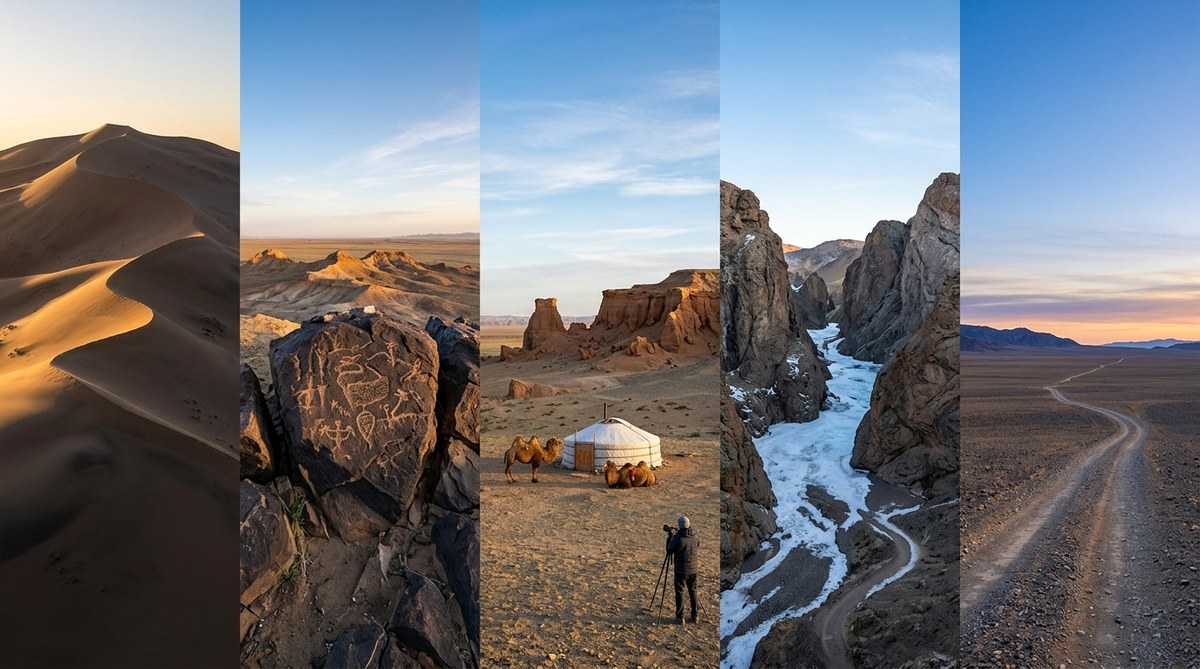
The Gobi Desert does not whisper. It roars in complete silence. Standing on a dune ridge with nothing but wind and sand stretching to every horizon, you feel something rare in the modern world. True aloneness. For a travel photographer or solo adventurer, that feeling translates directly into images with emotional weight. The Gobi is vast, empty, and deeply photogenic. But not all spots deliver the same quality of solitude. Some attract tourist jeeps and camera crews. Others remain so quiet that you can hear your own heartbeat. I have spent weeks traversing this landscape, and I have narrowed down the five places that offer the purest solitary experience for your lens.
The Gobi Desert holds five exceptional locations where solitude and photographic opportunity meet. Khongoryn Els delivers towering dunes without crowds if you hike past the first ridge. Yolyn Am offers a frozen gorge silent as a church. Bayanzag’s Flaming Cliffs glow at sunrise with no one else around. Tsagaan Suvarga presents erosion sculptures in isolation. Baga Gazariin Chuluu hides granite formations far from any tour route.
## Why Solitude Matters for Desert Photography
A crowded landscape makes shallow images. When other people appear in your frame, the sense of scale shrinks. The viewer sees a tourist instead of an ocean of sand. The Gobi is supposed to feel infinite. That feeling only survives when you stand alone.
Solitude also changes how you shoot. Without distractions, you notice details. The way light slides across a dune face. The texture of ancient rock. The slow movement of shadows. You can wait for the exact moment without someone rushing you to the next stop.
The best spots Gobi Desert solitude are not the easiest to reach. That is exactly the point. The effort filters out casual visitors. The reward is a landscape that still looks the way it did a thousand years ago.
## 1. Khongoryn Els: The Singing Dunes Without the Crowd
Khongoryn Els is famous. The dunes stretch for nearly 100 miles and rise over 800 feet. They make a low rumble when sand grains slide against each other. Locals call them the Singing Dunes.
Most tourists stop at the main parking area, climb the nearest ridge, take a photo, and leave. That is not where the solitude lives.
**To find true silence here:**
1. Arrive at least one hour before sunrise. The parking area will be empty.
2. Walk south along the base of the dunes for 25 minutes. Most people never go that far.
3. Climb the third major ridge you encounter. It is steeper but offers untouched sand patterns.
4. Set up facing east. The sun will hit the dune face at a low angle, creating deep shadows.
5. Stay for at least two hours after sunrise. The light changes constantly, and the crowds arrive late.
From this ridge, you see nothing but sand and sky. No vehicles. No voices. Just the occasional rumble of sliding grains.
For practical advice on timing your shoot, read our guide on [mastering golden hour landscape photography in Asia](https://naturesbestphotography.asia/mastering-the-art-of-golden-hour-landscape-photography-in-asia/).
## 2. Yolyn Am: The Ice Gorge in Late Spring
Yolyn Am sits inside the Gobi Gurvansaikhan National Park. It is a narrow gorge where ice persists well into June. The walls rise sharply on both sides, and the floor stays cold even when the desert above bakes at 100 degrees.
The solitude here feels different. It is enclosed, intimate, almost cathedral-like. Your footsteps echo off the rock walls.
**Why late spring works best:**
– The ice is still thick but starting to crack, creating interesting patterns.
– Most visitors come in summer when the ice has melted.
– The light enters the gorge at a sharp angle, illuminating the ice from beneath.
Bring a tripod. The gorge is dark, and you will need longer exposures. The ice reflects blue tones that pair beautifully with the red canyon walls.
If you enjoy combining unique natural features in one frame, you might also like our post on [capturing dramatic contrast of Mongolia’s grasslands and Gobi Desert](https://naturesbestphotography.asia/how-to-capture-the-dramatic-contrast-of-mongolia-s-grasslands-and-gobi-desert/).
## 3. Bayanzag: The Flaming Cliffs at First Light
Bayanzag is famous for dinosaur fossils and red sandstone cliffs that glow at sunset. Most photographers go at sunset. That means you have company.
The smarter play is sunrise.
At dawn, the cliffs catch a warm orange light that feels almost volcanic. The shadows are long and dramatic. And almost nobody is there.
**What makes Bayanzag special for solitude:**
– The area is large enough that you can walk 10 minutes from the main viewpoint and be completely alone.
– The eroded formations create natural frames for wide-angle shots.
– The lack of vegetation means your composition stays clean.
> “I sat on a rock at Bayanzag for three hours one morning. Not a single person walked past. The only sound was the wind moving through the sandstone. That morning gave me the best images of my entire trip.” – Mikael Strandberg, expedition photographer
One note: the ground here is uneven and can be unstable. Watch your footing while looking through the viewfinder.
## 4. Tsagaan Suvarga: The White Stupa in the Middle of Nowhere
Tsagaan Suvarga translates to White Stupa. It is a massive cliff face of white and cream-colored sedimentary rock that has eroded into towers, spires, and ridges. It looks like a ruined city carved by wind.
This spot is far from any major route. The drive from the nearest town takes several hours on unpaved roads. That isolation is exactly what makes it one of the best spots Gobi Desert solitude.
**What to expect:**
– No facilities. No water. No shade. Bring everything you need.
– The cliff face runs for about a kilometer. Walk along its base to find compositions.
– The white rock reflects light beautifully during the golden hour but can be harsh at noon.
– Midday light works well here if you shoot black and white. The contrast is stunning.
| Technique | When to Use It | Common Mistake |
|———–|—————-|—————-|
| Wide-angle with foreground rock | Early morning | Including too much sky, which washes out the frame |
| Telephoto compression of spires | Late afternoon | Using too shallow depth of field so only part of the formation is sharp |
| Panoramic stitch of the full cliff | Midday | Not overlapping frames enough, causing gaps in stitching |
| Long exposure to blur wind-blown dust | Any calm day | Forgetting to shield the lens from dust particles |
For campers, sleeping under the stars here is unforgettable. The night sky has zero light pollution. You can photograph the Milky Way directly above the white cliffs. Check out our guide on [essential techniques for capturing nightscape landscapes across Asia](https://naturesbestphotography.asia/essential-techniques-for-capturing-stunning-nightscape-landscapes-across-asia/).
## 5. Baga Gazariin Chuluu: Granite Boulders in Total Isolation
This spot is lesser-known than the others. Baga Gazariin Chuluu is a granite rock formation rising from the flat Gobi steppe. Large boulders are stacked on top of each other in ways that look almost impossible. The area is small but dense with photographic potential.
**Why it belongs on this list:**
– It receives almost no tourist traffic. Maybe one or two vehicles per week.
– The granite texture captures warm light beautifully at sunrise and sunset.
– You can camp directly among the boulders without anyone disturbing you.
– The surrounding flat landscape makes the formation feel monumental.
The solitude here is total. You might go a full day without seeing another person. That is rare in the Gobi and precious for a photographer trying to make intimate images.
**Three compositions to try at Baga Gazariin Chuluu:**
– Frame a single boulder against the empty horizon using a 70-200mm lens. This emphasizes scale.
– Use a wide angle from ground level to make the boulders loom overhead.
– Shoot at night with the boulders silhouetted against the star field. The granite holds heat and will not fog your lens the way cold sand can.
To get the most out of a remote shoot like this, read our tips on [choosing the perfect camera gear for capturing Asia’s stunning landscapes](https://naturesbestphotography.asia/choosing-the-perfect-camera-gear-for-capturing-asia-s-stunning-landscapes/).
## A Practical Plan for Shooting Solitude in the Gobi
Here is a simple workflow that works across all five locations:
**Before you go:**
– Check satellite imagery to understand the terrain.
– Download offline maps. Phone service is almost nonexistent.
– Pack more water than you think you need. The dry air dehydrates you faster than you realize.
– Inform someone of your route and expected return time.
**When you arrive:**
– Spend the first 30 minutes just walking. Do not shoot immediately. Let the place settle into you.
– Identify the best light direction for the time of day you are there.
– Set up and wait. The best images happen when you are patient.
**While shooting:**
– Use a tripod for every shot. Handheld sharpness is harder in wind.
– Bracket your exposures. Desert light changes fast.
– Include a human element (your own silhouette, a footprint, a backpack) to communicate scale.
– Shoot both horizontal and vertical orientations for different uses.
**After the shoot:**
– Review images on site to check focus and composition.
– Clean your gear immediately. Sand gets everywhere.
– Hydrate and rest. The Gobi sun drains your energy.
## Choosing the Right Season for Solitude
The Gobi has four distinct seasons, and each changes the experience of solitude.
| Season | Temperature Range | Solitude Level | Best For |
|——–|——————-|—————-|———-|
| Spring (Apr-Jun) | 40-75 F | High | Ice in Yolyn Am, wildflowers, mild temps |
| Summer (Jul-Aug) | 70-105 F | Medium | Long days, dramatic heat haze, but more visitors |
| Autumn (Sep-Oct) | 30-65 F | Very High | Cool weather, golden light, empty landscapes |
| Winter (Nov-Mar) | -20 to 30 F | Extreme | Snow-covered dunes, total isolation, challenging conditions |
If you want the best balance of comfortable temperatures and true solitude, aim for late September or early October. The summer crowds have gone home, and the light sits low and warm all afternoon.
For more on working with challenging conditions, check out our guide on [mastering low light photography techniques in Asian landscapes](https://naturesbestphotography.asia/mastering-low-light-photography-techniques-in-asian-landscapes/).
## What Gear Actually Matters in the Gobi
You do not need the most expensive camera to capture the Gobi. You need gear that survives dust, wind, and temperature swings.
**Essentials:**
– A weather-sealed camera body. Dust gets inside non-sealed bodies within hours.
– A zoom lens covering 16-35mm and a telephoto from 70-200mm. Those two ranges cover 90% of desert compositions.
– A sturdy tripod. Light tripods shake in the wind.
– Circular polarizer. It cuts glare from sand and rock and deepens the sky.
– Lens cleaning kit with a blower brush. Do not use your shirt. Sand scratches glass.
**Non-essentials that help:**
– A second camera body as backup. If one fails, you are not done.
– Graduated neutral density filters. They balance bright sky and darker ground.
– A GPS device or personal locator beacon. Cell phones fail here.
If you are still building your kit, our guide on [what gear you need for landscape photography in the Himalayas](https://naturesbestphotography.asia/what-gear-do-you-need-for-landscape-photography-in-the-himalayas/) covers many of the same considerations that apply to the Gobi.
## How to Capture the Feeling of Solitude in a Single Frame
Technical skill gets you a sharp image. Composition gets you an emotional one. To convey solitude, you have to make the viewer feel small.
**Techniques that work:**
– Place the horizon very low in the frame. Let the ground dominate.
– Use a lone figure or object as a scale reference. A single person against a massive dune says more than an empty landscape.
– Shoot during the golden hour. Long shadows and warm light create mood.
– Include negative space. Empty sky or empty sand tells the story.
– Use leading lines from wind patterns or erosion to draw the eye through the frame.
Many of these concepts are covered in detail in our article on [10 essential landscape photography techniques for capturing China’s karst mountains](https://naturesbestphotography.asia/10-essential-landscape-photography-techniques-for-capturing-china-s-karst-mountains/), which translates well to desert work.
## Your Next Steps Toward the Empty Horizon
The Gobi Desert does not give its solitude freely. You have to earn it with planning, patience, and the willingness to walk farther than the crowd. But the reward is a portfolio of images that feel honest. No tourists. No distractions. Just you and a landscape that has been quiet for millions of years.
Pick one location from this list. Research the season. Pack your gear. Go alone or with one trusted companion. Spend at least three full days in the area. Let the silence do its work.
The best spots Gobi Desert solitude are still out there, waiting for someone with a camera and the courage to leave the road behind.