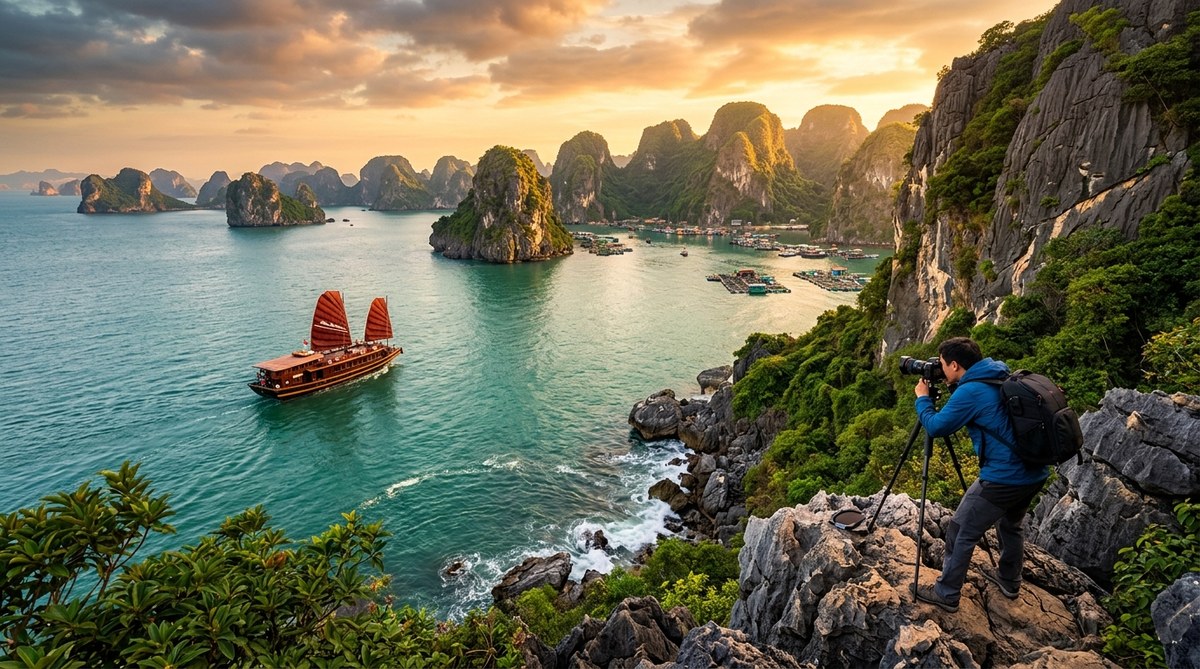
The sand squeaks under your sandals as the tide pulls back, revealing a mirror of wet sand reflecting the pastel sky. In the distance, a fleet of round bamboo boats bobs near the shore of Hoi An. This is the moment you came to Vietnam to photograph. And it is the moment that will test every skill you have.
Vietnam owns one of the most dramatic coastlines in Southeast Asia. From the limestone karsts of Ha Long Bay to the sweeping dunes of Mui Ne, from the rugged cliffs of Hai Van Pass to the tranquil lagoons of Phu Yen, the country offers endless variety for landscape photographers. But capturing these scenes well requires more than just showing up with a camera. Humidity, intense light, unpredictable tides, and crowds all create challenges. The good news is that with the right approach, you can bring home images that rival any professional portfolio.
Vietnam’s 2,000-mile coastline rewards photographers who prepare for its unique challenges. From Ha Long Bay’s towering karsts to the sand dunes of Mui Ne, each location demands specific approaches to light, composition, and gear. This guide covers essential techniques for capturing Vietnam’s coastal beauty, including timing your shoots, selecting the right filters, working with tropical light conditions, composing with strong foreground elements, and managing humidity for your gear. Learn how to turn challenging conditions into photographic opportunities that truly stand out.
The Light Along Vietnam’s Shores
Sunrise and sunset in Vietnam arrive fast and fade fast. The tropical sun drops below the horizon in minutes, not the drawn-out glow you might experience at higher latitudes. This compression of the golden window means you must be set up and ready before the show starts.
The best light for coastal landscape photography in Vietnam happens roughly 20 minutes before sunrise and 30 minutes after sunset. That is your window. During these moments, the haze that blankets the coast during midday softens into warm tones of amber, rose, and violet. The air itself becomes a diffusion filter.
For a deeper look at how to work with these specific light conditions, read our guide on It covers timing across different latitudes and seasons, which is especially useful when planning a trip from north to south Vietnam.
The Midday Challenge
Between 10 a.m. and 3 p.m., the light over Vietnam’s coast is harsh and contrasty. Shadows slam hard against highlights. The sky washes out to a pale blue or white. Many amateur photographers pack up their gear during these hours. Smart photographers use this time to scout.
Walk the beach at midday. Study where the tide line falls. Look for rocks, driftwood, fishing boats, or abandoned baskets that could serve as foreground anchors during golden hour. Note the angles. Mark your GPS coordinates on your phone. When you return at dawn or dusk, you will not waste time searching for a composition.
Gear That Handles Vietnam’s Coastal Conditions
Your camera body matters less than your approach. Any modern mirrorless or DSLR from the last five years can produce stunning coastal landscape photography in Vietnam. What matters more is how you protect and support that gear.
The Tripod Rule
You need a tripod that can handle wet sand, salt spray, and steady wind. Carbon fiber is ideal because it resists corrosion and weighs less. Avoid aluminum legs if you plan to shoot near breaking waves. Salt water will pit the metal over time.
Bring three things for your tripod:
- Stainless steel or alloy spikes that replace the rubber feet when shooting on sand
- A sandbag or carabiner to hang your camera bag from the center column for extra stability
- A quick-release plate system so you can remove the camera, wipe it down, and reattach without fumbling
Filters Are Non-Negotiable
Three filters will change your coastal photography in Vietnam more than any lens upgrade.
| Filter Type | What It Does | When to Use It in Vietnam |
|---|---|---|
| Circular Polarizer | Cuts glare on water, deepens blue sky, reduces haze | Every shot with water or wet rocks. Essential for Ha Long Bay reflections |
| 6-stop Neutral Density (ND) | Allows longer shutter speeds in bright light | Creating silky water effects during the first hour after sunrise |
| 3-stop Soft Graduated ND | Balances bright sky with darker foreground | Dawn and dusk scenes where the sky is 2-3 stops brighter than the land |
“The biggest mistake I see photographers make in Vietnam is using a 10-stop ND at sunrise and ending up with a 3-minute exposure that turns waves into flat fog. A 6-stop is almost always enough for coastal work. Start there and adjust.” — Tran Minh, Vietnamese landscape photographer based in Da Nang
For a full breakdown of what to bring, see our guide on
Composition for Vietnam’s Coastlines
Vietnamese coastal scenes are busy. Fishing boats, nets, ropes, bamboo cages, coral fragments, and palm fronds all compete for attention. Your job is to organize that chaos into a clear visual statement.
The Foreground First Rule
Before you adjust your exposure or focus, find a foreground that connects the viewer to the scene. A single fishing basket at the edge of the water. A line of rocks leading into the sea. The reflection of a karst in a tidal pool.
In Vietnam, some of the best foregrounds are human-made. The round bamboo baskets (thuyen thung) of Hoi An. The wooden stilt markers of fishing villages near Nha Trang. The rope coils left on the beach by squid fishermen. These elements tell a story and ground your image in a specific place.
Use a wide lens in the 16-24mm range for full-frame cameras. Get low. Place your tripod inches from the foreground object. This creates a sense of depth that pulls the eye from the front of the frame to the horizon.
The Rule of Thirds (and When to Break It)
Vietnam’s coastlines often feature a distinct horizon line where the ocean meets the sky. In most scenes, placing the horizon on the upper third line gives more weight to the foreground. Place it on the lower third line when the sky is dramatic.
But Phu Yen’s Ghenh Da Dia (the Giant Rock Reef) is a place where you should ignore the rule entirely. The hexagonal basalt columns create a leading line that calls for a centered horizon with the rocks filling the bottom two-thirds of the frame. Know the rule, then know when to set it aside.
For more ideas on framing scenes with cultural elements, check out
Working with Shutter Speed on the Water
Vietnam’s coastal waters range from the flat calm of Lan Ha Bay to the pounding surf of My Khe Beach. Your shutter speed controls how that water appears in your final image.
Four Shutter Speed Zones for Coastal Water
-
1/500 second and faster — Freezes individual droplets. Use for dramatic wave crashes against rocks at Hai Van Pass or the spray around fishing boats.
-
1/15 to 1/4 second — Creates a slight blur that suggests motion while keeping some texture. Ideal for receding waves on wet sand that create a mirror effect.
-
1 to 4 seconds — Turns rough water into a soft, milky flow. Works well for waterfalls cascading onto beaches, like the ones near Quy Nhon.
-
8 to 30 seconds — Smooths the ocean into a flat, mist-like surface. Best for calm harbors and sunrise reflections in Ha Long Bay.
To achieve these longer exposures in bright conditions, you need an ND filter. A 6-stop ND at f/11 and ISO 100 will give you roughly a 2-second exposure at 9 a.m. in Nha Trang. Adjust from there.
For handling the technical side of low-light exposures on the coast, read The principles apply directly to early morning work with filters.
The Practical Process for a Morning Shoot
Here is a repeatable workflow that works for any coastal location in Vietnam.
-
Check the tide chart the night before. Use an app like Tides Near Me or the local tide table posted at harbors. Arrive 45 minutes before high tide if you want waves crashing on rocks. Arrive during falling tide if you want tidal pools and exposed sand.
-
Scout your composition in low light. Use a red headlamp to avoid ruining your night vision. Walk the beach and check your chosen foreground for obstacles like trash, footprints, or seaweed.
-
Set your tripod low and level. Extend the center column only as a last resort. Use the bubble level on your tripod or your camera’s built-in level.
-
Focus manually on your foreground element. Use live view and zoom in 10x to confirm sharpness. Tape the focus ring down with a small piece of gaffer tape so it does not shift.
-
Apply your filters. Start with the polarizer. Add the graduated ND if the sky is more than 2 stops brighter than the foreground. Add the solid ND only if you need a longer shutter speed.
-
Take a test shot at ISO 400, f/11, and a shutter speed that gives you a correct exposure. Review the histogram. Adjust the shutter speed for the effect you want. Set the self-timer to 2 seconds to avoid camera shake.
-
Shoot in bursts of three. Take one exposure at your metered setting, one 1 stop underexposed, and one 1 stop overexposed. This gives you options for blending later.
Editing Your Coastal Images from Vietnam
The raw files from Vietnam’s coast will look flat. That is normal. The haze and humidity reduce contrast. Your job in post-processing is to restore depth without overdoing it.
Start with the basics. Pull the exposure down slightly. Increase contrast by about 15%. Lift the shadows to reveal detail in dark rocks or boats. Drop the highlights to recover the sky.
Then address the color. Vietnam’s coastal light has a natural warmth that looks best when you keep it. Do not cool down the white balance just to match what you think a seascape should look like. Let the tropics feel tropical. Boost the saturation on the oranges and yellows by 5-10%. Add a slight split tone with warm highlights and cool shadows.
For a full editing workflow tailored to Asian light conditions, see
Common Mistakes and How to Avoid Them
Here is a quick reference table for the most frequent missteps in coastal landscape photography in Vietnam.
| Mistake | Why It Happens | How to Fix It |
|---|---|---|
| Blurry foreground at f/16 | Diffraction from stopping down too far | Shoot at f/11 and focus stack if needed |
| Overexposed sky in sunrise shots | Not using a graduated ND filter | Carry a 3-stop soft GND and use it every sunrise |
| Sand on sensor | Changing lenses in the wind | Go to an indoor spot or a car to swap lenses |
| Flat colors at midday | Harsh overhead light reduces saturation | Only shoot between 5-7 a.m. and 4-6 p.m. |
| Salt spots on lens from spray | Shooting near breaking waves without protection | Use a UV filter as a sacrificial layer and wipe with a microfiber cloth |
Protecting Your Gear from the Elements
Vietnam’s coastal environment is brutal on equipment. Salt spray is invisible and deadly. It settles on every surface and eats away at seals, buttons, and lens coatings.
Bring a large microfiber cloth and use it constantly. After every session, wipe down your camera body, lens barrel, and filters. Keep your camera bag sealed with a rain cover even when it is not raining. The humidity alone will fog your lens if you move between air-conditioned spaces and the beach.
If you are shooting near heavy surf, use a clear plastic bag with a hole cut for the lens hood. Secure it around the lens with a rubber band. It looks silly. It saves your gear.
For a deeper conversation about keeping your equipment safe in Asia’s climate, read
Where to Practice These Techniques in 2026
If you are planning a trip this year, here are four locations that offer ideal conditions for practicing coastal landscape photography in Vietnam.
-
Ha Long Bay (Lan Ha Bay side) — Calm water, towering karsts, and the best reflection shots in the country. Go in April or May for the clearest skies.
-
Phu Yen Province (Ghenh Da Dia) — The hexagonal rock columns create a natural leading line. Best at sunrise when the sun rises behind the rocks.
-
Mui Ne Sand Dunes — Not a beach, but the red and white dunes meet the coast. Use the sand ripples as foreground texture with the ocean in the background.
-
Son Tra Peninsula near Da Nang — Rocky headlands with views of Ling Ung Pagoda. Try a long exposure at sunset with the statue of the Goddess of Mercy in the frame.
Your Next Shot Is Waiting
The coast of Vietnam does not give up its best images easily. It asks for early mornings, careful preparation, and a willingness to get sand in places you did not know had sand. But the reward is a body of work that feels alive. The golden light on the karsts. The fishermen casting nets into the reflecting tide. The waves that have been shaping this coastline for thousands of years.
Pack your tripod. Charge your batteries. Check the tide chart one more time. Then go make the images that only you can make.