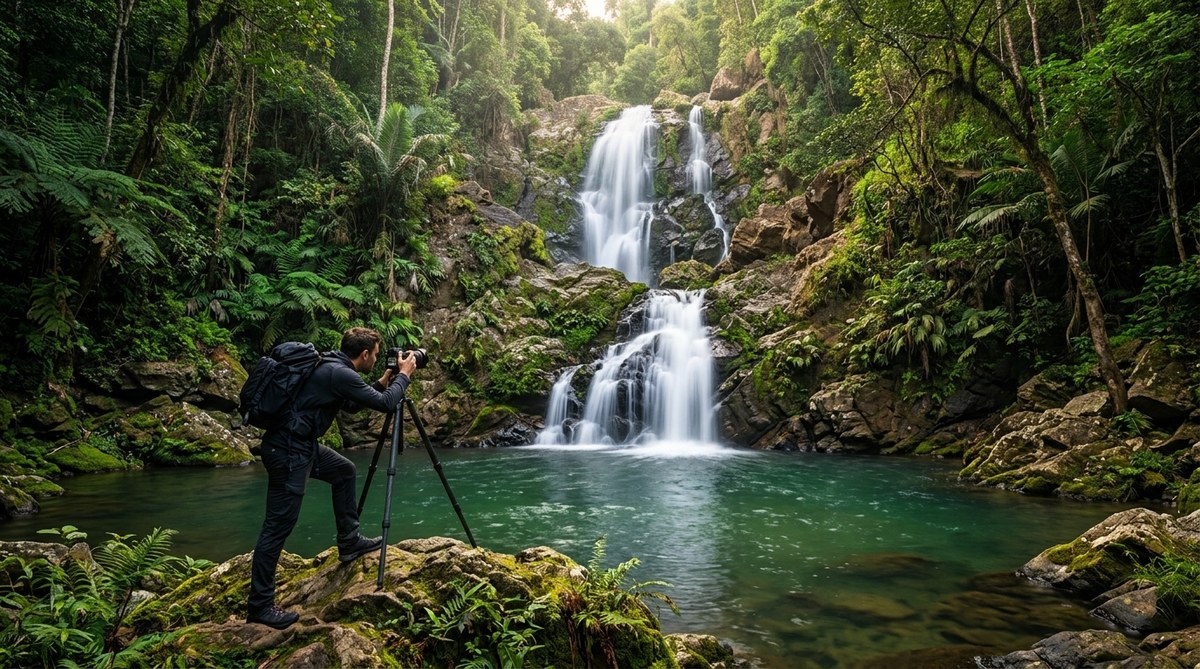
You are standing in a cool, green ravine. The air smells of wet earth and moss. A curtain of water drops fifty feet into a pool the color of jade. There is no one else around. This is the moment you came for. Capturing that feeling in a photograph takes more than luck. It takes preparation, patience, and a few insider tricks. Whether you are planning a trip to Southeast Asia, the Himalayas, or the islands of Indonesia, these seven secrets will help you bring home images that stand out.
The best shots of hidden waterfalls in Asia come from a mix of smart planning and creative technique. Use a polarizing filter to cut glare, shoot during the golden hour for warm light, and include a human element for scale. Scout locations via local guides and satellite maps. Always protect your gear from spray. These seven secrets will transform your waterfall photography in 2026.
Know the Season Before You Book
Rainfall patterns across Asia vary wildly. A waterfall that thunders in July might be a sad trickle by December. For lush, powerful flows, plan your trip during the wet season. In Thailand, Laos, and Vietnam, that usually means May through October. For Indonesia and the Philippines, the monsoon runs from November to March.
But wet season brings challenges. Trails get slippery. Light can be flat under heavy cloud cover. You want a balance. Aim for the shoulder months, when the rains are still feeding the falls but the skies offer breaks of sun. In Japan, late June through July is prime for mossy waterfall hikes. In China’s Jiuzhaigou Valley, autumn brings stable weather and vibrant fall colors behind the cascades.
Check local weather patterns for 2026. El Niño years can shift monsoon timing. Use apps like Windy or Zoom Earth to track cloud cover two weeks out. Your goal is to arrive when the water is high and the light is promising.
Scout with Satellite and Local Eyes
Hidden waterfalls are hidden for a reason. They are not on the main tourist map. To find them, you need two tools: satellite imagery and a local contact.
Start on Google Earth or AllTrails. Look for thin blue lines running through steep terrain. Zoom in. If you see a break in the tree line or a white patch near a river bend, that is a potential waterfall. Cross-reference with Instagram geotags or Flickr groups focused on hidden waterfalls Asia photography. Many photographers share location pins in private forums.
Once you have a candidate, find a local guide. A guide knows the trail conditions, the best time of day for light, and whether the waterfall dries up in certain months. Hire someone from a nearby village. They will often know three or four falls that are not in any guidebook. Treat them well, and they might show you a spot no photographer has ever shot.
Protect Your Gear from Water and Humidity
Waterfall spray is relentless. A single gust of wind can coat your lens in droplets. Humidity can fog your glass and creep into your camera body. In 2026, there is no excuse for losing a shot to wet gear.
Use a rain cover or a simple plastic bag with a hole cut for the lens. Keep a microfiber cloth in your pocket. Wipe the front element between every shot. For long exposures, use a lens hood to block stray spray. A UV filter is cheap insurance. If a drop lands on it, you can wipe it without damaging the lens coating.
Store your camera in a sealed dry bag when hiking between locations. Silica gel packets inside your bag help absorb moisture. If you are shooting in high humidity, let your camera acclimate slowly. Pull it out of the bag ten minutes before you shoot. That prevents condensation from forming on the sensor.
Here is a quick table of common mistakes and how to avoid them:
| Mistake | Why It Hurts Your Shot | How to Fix It |
|---|---|---|
| Shooting at midday | Harsh light creates high contrast and blown highlights | Arrive at golden hour or use a diffuser |
| No polarizer | Glare on wet rocks and water surface hides detail | Attach a circular polarizing filter |
| Ignoring the foreground | Image feels flat without depth | Add a rock, flower, or person in the foreground |
| Wrong shutter speed | Water looks either frozen or muddy | Use 1/2 to 2 seconds for silky motion |
| Not scouting first | Poor composition and wasted time | Visit the location at least a day before |
Master the Silky Water Look
The classic waterfall shot shows water flowing like soft cotton. That effect comes from a slow shutter speed. You need a tripod. Handheld shots at slow speeds will be blurry.
Set your camera to manual mode. Start with ISO 100. Choose an aperture between f/11 and f/16 for good depth of field. Then set your shutter speed to 1/2 second. Take a test shot. If the water looks too frozen, slow the shutter to 1 second, then 2 seconds. If the water is overexposed (too bright), use a neutral density filter. A 3-stop or 6-stop ND filter will let you drag the shutter even in bright conditions.
Check your histogram. You want the highlights (the white water) to be just below the right edge. If they are climbing the wall, you are losing detail. Add more ND filtration or close your aperture further.
For a different look, try a faster shutter speed, around 1/250th of a second. This freezes individual droplets and captures the raw power of the water. Both styles work. Choose based on the mood you want.
Include a Person for Scale
A waterfall can look small in a photo. Without a reference, the viewer has no idea if it is ten feet tall or a hundred. Adding a person solves that problem instantly.
Ask a friend or your guide to stand near the base of the falls. Have them face away from the camera or look up at the water. Their silhouette gives the image a sense of size and wonder. It also adds a human story. The viewer imagines themselves standing there.
Dress the person in a color that contrasts with the scene. A red jacket against green moss works well. Avoid white, which blends into the water. For a more natural look, have them wear neutral earth tones.
This technique is especially effective for hidden waterfalls Asia photography because many of these locations are remote. The person in the frame reinforces the idea of discovery.
Use the Surrounding Environment
A waterfall is the star, but the setting is the supporting cast. Look for elements that add context. Mossy rocks, twisted tree roots, ferns, and mist all tell the story of a living landscape.
Compose your shot so the waterfall is not dead center. Use the rule of thirds. Place the falls on one side and let the foreground lead the eye toward it. A stream of water flowing over rocks in the bottom corner can guide the viewer into the frame.
Look for natural frames. A tree branch arching over the top of the falls, a cave opening beside the cascade, or a curtain of vines all add depth. Walk around the pool. Get low. Shoot from behind a rock. Change your angle until the scene feels balanced.
If the light is soft and even, try a vertical orientation. Vertical shots emphasize the height of the waterfall and work well for social media and magazine layouts.
Edit with Restraint
Post-processing can make a good image great, but it can also ruin it. The goal is to enhance what you saw, not to invent a new reality.
Start with basic adjustments: exposure, contrast, white balance. Waterfalls in shaded ravines often have a blue or green color cast. Warm up the white balance slightly to make the water look more natural. Boost the clarity slider a little to bring out texture in the rocks. Do not overdo it. Too much clarity creates halos around edges.
Use a graduated filter to darken the sky if it is too bright. Use a radial filter to brighten the waterfall itself. This draws the eye to the main subject.
Avoid oversaturating the greens. Moss and foliage can look fake if you push the vibrance too high. Instead, use the HSL panel to adjust specific colors. Lower the luminance of the greens to make them richer without turning them neon.
For black and white conversions, look for high contrast scenes. A dark cave with a bright waterfall works beautifully in monochrome.
“The best waterfall photos are the ones that make you feel the cool mist on your face. Do not chase perfection. Chase the feeling.”
Mira Chen, landscape photographer based in Yunnan, China
Plan Your Trip for 2026
The year 2026 offers some excellent opportunities for waterfall photography. Check the lunar calendar. A full moon rising over a waterfall is a rare and magical shot. Use an app like PhotoPills to predict the moon’s position relative to your location.
Consider visiting lesser known regions. The waterfalls of Arunachal Pradesh in India, the remote cascades of Sulawesi in Indonesia, and the hidden falls of northern Laos are still under photographed. Getting there takes effort, but the reward is a portfolio of images that no one else has.
For more ideas on composing these landscapes, read our guide on 7 composition tips for stunning wide-angle landscape shots in Asia. It pairs well with the techniques here.
Your Next Step
The difference between a snapshot and a stunning photograph is often just one small change. A polarizer filter. A slower shutter. A guide who knows the secret trail. Pick one of these seven secrets and apply it on your next outing. Then try another. Over time, your hidden waterfalls Asia photography will improve dramatically.
Pack your rain cover. Charge your batteries. The waterfalls are waiting for you in 2026.