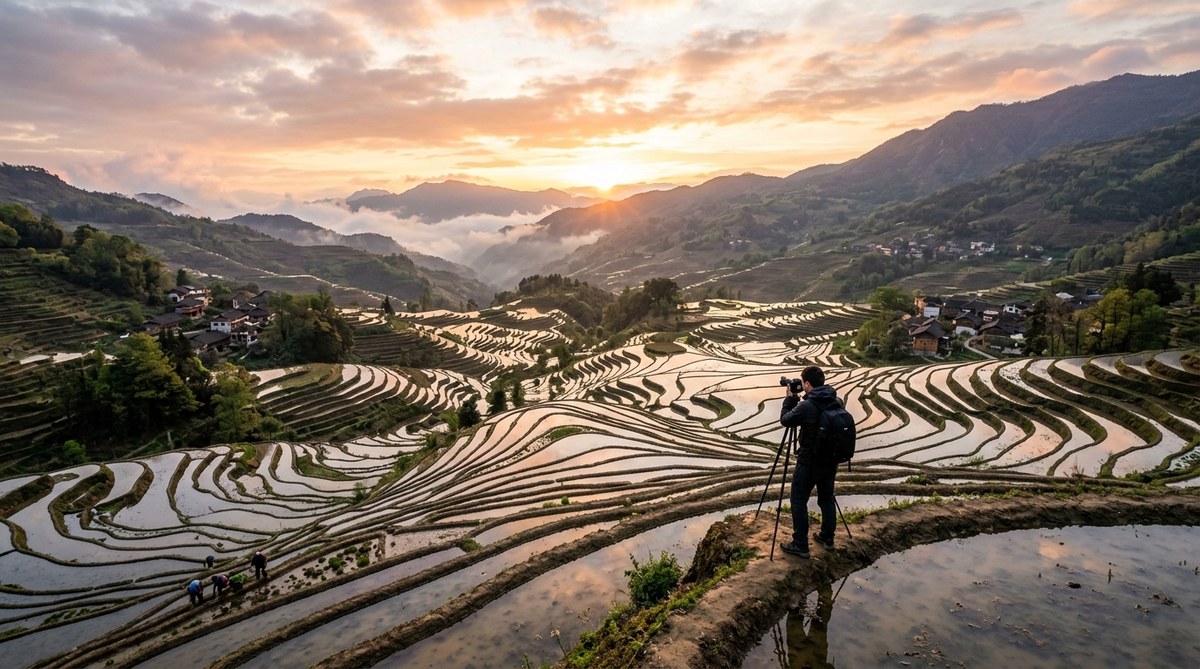
The rice terraces of Yunnan are one of Asia’s most photographed landscapes. For good reason. These ancient agricultural steps curve across mountainsides like living sculptures. Light shifts across them by the minute. Water reflects the sky in ways that feel almost painted. For any travel photographer, this place belongs on your short list. The scale alone can stop you in your tracks. But capturing that feeling in a photograph takes more than just showing up. It takes timing, technique, and a little local knowledge.
Yunnan rice terraces photography rewards those who plan around the growing season and the light. The best shots come during sunrise and sunset when water mirrors the sky. Visit between November and April for flooded terraces. Use a telephoto lens for compression and a wide lens for scale. Avoid midday harsh light. Shoot from multiple vantage points to find your unique frame.
Why Yunnan Rice Terraces Stand Apart
There are rice terraces across Asia. You have seen them in the Philippines, in Bali, in Vietnam. But Yunnan offers something different. The sheer elevation changes here create dramatic depth. Terraces drop hundreds of feet in a single frame. The Yuanyang region alone has layers that seem to fold into infinity. When the water catches the morning light, the whole mountain glows.
The ethnic minority communities add another layer of visual interest. Hani and Yi villages sit among the terraces. Traditional clothing, daily farming routines, and morning cooking smoke all give you human elements to anchor your landscapes. This is not a sterile natural wonder. It is a living, working cultural landscape.
For photographers focused on golden hour landscape photography in Asia, Yunnan provides some of the longest and most dramatic golden hours you will find anywhere. The mountain terrain extends twilight. Colors linger.
The Best Seasons for Yunnan Rice Terraces Photography
Timing is everything here. The terraces look completely different depending on the month. Here is a breakdown of what to expect.
- November to April (Flooded Season): This is the prime window. Farmers flood the terraces after the harvest. Water fills every step. The reflections are at their best. Sunrise and sunset turn the paddies into mirrors of orange and pink.
- May to September (Green Season): Rice grows tall and the terraces turn lush green. The textures change. You lose the mirror effect but gain rich agricultural patterns. This period overlaps with monsoon season, so expect clouds and rain.
- Late September to October (Harvest): The rice turns gold. The terraces become warm and earthy. You can photograph harvest activity. Light is softer as autumn settles in.
For the classic Yunnan rice terraces photography that you see in competitions and publications, plan your trip between December and March. The water is clean and still. The skies are clearer. The temperatures are cool but manageable.
Top Locations for Shooting the Terraces
Not all terrace sites are equal. Some are heavily visited. Others require a short hike but reward you with solitude.
Yuanyang Rice Terraces
This is the crown jewel. Located in southern Yunnan, the Yuanyang terraces spread across several viewing platforms. Duoyishu is the spot for sunrise. The clouds often settle in the valley below, creating a sea of mist with terraces emerging above it. Laohuzui (Tiger Mouth) offers a wider panorama and is famous for sunset. Bada gives you a more intimate view with villages in the frame.
Arrive before dawn. The platforms fill with photographers during peak season. Tripod space is limited. Bring a headlamp for the walk in the dark.
Longji Rice Terraces
Also known as the Dragon’s Backbone, these terraces sit near Guilin in northern Guangxi. They are technically outside Yunnan province but often grouped into Yunnan photography itineraries. The terraces here are older and the curves are more dramatic. Ping An village is the main hub. The view from the top of the Seven Stars伴 Moon platform is stunning.
For capturing vibrant mountain landscapes in remote regions, Longji offers excellent hiking routes that take you away from the crowds.
Gear Suggestions for Yunnan Terrace Photography
You do not need the most expensive kit. But a few specific tools will help you nail the shot.
| Gear Item | Why It Matters | Common Mistake |
|---|---|---|
| Tripod | Essential for sharp sunrise and sunset shots | Using a cheap tripod that wobbles in wind |
| Telephoto lens (70-200mm or longer) | Compresses layers and isolates patterns | Relying only on wide shots |
| Wide-angle lens (16-35mm) | Captures the full scale of the terraces | Forgetting to include a foreground element |
| Polarizing filter | Reduces glare on water and boosts color saturation | Over-rotating and making water look unnatural |
| Graduated ND filter | Balances bright sky with darker terraces | Using a regular ND when only one stop is needed |
| Remote shutter | Prevents camera shake during long exposures | Touching the camera during a bulb exposure |
If you are planning a larger Asia trip and wondering what else to carry, check out this guide on choosing camera gear for Asian landscapes. It covers the full range of essentials.
Composition Techniques That Work
The terraces can overwhelm you. There is so much to see that your first frames often end up messy. Focus on these principles instead.
Look for leading lines. The edges of the terraces create natural curves. Use them to guide the eye from the foreground toward the middle distance. A single curved terrace line running diagonally is stronger than a dozen random lines.
Shoot from a high vantage point. The best compositions come from above. Walk the ridges. Find a spot where four or five layers of terraces stack on top of each other. Compression from a telephoto lens will make those layers feel stacked like a staircase.
Include a human element. A farmer walking along a terrace edge, a child carrying water, or a villager in traditional dress. These figures add scale and story. Wait for them. Do not stage them. Authenticity matters.
Use the water as a mirror. When the water is still, the sky reflects perfectly. Place the horizon line low in the frame to emphasize the reflection. A perfect reflection of a colorful sunrise doubles the visual impact of your image.
For more on reflection techniques, see this guide on capturing the perfect reflection shot in Asian lakes. The principles transfer directly to flooded terraces.
A Step by Step Shooting Workflow
When you arrive at your chosen spot, follow this process to maximize your chances of a great shot.
- Scout the location the afternoon before. Walk the viewing platforms and ridges. Note where the sun will rise or set. Mark two or three potential compositions.
- Set up your tripod 45 minutes before sunrise. Lock in your composition. Level the horizon. Attach your remote shutter.
- Take a test shot at your base exposure. Check focus on the middle distance. Adjust your aperture to f/8 or f/11 for sharpness across the frame.
- Bracket your exposures. Take three frames at 0, +1, and -1 stops. This gives you options for blending later if the dynamic range is too high.
- Shoot through the changing light. Keep shooting as the light evolves. The best color often comes 10 to 20 minutes after the sun breaks the horizon.
- Review and recompose. After the main show, look at your images. If something feels off, adjust your position for the next morning.
For sunrise and sunset specifically, this guide on capturing dramatic Asian sunrise and sunset landscapes offers additional timing and metering tips that apply directly to Yunnan.
Expert Advice from a Long Time Yunnan Photographer
“The number one mistake I see photographers make in Yuanyang is leaving after the first sunrise. They get one good frame and pack up. But the light changes here every single morning. I have shot the same spot for five days in a row and gotten five completely different images. Fog, clouds, clear skies, rainbows. You never know what you will get unless you stay. Also, talk to the local farmers. They know where the best light falls in each season. A simple conversation can save you hours of guessing.”
That advice came from a photographer who has been shooting the terraces for over a decade. The lesson is simple. Patience and local connection matter more than any gear upgrade.
Common Mistakes and How to Fix Them
Even experienced photographers slip up in Yunnan. The conditions are tricky. Here is a table of the most frequent errors and their solutions.
| Mistake | Why It Happens | The Fix |
|---|---|---|
| Blurry long exposures | Wind shakes the tripod | Hang your bag from the tripod hook for stability |
| Overexposed sky | Bright sky tricks the meter | Use a graduated ND filter or bracket exposures |
| Flat colors | Midday light washes everything out | Shoot only during golden hour or blue hour |
| Empty foreground | Wide shot captures too much empty space | Include a rock, plant, or terrace edge in the foreground |
| Distorted horizon | Wide angle lens tilts on uneven ground | Use the leveling bubble on your tripod head |
| Too much clutter | Trying to include everything | Zoom in and isolate one section of the terraces |
Editing Your Yunnan Terrace Photos
Post processing matters for this landscape. The dynamic range between bright sky and dark reflection is wide. Start with a basic global adjustment. Raise the shadows to reveal detail in the water. Drop the highlights to keep texture in the clouds. Increase clarity slightly to bring out the lines in the terraces. Add a touch of warmth to the highlights if you shot during golden hour.
For color grading, lean into the natural palette. Greens and blues during the growing season. Golds and warm oranges during harvest. Deep blues and soft pinks for flooded season reflections. Do not oversaturate. The terraces are already colorful. Your job is to enhance, not invent.
Local adjustments work well here. Use a radial filter to brighten a village or a farmer in the frame. Use a linear gradient to darken the edges and pull attention inward. This guide on mastering Asian landscape photography edits covers these techniques in more detail.
Bringing Your Best Work Home
Yunnan rice terraces photography is about patience and presence. The landscape does the heavy lifting. You just have to be there at the right time with the right approach. Plan your trip around the flooded season. Stay for multiple mornings. Talk to the locals. Shoot wide for scale and long for compression. Keep your gear stable and your compositions clean.
The best part? No two trips are the same. The light shifts. The water level changes. The farmers move through their daily routines. You could visit ten times and come home with ten completely different portfolios. That is the magic of this place.
So pack your tripod. Book that flight. Wake up before dawn. The terraces are waiting.