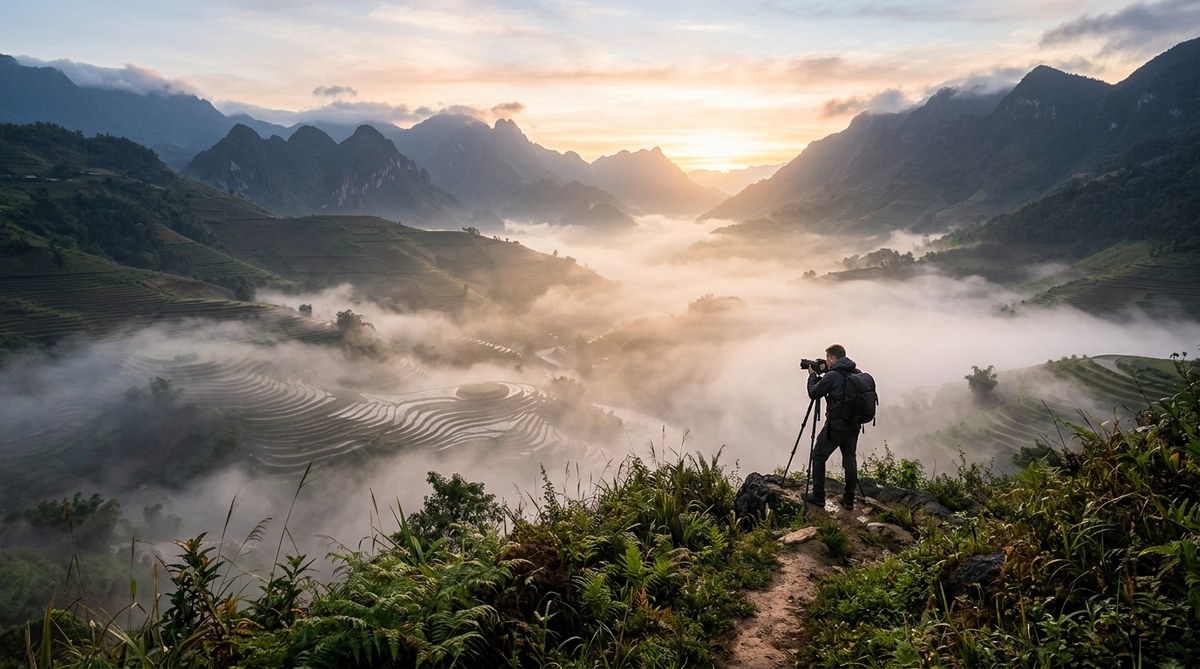
The first light cracks the horizon over a sea of clouds. Below you, rice terraces spill down the mountain like liquid silver. A fishing boat glides across a mirror lake, cutting through a blanket of mist that clings to the water. This is Vietnam at dawn. And if you know where to stand, these moments belong only to you.
Most photographers rush to Sapa or Ha Long Bay. Those places are beautiful. But they are also crowded. The real magic happens in the lesser known corners, where the fog rolls in thick and the tourists stay away. I have spent years tracking down these hidden frames. Here are five secret spots for misty morning landscape photography in Vietnam that will transform your portfolio.
Vietnam’s misty morning landscapes are best captured far from the tourist trail. Focus on five offbeat locations Ta Xua, Pu Luong, Hoang Su Phi, Mang Den, and Van Ho. Arrive before sunrise during the cool season (November to March). Use a telephoto lens for compressed layers and a tripod for long exposures. Fog peaks between 5:30 and 7:00 AM. Local guides are essential for accessing the most photogenic vantage points.
Ta Xua Peak: The Cloud Hunting Capital
Ta Xua sits in Bac Yen district, Son La province. Locals call it the “cloud hunting” capital of northern Vietnam. The peak rises to 2,865 meters, and its most famous feature is the Dinosaur Spine ridge a narrow trail of jagged rock that cuts through a sea of clouds.
The secret is timing. Mist forms year round, but the best conditions happen from October to December. Arrive at the summit by 5:00 AM. You will watch the valley below fill with a soft white blanket that stretches to the horizon. The sun rises behind the clouds, casting a warm pink glow that lasts about twenty minutes.
For composition, find a foreground element. A lone pine tree. A rock formation. A local farmer walking the ridge. Without a foreground, the cloud sea can look flat. A strong subject gives the viewer a sense of scale.
“The difference between a good shot and a great shot at Ta Xua is the foreground. Wait for a bird to cross the frame. Watch for a farmer with a conical hat. That human element turns a landscape into a story.” Local photographer Tran Van Hung, based in Son La.
Gear tip: A 70-200mm lens works well here. It compresses the layers of mist and mountain. Do not forget lens wipes. Condensation builds fast.
Pu Luong Nature Reserve: Mist in the Valley
Pu Luong is in Thanh Hoa province, about four hours from Hanoi. It remains quiet compared to Sapa. The reserve features hanging rice terraces, stilt villages, and deep valleys that trap morning fog like a bowl.
The best spot is the area around Kho Muong village. Walk out before dawn toward the bamboo bridge. The mist pools in the valley below the terraces. As the sun rises, light filters through the fog in shafts that move across the fields.
Photograph from an elevated position. The hill behind the homestay at Pu Luong Eco Garden offers a perfect vantage point. Shoot downward into the mist to capture the layered terraces fading into white.
For a deeper understanding of shooting in variable light, read our guide on mastering the art of golden hour landscape photography in Asia. The principles apply directly to Pu Luong’s shifting morning light.
Hoang Su Phi: Terraces Beyond the Map
Hoang Su Phi is a remote district in Ha Giang province. It sits near the Chinese border. The rice terraces here are older and steeper than those in Sapa. They climb hillsides at angles that feel impossible.
What makes Hoang Su Phi special for misty mornings is the elevation range. The terraces span from 800 to 1,500 meters. Fog settles at different levels depending on the temperature. Some mornings, the mist sits in the valley while the terraces above stay clear. Other mornings, the entire mountain disappears into soft white.
Best locations within Hoang Su Phi:
- Ban Phung village: Classic terraced curves with distant peaks
- Thong Nguyen village: Waterfalls feeding into the terraces
- Ho Thau village: Highest elevation, best for cloud inversions
- Nam Ty village: Least visited, requires a local guide
The cool season from September to November offers the most consistent morning fog. Rice harvest happens in late September and early October. At that time, the terraces turn gold and the mist adds a dreamlike quality.
Three steps for a successful morning shoot in Hoang Su Phi:
- Coordinate with a local guide the night before. Roads are unpaved and unmarked. Guides know which trails stay open after rain.
- Set your alarm for 4:15 AM. Travel to the vantage point requires 30 to 45 minutes of walking in darkness. Bring a headlamp with a red light mode to preserve night vision.
- Shoot from 5:30 AM to 7:00 AM. The mist is thickest in the first hour. As the sun climbs, the fog burns off from the bottom up. Capture both phases for variety.
A telephoto lens between 100mm and 400mm is ideal for isolating sections of the terraces against the mist. Wide shots are tempting, but the real magic is in the details.
Mang Den: The Pine Forest Cloud Factory
Mang Den is a small town in Kon Tum province, central Vietnam. It sits at 1,200 meters elevation. People call it the “second Da Lat” because of the pine forests and cool climate. But Mang Den is far less developed. The mist here behaves differently than in the north.
The fog rolls in from the surrounding forests rather than pooling in valleys. It moves through the pine trees like smoke, creating a sense of motion. You can capture this with longer exposures that blur the mist into soft streaks.
Three locations stand out:
- Dak Ke Lake: The water is still at dawn. Mist hovers inches above the surface. Pine trees reflect in the glassy water. Use a polarizer to cut glare and deepen the greens.
- Pa Sy Waterfall: A three tiered waterfall surrounded by old growth. Morning mist wraps around the cascades. Shoot at 1/4 second to blur the water while keeping the mist soft.
- Kon Bring Village: An ethnic minority village at the forest edge. Smoke from cooking fires mixes with the morning fog. The combination creates layered atmosphere.
Mang Den is accessible year round, but the best mist occurs from December to February. Temperatures drop to 10 degrees Celsius at dawn. Pack a thermal layer.
For more on shooting water features, check our guide on discovering the best techniques for capturing vibrant Asian waterfall landscapes. The waterfall methods pair well with Mang Den’s misty conditions.
Van Ho: Tea Plantations in the Clouds
Van Ho is in Son La province, near the border with Laos. It is a highland plateau covered in tea plantations. The mist here is consistent and predictable. Every morning from November through February, the tea fields disappear under a layer of fog that sits waist high.
You can walk through it. The tea bushes emerge from the white floor like green sculptures. This creates a unique opportunity for low angle photography. Get down to ground level. Shoot across the tea rows so the mist fills the background while the foreground leaves stay sharp.
Where to position yourself:
| Spot | Best Angle | Mist Behavior | Best Month |
|---|---|---|---|
| Tea hill near Chieng Xuan | Shooting downward from the ridge | Dense, sits low | December |
| Valley between Pa Khen and Hua Tat | Level with the mist layer | Wispy, moves fast | January |
| Long Luong mountain summit | Above the clouds | Cloud sea with peaks | November |
| Old tea processing station | Against the light | Backlit, glows | February |
The light at Van Ho is softer than in the northern highlands. The mist acts as a giant diffuser. You can shoot well past the first hour without harsh shadows. This gives you more time to compose.
Common mistakes and how to avoid them:
| Mistake | Why It Happens | The Fix |
|---|---|---|
| Overexposed sky | Camera meter reads the dark foreground | Use spot metering on the mist. Dial in +0.7 EV compensation. |
| Flat composition | No strong subject | Wait for a farmer, a buffalo, or a lone tree to break the fog. |
| Blurry images due to condensation | Lens fogs up in humid conditions | Keep the camera in a sealed bag until you are ready to shoot. Let it acclimate for 10 minutes. |
| Missed blue hour | Arriving too late | Check sunrise time the night before. Be in position 45 minutes before sunrise. |
When you return home, the editing stage matters just as much as the capture. The mist can look muddy if you push the contrast too hard. Learn how to process these files by reading our guide on mastering Asian landscape photography edits for stunning results. It covers how to preserve soft tonal transitions while adding clarity to your subject.
Putting These Spots Into Practice
Five locations. Five different types of mist. Each one demands a slightly different approach.
- Ta Xua is about the grand cloud sea. Bring a telephoto and a wide lens.
- Pu Luong rewards patience. The light shifts every few minutes.
- Hoang Su Phi requires a guide. The payoff is solitude and scale.
- Mang Den is for texture. The mist moves through the pine needles.
- Van Ho teaches you about low fog. Get your boots muddy and your knees dirty.
A good camera body matters, but do not obsess over gear. A mid range mirrorless camera with a 24-70mm and a 70-200mm covers every scenario here. A sturdy tripod is non negotiable. The wind picks up at these elevations, especially on ridges. A carbon fiber tripod with a hook for added weight helps in gusty conditions.
If you are still choosing equipment, our article on choosing the perfect camera gear for capturing Asia’s stunning landscapes will save you from buying the wrong gear.
The Morning Mist Is Waiting
Vietnam holds more misty mornings than any photographer can capture in a single trip. That is the beauty of it. Each return visit reveals something new. A different angle. A different light. A different layer of fog that you missed the first time.
Pack your bag. Set your alarm for an ungodly hour. Walk into the dark with your tripod over your shoulder. When the first glow hits the mist and the world goes quiet, you will remember why you fell in love with landscape photography in the first place.
The secret spots are out there. Go find them.