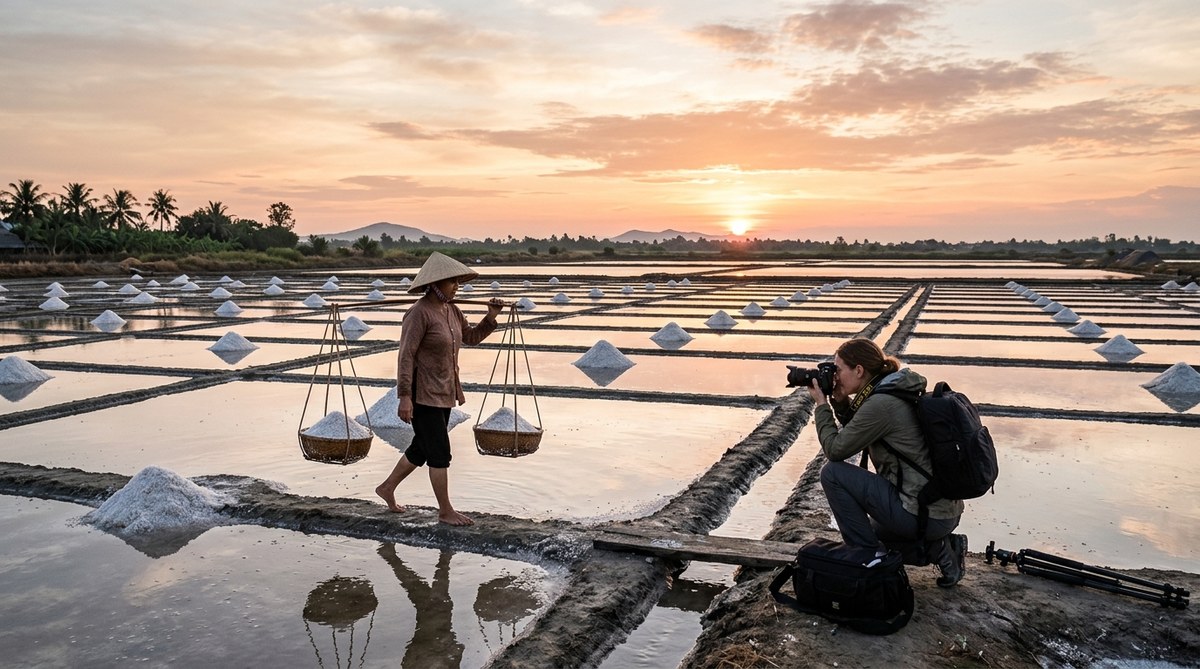
The first time you see the salt flats of the Mekong Delta, your brain might not believe your eyes. Endless checkerboards of white and silver stretch toward the horizon, broken only by the silhouette of a conical hat and a bamboo pole. It looks more like a frozen tundra in Canada than a tropical river delta in Vietnam. But this is the dry season in the far south, when farmers harvest sea salt from the earth under a relentless sun. For photographers, this landscape offers something rare: a chance to shoot a minimalist, abstract world that feels untouched by time.
The Mekong Delta salt flats offer a unique, off-the-beaten-path photography experience in Vietnam. The best time to visit is during the dry season from December to April. Focus on the provinces of Bac Lieu and Tra Vinh for the most photogenic fields. Shoot during golden hour for warm light, and use a polarizer to cut glare. Pack a wide-angle lens for landscapes and a telephoto for abstract patterns.
Why the Salt Flats Deserve a Spot on Your 2026 Itinerary
Vietnam has no shortage of iconic photo locations. Ha Long Bay, the terraced fields of Sapa, the neon glow of Ho Chi Minh City. But the salt flats are different. They are quiet. They are strange. And they are disappearing.
Salt production in the Mekong Delta is a centuries-old tradition. Families flood shallow fields with brackish water from the delta channels. Under the heat of the dry season, the water evaporates, leaving behind a crust of pure white salt. Workers rake it into rows, creating lines and textures that look like a minimalist painting. For a travel photographer, the visual payoff is huge. You get symmetry, reflection, and human scale all in one frame.
The year 2026 is a good time to go. Climate change and saltwater intrusion are pushing the industry to adapt. Some fields are being converted to shrimp farms. Others are shrinking. The window to capture this traditional way of life is narrowing.
Where to Find the Best Salt Flats
You won’t find these fields on a standard group tour. You need to head to specific provinces in the southern delta. Two areas stand out for photography.
Bac Lieu Province is the heart of the salt industry. The fields here are massive. You can drive along the coastal roads and see endless white squares stretching inland. The local salt cooperative near the town of Gia Rai is a good starting point. Arrive early, and you will see workers pushing salt into piles with wooden rakes.
Tra Vinh Province offers a different look. Here, the fields are smaller and more intimate. They are often bordered by palm trees and small canals. This gives you a chance to frame your shots with foreground elements. The coastal district of Duyen Hai is particularly good.
Ben Tre is a third option, though the fields are smaller. The advantage here is that you can combine a salt flat shoot with a boat trip through the famous coconut canals. It is a good backup if you are short on time.
Timing Your Trip for Light and Activity
The salt harvest runs from December through April. That is the dry season in southern Vietnam. Rain is rare, and the sun is intense. The harvest itself happens in cycles. Farmers flood the fields, wait for evaporation, and then rake the salt. You need to time your visit to catch the fields at their peak.
A numbered list for planning your shoot:
- Check the local harvest calendar. Contact a homestay or a local guide in Bac Lieu a week before you arrive. They can tell you if the fields are being raked or if they are still drying. A freshly raked field has the cleanest lines.
- Arrive at the fields by 5:00 AM. The golden hour light starts around 5:30 AM in the delta. You want to be set up and composing your shot as the sun breaks the horizon.
- Shoot again in the late afternoon. The light gets interesting again around 3:30 PM. The low angle creates long shadows across the salt rows. This is the best time for abstract, graphic compositions.
- Stay for sunset. The flats catch the last light of the day. The white surface reflects the orange and pink sky. It is a mirror that rivals any lake in Asia.
Camera Gear and Settings for the Salt Flats
The salt flats are a high-contrast environment. The white salt is bright. The sky is bright. Shadows from workers and equipment can be very dark. You need to manage exposure carefully.
A bulleted list of gear recommendations:
- Wide-angle lens (16-24mm). This is your workhorse for capturing the scale of the fields. Get low to the ground to emphasize the texture of the salt.
- Telephoto lens (70-200mm). Use this for compression. A worker 200 feet away will look like they are standing right next to the pile of salt behind them.
- Circular polarizer. This is the most important filter for this location. It cuts the glare off the wet salt and the water in the channels. It also saturates the blue sky.
- Tripod. You will need it for sharp shots in low light at sunrise and sunset. It also helps you nail precise compositions.
- Lens cloths and a protective bag. The salt dust is fine and sticky. It will get on your gear. Wipe your front element frequently.
A Markdown table for technique and common mistakes:
| Technique | Why It Works | Common Mistake |
|---|---|---|
| Shoot at f/8 to f/11 | Keeps the entire field sharp from front to back. | Shooting wide open at f/2.8, which blurs the foreground. |
| Use spot metering on the salt | Prevents the white from blowing out to pure white. | Using matrix metering, which averages the scene and overexposes the salt. |
| Include a human figure | Adds scale and a story to the image. | Shooting only empty landscapes, which can look flat and lifeless. |
| Bracket your exposures (3 shots) | Lets you blend highlights and shadows in post. | Relying on a single exposure that loses detail in the bright salt or dark shadows. |
Working with the People in the Fields
The salt farmers are the soul of this landscape. They work from dawn until mid-morning, then again in the late afternoon. They are used to visitors, but they are not a tourist attraction. Be respectful.
Ask permission before taking a close portrait. A smile and a wave usually work. If you speak a few words of Vietnamese, like “xin chao” (hello) and “cam on” (thank you), it goes a long way. Many farmers will pose for a moment, then go back to work. Do not disrupt their labor. They are on a tight schedule. The salt must be collected before the afternoon rains come.
“The best portraits I have taken in Vietnam were in the salt flats of Bac Lieu. I sat on the edge of a field for an hour, just watching. Eventually, a woman came over and offered me water. She did not speak English, but we shared that moment. I took one photo. It is the only one that matters.” — A photographer from the 2025 Nature’s Best Photography Asia workshop.
Composition Tips for Abstract and Landscape Shots
The salt flats are a playground for composition. The lines are geometric. The colors are minimal. You can lean into abstraction or go for a classic landscape.
For abstract shots: Fill the frame with patterns. Look for diagonal lines created by the rakes. Find a single pile of salt with a shadow that leads the eye. Use your telephoto lens to isolate a small section of the field. This is where you can create images that look like modern art.
For landscape shots: Use the rule of thirds. Place the horizon on the lower third to emphasize the sky. Place it on the upper third to emphasize the salt. Include a foreground element like a rake, a basket, or a worker. This gives the image depth.
For reflection shots: Wait for a calm morning when water is still on the fields. The salt flats become a perfect mirror. Use a slow shutter speed if there is a slight breeze to smooth the water. You can learn more about this technique in our guide on 5 techniques for capturing the perfect reflection shot in Asian lakes.
How to Get There and Where to Stay
The salt flats are not near a major international airport. You will fly into Ho Chi Minh City (Tan Son Nhat). From there, you have two options.
Option one: Rent a car and driver. This is the easiest. The drive to Bac Lieu takes about 5 hours on Highway 1. A driver for a week costs around $400 USD. It is worth the money. You can stop at any field that catches your eye.
Option two: Take a bus. Buses run from Ho Chi Minh City to Bac Lieu city. The trip takes 6 hours. Once there, you can hire a local motorbike driver for the day to take you to the fields. This is cheaper but less flexible.
For accommodation, stay in a simple hotel in Bac Lieu city or Gia Rai. There are also homestays near the coast. The food is excellent. Try the local seafood and the salted shrimp paste.
Combining the Salt Flats with Other Delta Locations
A trip to the salt flats can be part of a larger loop through the Mekong Delta. You can start in My Tho, visit the floating markets of Can Tho, and then head south to Bac Lieu. Finish in Tra Vinh before looping back to Ho Chi Minh City. This route takes 5 to 7 days.
If you want to focus on coastal photography, the nearby mangroves and shrimp farms offer a different aesthetic. Check out our guide on 6 essential techniques for capturing coastal landscapes in Vietnam for more ideas.
For those who love night photography, the salt flats are far from city lights. On a moonless night, the Milky Way is visible. The white salt reflects the stars. It is a surreal experience. Read our essential techniques for capturing stunning nightscape landscapes across Asia to prepare for that shoot.
Your 2026 Salt Flat Photography Checklist
Before you go, run through this list.
- Confirm the dry season harvest is active (January to March is the safest window).
- Book a local guide or driver who knows the field locations.
- Pack a polarizer and a sturdy tripod.
- Bring a rain cover for your bag. The delta weather can be unpredictable.
- Carry plenty of water and sun protection. The heat is intense.
- Learn the Vietnamese words for “salt” (muoi) and “field” (dong).
A Final Word on This Vanishing Landscape
The salt flats of the Mekong Delta are not just a photo opportunity. They are a window into a way of life that is slowly fading. Each year, fewer families work the fields. The younger generation moves to the cities. The saltwater intrusion that makes the harvest possible is also threatening the land itself.
When you stand on those white fields in 2026, you are witnessing something fragile. Treat it with care. Shoot with intention. And share those images so others can see this strange, beautiful corner of Vietnam before it changes forever.