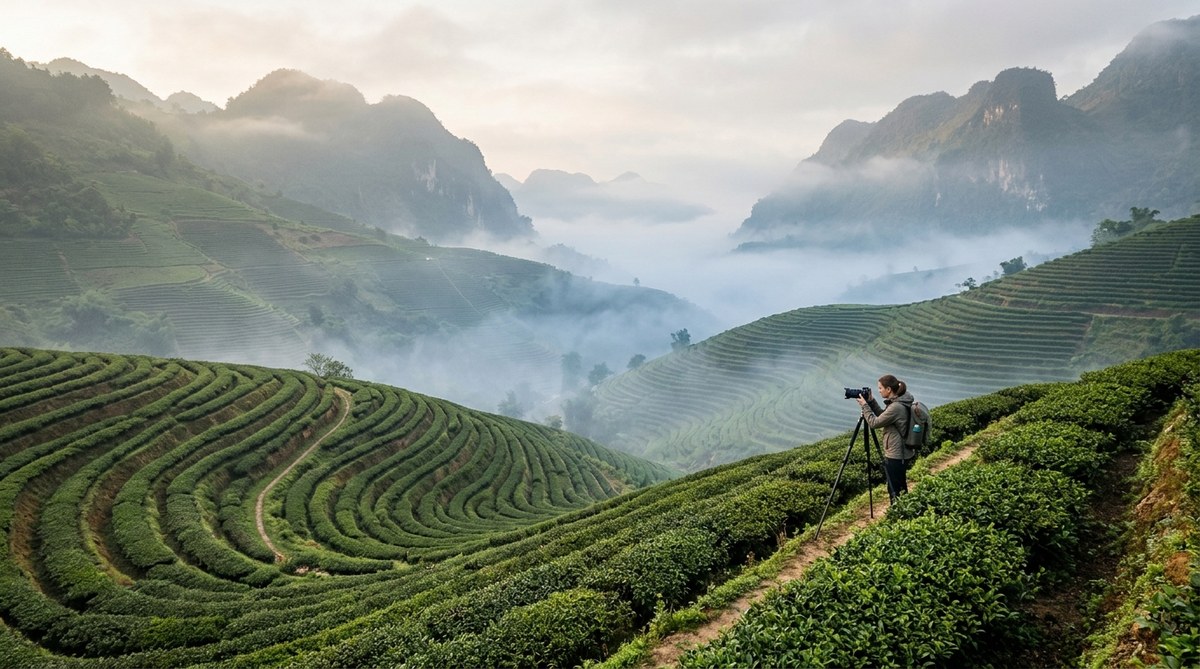
The first time I saw the tea terraces of Luang Prabang wrapped in morning mist, I forgot to press the shutter. That is rare for a working photographer. The hillside looked like a Chinese ink painting come to life, with rows of camellia sinensis cutting soft curves into the fog. In that moment I understood why this spot in northern Laos draws landscape shooters from around the world. The combination of ancient agricultural lines and unpredictable mountain weather creates a canvas that changes by the minute. But capturing that feeling in a frame takes more than luck. You need the right approach to timing, gear, and composition.
To photograph Luang Prabang tea terraces mist, arrive at the site by 5:30 AM during the cool dry season from November to February. Use a telephoto lens to compress the layered rows, set your aperture between f/8 and f/11 for depth, and underexpose by half a stop to keep the fog from washing out. Pack a rain sleeve and a tripod with spiked feet for the slippery clay paths.
Why the Mist Makes These Terraces Special
The tea fields outside Luang Prabang sit at roughly 800 meters elevation. That altitude, combined with the surrounding Mekong River valley, produces a specific microclimate. Warm, moist air rises from the river overnight and meets the cooler mountain slopes at dawn. The result is a blanket of fog that settles into the terrace bowls and spills over the ridges like slow water.
Unlike the rice terraces of the Philippines or Yunnan, these tea gardens are not flooded. The plants grow in dense, dark green rows that trace the contour of the hills. When mist rolls in, it fills the spaces between the rows and creates negative space. The contrast between the sharp lines of the tea bushes and the soft blur of the fog is what makes this location unique. You are not just photographing a landscape. You are photographing the relationship between structure and atmosphere.
The Best Time to Be on the Hill
Timing is everything here. You cannot just show up at noon and hope for fog. The mist typically forms between 5:00 AM and 7:00 AM, then burns off as the sun climbs higher. By 8:30 AM most of the magic is gone.
Here is a practical timeline that works for most photographers:
- 4:45 AM Leave your accommodation in Luang Prabang. The drive to the main terrace area takes about 45 minutes on a winding road. Hire a local driver the night before.
- 5:30 AM Arrive at the viewpoint while it is still dark. Set up your tripod and compose your first shot using a headlamp. The pre-dawn light will start showing the mist structure.
- 5:45 AM to 6:30 AM This is the blue hour window. The sky shifts from deep indigo to soft lavender. The mist glows with a cool blue tint. Shoot wide shots that show the scale of the terraces.
- 6:30 AM to 7:15 AM The golden light hits the top of the mist layer. This is when you want to switch to a telephoto lens and isolate sections of the terraces. The contrast between warm light and cool shadows peaks here.
- 7:15 AM to 8:00 AM The mist starts thinning. Use this time for detail shots of individual tea plants, workers arriving, or the texture of the leaves.
The dry season months from November to February offer the most consistent mist. January is the sweet spot. March gets hotter and the fog becomes less reliable. The rainy season from June to October brings heavy clouds but also frequent downpours that can ruin gear and make the paths dangerous.
Gear You Should Pack
The conditions on the terrace hillsides are humid, cool, and sometimes muddy. Choose gear that handles moisture and low light well.
- Camera body with good dynamic range. The mist creates a high contrast scene. You want a sensor that can hold detail in the bright fog and the dark foliage at the same time. Most modern full frame cameras work well. Crop sensors can manage if you shoot in raw and expose carefully.
- Tripod with spiked feet. The paths are clay. Standard rubber feet slip. Spikes dig into the dirt and keep your setup stable during the long exposures you will need in the pre-dawn light.
- Telephoto zoom lens (70-200mm or 100-400mm). This is the most important lens for this location. The mist compresses distance, and a telephoto lens lets you stack the rows of tea plants into layered bands. A wide angle is useful for the grand vista, but the telephoto is what creates the iconic look.
- Standard zoom (24-70mm). Use this for environmental shots that include the surrounding mountains or a human element for scale.
- Rain sleeve or weather sealed bag. The mist is essentially water. After 30 minutes your gear will be damp. A simple plastic rain sleeve over the camera body prevents moisture from seeping into the electronics.
- Circular polarizer. This filter cuts through the haze when the mist is thin and saturates the green of the tea leaves. Do not overuse it. A half rotation is usually enough.
- Remote shutter release. Even breathing on the camera at 1/15 of a second can introduce shake. A cable release or wireless trigger keeps things sharp.
For a deeper look at selecting the right tools for challenging environments, read our guide on choosing the perfect camera gear for capturing Asia’s stunning landscapes.
Camera Settings for Misty Conditions
Mist fools your camera’s light meter. The fog is bright, so the meter tries to underexpose the scene to compensate. That makes the tea plants look too dark and the mist look grey instead of white.
| Setting | Recommendation | Why It Works |
|---|---|---|
| Exposure compensation | -0.7 to -1.0 EV | Keeps the mist white without clipping highlights |
| Aperture | f/8 to f/11 | Balances depth of field with lens sharpness |
| ISO | 100 to 400 | Keeps noise low in the smooth mist areas |
| White balance | Daylight or 5500K | Preserves the cool blue of early morning mist |
| Focus mode | Manual, single point | Autofocus hunts in fog; manual gives you control |
Set your focus on a tea bush about one third of the way into the frame. That gives you a natural focal point while the mist blurs the background.
Composition Techniques for Layered Shots
The tea terraces are a study in repetition. The rows repeat across the hillside. Your job is to organize that repetition into a visual rhythm.
Use the mist as a natural gradient. The fog gets thicker as it moves down the valley. Position yourself so the foreground rows are sharp, the middle rows soften, and the far rows disappear into white. This creates a sense of depth that pulls the viewer into the frame.
Look for diagonal lines. The terraces are not perfectly horizontal. They curve along the hill. Find a spot where the rows cut diagonally across the frame. That adds energy to an otherwise calm scene.
Include a human element if possible. A tea picker in a conical hat, a bicycle parked on the path, or a farmer carrying a basket. The scale of the terraces is hard to read without a familiar object. One person in the frame tells the viewer that these rows are massive.
For more on working with natural light in similar conditions, check out our tutorial on mastering the art of golden hour landscape photography in Asia.
Common Mistakes and How to Avoid Them
I have watched photographers make the same errors at this location year after year. Here is a table of the most frequent mistakes and the fixes.
| Mistake | Why It Happens | The Fix |
|---|---|---|
| Overexposed mist | Camera meter reads the fog as middle grey | Dial in -0.7 EV compensation |
| Flat, boring composition | Shooting from the main viewpoint only | Walk 50 meters along the ridge for a new angle |
| Blurry images | Wind shakes the camera during long exposure | Use a sturdier tripod and a 2 second timer delay |
| Muddy, dull greens | Mist desaturates the foliage | Add a polarizer or boost vibrance in post |
| Missed the fog | Arrived after 7:30 AM | Stay overnight in a nearby guesthouse for the early start |
Post Processing for Misty Terraces
The raw files from the Luang Prabang terraces will look flat. That is normal. The mist scatters light and reduces contrast. You need to bring that contrast back in editing without making the image look artificial.
Start by setting the black point. Drag the blacks slider to the left until the darkest tea leaves hit a true dark green, but not pure black. Then lift the shadows slightly to reveal texture in the lower rows.
Use a graduated filter in Lightroom or Capture One to darken the top of the frame. The sky above the mist is often brighter than the terraces. Balancing that exposure keeps the viewer’s eye on the tea rows.
Add a small amount of clarity, around +10 to +15. Too much clarity creates halos around the mist. You want the fog to stay soft.
For a full walkthrough of editing landscapes from Asia, see our guide on mastering Asian landscape photography edits for stunning results.
“The tea terraces of Luang Prabang taught me that the best landscape photographs are not about the view. They are about the air between the viewer and the view. The mist is not an obstacle. It is the subject.” — Duangphathai S., landscape photographer based in Vientiane
How to Navigate the Site
The main access point is a village called Ban Phanom, about 30 kilometers southeast of Luang Prabang city. The road is paved but narrow. A tuk tuk or private car is the best option. Public songthaews run irregularly.
Once you arrive, you will see a small wooden sign marking the trailhead. The path is a single track that winds along the edge of the terraces. It is about a 15 minute walk to the primary viewpoint. Do not stop there. Continue another 10 minutes to the second ridge. That spot has a better angle for the layered mist shots.
The ground is uneven and slippery. Wear hiking boots with good grip. Bring water and a light jacket. The temperature at 6:00 AM in January is around 10 degrees Celsius (50 Fahrenheit). By 9:00 AM it warms up to 20 degrees Celsius (68 Fahrenheit).
A Final Word on Patience
The mist does not cooperate on a schedule. Some mornings you will get a thick, even blanket of fog that lasts for hours. Other mornings the mist burns off in 20 minutes. The difference between a good photo and a great one is often just waiting. Stay in position. Watch how the light changes. When the sun breaks through a gap in the fog and hits a single row of tea plants, that is your moment.
If you are planning a trip to Laos in 2026, put the Luang Prabang tea terraces on your itinerary. They are not as famous as the rice terraces of Southeast Asia, and that is exactly why they are worth photographing. Fewer crowds mean more room to move, more time to compose, and a better chance of capturing that quiet, misty atmosphere that makes this place feel like a secret.
For more locations like this, take a look at our list of 5 secret spots for misty morning landscape photography in Vietnam. The techniques overlap, and the results are just as rewarding.
Now get out there before the sun burns the fog away.