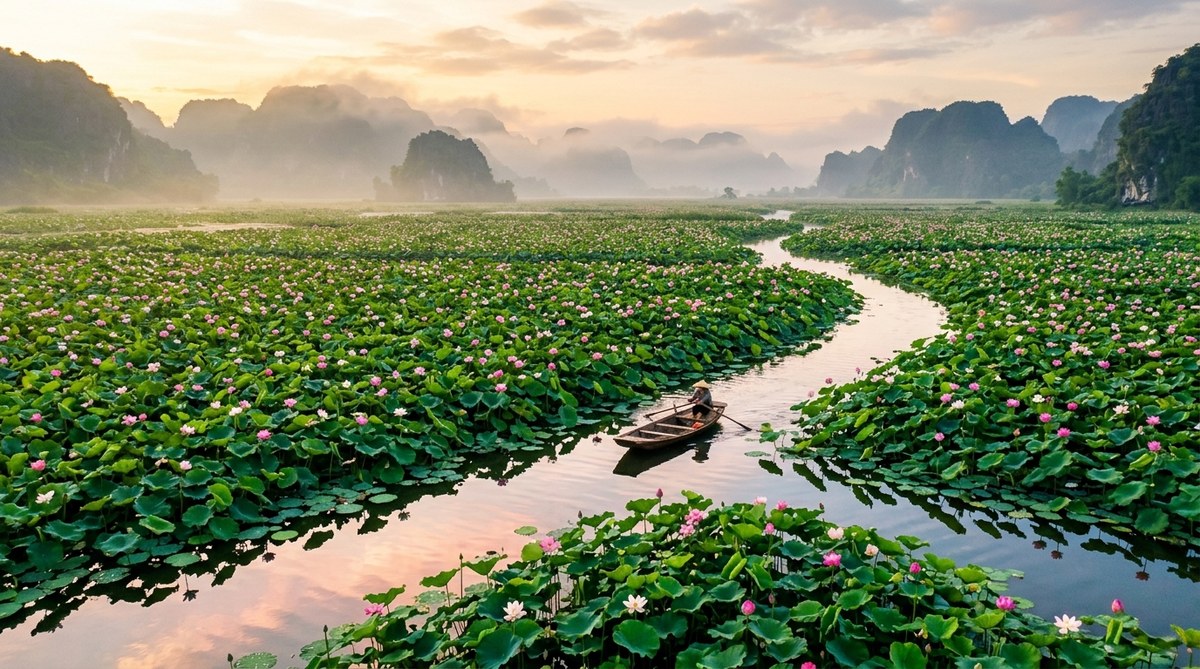
There is a reason the lotus flower holds such a sacred place in Vietnamese culture. It rises from the mud, untouched by the grime, and blooms into something impossibly pure. For an abstract landscape photographer, that journey from murky water to perfect petal is pure visual gold. The lotus fields of Vietnam are not just a subject. They are a living canvas of texture, color, and reflection that changes by the hour. In 2026, these flooded plains are becoming a top destination for photographers who want to move past the classic postcard shot and into something more painterly. The interplay of light on the water, the geometric repetition of stems, and the soft, diffused color of the petals create endless opportunities for abstract compositions. If you are looking to build a portfolio that stands out, this is the place to do it.
Vietnam’s lotus fields offer a rare mix of natural geometry and soft, organic form. For abstract landscape photography, the best results come from shooting during the golden hours of early morning, using a telephoto lens to isolate patterns, and embracing the mist and reflections that make the ponds look like an Impressionist painting. Plan your trip between May and July for peak bloom.
Why Lotus Fields Work for Abstract Work
Most landscape photographers chase grand vistas. They want the wide shot of the mountain range or the sweeping coastline. Lotus fields are the opposite. They force you to look at the small details. The way a single leaf curls at the edge. The reflection of a cloud in a puddle of dark water. The stems that create a grid of vertical lines against a soft pink background.
This is what makes the location so strong for abstract landscape photography. You do not need a wide-angle lens to capture the scene. In fact, a wide lens often makes the field look like a messy pond. The magic happens when you zoom in. A telephoto lens between 100mm and 400mm allows you to compress the scene. It flattens the depth, turning a chaotic field of plants into a two-dimensional pattern of color and line. That is the heart of abstraction.
The best part? You do not need perfect weather. Overcast skies are your friend here. They create a soft, even light that reduces harsh shadows and makes the pinks and greens pop. A light mist or fog adds another layer of mystery. The lotus field becomes a dreamscape.
Best Locations for Abstract Lotus Photography in 2026
Not all lotus fields are created equal. Some are too crowded with tourists. Others are maintained more for agriculture than aesthetics. Here are the locations that offer the best visual potential for abstract work this year.
Dong Thap Muoi (Plain of Reeds)
This is the crown jewel for abstract photographers. Located in the Mekong Delta, Dong Thap Muoi is a vast wetland where lotus grows wild. The scale here is enormous. You can find yourself alone in a sea of green and pink that stretches to the horizon. The water is dark, almost black, which creates incredible contrast against the bright petals. Head to the Tram Chim National Park area for the most protected and pristine sections.
Sen Village in Hanoi
If you are short on time and based in the north, Sen Village (also known as Charaih Sen) is a cultivated tourism area that still offers strong abstract potential. The fields are organized and accessible. You can walk along the dikes and get low to the water. The morning light here filters through the trees on the edge of the field, creating dappled patterns on the surface.
Van Giang Lotus Field (Hue)
Hue is known for its royal history, but the lotus fields on the outskirts are a quieter draw. Van Giang is a favorite among local photographers. The ponds here are smaller and more intimate. You can get very close to the flowers. The surrounding hills add a soft backdrop that helps isolate your subject.
A Practical Workflow for the Field
When you arrive at a lotus field, it is easy to feel overwhelmed. There is so much visual noise. Stems cross each other. Leaves overlap. Flowers face every direction. You need a system to find the abstract shot.
- Scan the edges first. The most interesting patterns often form where the lotus meets the bank. Look for reflections in the still water. A single flower with a perfect mirror image is a strong starting point.
- Use your lens hood and get low. The biggest enemy of abstract lotus photography is glare from the water. A lens hood helps. Getting your camera low to the water changes the angle of reflection and can eliminate distracting highlights.
- Focus on a single color palette. Decide if you are shooting for the pink of the petals, the green of the pads, or the dark brown of the stems. Isolate that color. Use a shallow depth of field (wide aperture like f/2.8 to f/4) to blur the rest.
- Look for leading lines. A curved stem that points toward a bloom. A row of pads that creates a diagonal line. Use these to guide the viewer’s eye through the frame.
- Shoot through the haze. If there is morning mist, do not wait for it to clear. Use it. The mist softens the background and turns the field into a layered scene of fading shapes.
Gear and Settings for the Abstract Lotus Shot
You do not need a bag full of exotic lenses, but some gear choices make the job easier. Here is a breakdown of what works and what does not.
| Technique | Recommended Gear | Mistake to Avoid |
|---|---|---|
| Isolating a single bloom | 70-200mm or 100-400mm zoom | Using a wide-angle lens (too much clutter) |
| Capturing reflections | Polarizing filter | Shooting at midday (harsh light kills reflections) |
| Soft, dreamy backgrounds | Aperture f/2.8 to f/4 | Stopping down to f/11 (background stays sharp) |
| Sharp focus on petals | Manual focus with focus peaking (mirrorless) | Relying on autofocus in dense stems (it hunts) |
| Low angle perspective | Flip-out screen or right-angle finder | Holding camera at eye level (misses the water line) |
Expert advice from a seasoned field photographer: “Do not chase the perfect flower. The most compelling abstract images often come from the broken stems, the floating petals, and the way the water ripples around a decaying leaf. Imperfection creates interest.”
The Three Best Times of Day
Light is everything. Lotus fields are sensitive to the angle of the sun because the water acts as a mirror. Here are the windows you should target.
- Sunrise (5:00 AM to 6:30 AM): This is the prime time. The sun is low, the mist is often present, and the lotus flowers are fully open. The light is warm and golden. The reflections are at their most vibrant.
- Golden hour before sunset (4:00 PM to 5:30 PM): The light gets warm again, but the flowers may start to close depending on the species. Use this time for silhouette work against the setting sun.
- Overcast midday: Do not pack up just because the sun is hidden. An overcast sky creates a giant softbox. The colors become more saturated, and the contrast drops, which is perfect for a minimalist, high-key abstract look.
Common Mistakes and How to Fix Them
Even experienced photographers fall into traps when shooting in the wetlands. Here are the most common issues and the simple fixes.
- Mistake: Overexposing the pink petals. Lotus petals are highly reflective. In bright sun, they blow out to white.
- Fix: Use exposure compensation at negative 0.7 to 1.0 stops. Check your histogram and make sure the highlights are not clipped.
- Mistake: Including too much sky. A wide, empty sky above a lotus field adds nothing to an abstract composition.
- Fix: Fill the frame with the water and the plants. Crop out the sky entirely unless it has dramatic clouds or color.
- Mistake: Shooting in the middle of the day in June. The heat is intense. The light is harsh. The flowers wilt.
- Fix: Shoot only in the early morning or late afternoon. Use the middle of the day to scout new locations or review your shots.
How to Edit for a Painterly Look
The raw file from a lotus field often looks flat. The water is murky, and the greens can look muddy. The goal in post-processing is to push the image toward a fine-art look. Start by adjusting the white balance. Lotus fields often have a green cast from the algae in the water. Warm it up slightly to bring out the pink.
Use the clarity slider carefully. Negative clarity (around -10 to -20) adds a soft, dreamy glow that mimics the look of a watercolor painting. Increase the vibrance, but be careful with saturation. You want the pinks to be rich, but not neon. Use a radial filter to darken the edges of the frame. This draws the eye into the center of the composition.
For a more advanced edit, try converting a few shots to black and white. The dark water and the bright petals create a high-contrast monochrome image that feels modern and graphic. This is a great way to add variety to your portfolio.
Planning Your Trip for 2026
The lotus blooming season in Vietnam runs from May to July. The absolute peak is usually in late May and early June. This is when the fields are at their most dense and vibrant. Book your travel for the last week of May. You will catch the peak bloom and the start of the rainy season. Do not let the rain scare you. A light rain creates ripples on the water that add texture to your abstract shots.
You will want to stay near the fields. In Dong Thap, look for a homestay in the Cao Lanh area. In Hanoi, Sen Village is a short drive from the city center. In Hue, you can stay in the city and take a morning taxi to Van Giang. Remember to bring insect repellent and waterproof boots. The paths can be slippery.
For more general advice on shooting in the region, check out our guide on mastering the art of golden hour landscape photography in Asia. If you are planning a broader trip, our tips on choosing the perfect camera gear for capturing Asia’s stunning landscapes will help you pack light without missing a shot.
Making the Lotus Field Your Studio
The most important shift you can make is to stop seeing the lotus field as a location and start seeing it as a studio. The water is your floor. The mist is your diffusion panel. The stems are your props. Every element is there for you to rearrange with your lens. Do not try to document the field. Try to paint with it.
For abstract landscape photography, the lotus fields of Vietnam offer a rare chance to create images that feel both ancient and modern. The shapes are organic, but the compositions can be as structured as a minimalist painting. Spend your first morning just walking the banks without your camera. Look for the patterns. Then, when you see the shot, take your time. Wait for the wind to die down. Wait for the light to shift. The best abstract images come from patience.
If you want to push your editing even further, our guide on mastering Asian landscape photography edits for stunning results covers advanced techniques like color grading and texture blending that work perfectly for lotus shots.
From the Mud to the Frame
The lotus is a symbol of resilience. It grows in the mud, but it reaches for the light. As a photographer, you are doing the same thing. You are wading through the water, dealing with the heat, the bugs, and the uncertain weather. But when you look at the back of your camera and see that perfect abstract pattern of pink and green, you know it was worth it.
Pack your gear, book that ticket for May 2026, and get ready to see the world through a different lens. The lotus fields are waiting.