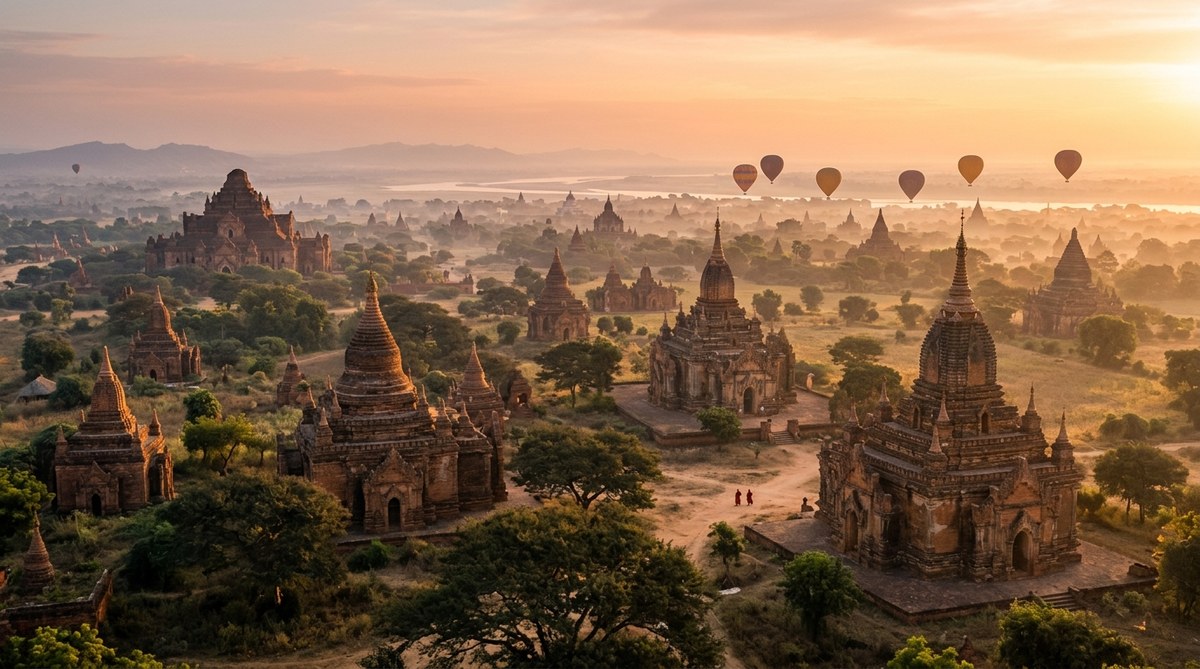
The sun cracks the horizon, and the first rays of pink and gold set the ancient temples of Bagan on fire. More than 2,000 Buddhist monuments scatter across a vast plain, each one catching the light in its own way. Hot air balloons drift silently overhead, and everything feels still. This is Bagan — a place that has drawn landscape photographers for decades. In 2026, with travel fully reopened and fewer crowds than pre pandemic years, it remains one of Asia’s most rewarding locations for anyone who loves to shoot wide, dramatic landscapes.
Bagan offers unmatched landscape photography opportunities thanks to its dense cluster of ancient temples, dramatic light, and flat terrain. The best results come during golden hour and the dry season (November to February). A telephoto lens compresses the temples, while a wide lens captures sweeping scenes. Use a tripod, shoot early, and respect the local culture to bring back portfolio worthy images.
Why Bagan Is a Landscape Photographer’s Paradise
Bagan sits on a dry, dusty plain along the Ayeyarwady River. Unlike many historic sites, the temples are not fenced off or hidden behind modern buildings. They rise directly from the earth, scattered in every direction. This layout gives you endless compositional possibilities.
The flat terrain is a huge advantage. You can shoot from ground level and still see dozens of spires in one frame. Climb a small temple, and you get a 360 degree view of the entire landscape. The hot air balloons that launch at sunrise add scale and a sense of wonder. For landscape photographers, Bagan is like a living diorama that changes with every minute of light.
If you are looking for inspiration, check out our guide on https://naturesbestphotography.asia/mastering-the-art-of-golden-hour-landscape-photography-in-asia/ to understand how the light in Bagan compares to other Asian landmarks.
Best Times for Bagan Landscape Photography
Timing is everything in Bagan. The dry season from November through February gives you the clearest skies and the most predictable sunrises and sunsets. Temperatures are comfortable, often in the 70s and 80s °F during the day. March to May brings heat and haze, which can create atmospheric shots but also limit visibility. The monsoon season (June to October) offers dramatic clouds and fewer tourists, but rain can cut a shoot short.
| Time of Day | Pros | Cons |
|---|---|---|
| Sunrise (5:30 – 7:00 AM) | Soft golden light, hot air balloons, low tourist density | Requires early wake up, cold mornings |
| Sunset (4:30 – 6:00 PM) | Warm tones, long shadows, dramatic sky | Crowded viewpoints, dust in the air |
| Blue hour (after sunset) | Magical twilight, silhouettes, minimal people | Rapid light change, need steady tripod |
| Midday (10 AM – 3 PM) | Harsh shadows, good for black and white | Flat colors, high contrast, avoid for color work |
For a deeper look at timing, read our article on
Essential Gear for Shooting Bagan
You do not need a truck full of gear, but a few key pieces will make a big difference.
- Camera: Any interchangeable lens camera works. A full frame body gives better dynamic range for high contrast scenes.
- Lenses: A wide angle (16-35mm) captures the vastness. A telephoto (70-200mm or longer) compresses distant temples into layered compositions. Do not skip the telephoto.
- Tripod: Mandatory for sunrise, sunset, and any low light work. A carbon fiber tripod is lighter to carry up temple steps.
- Filters: A polarizer cuts glare and deepens the blue sky. A graduated neutral density filter balances the bright sky with the darker ground.
- Extra batteries and memory cards: Dust and heat drain batteries faster than you expect.
For a full gear rundown, see
Composition Techniques to Frame the Temples
Bagan can overwhelm you with choices. Use these techniques to simplify your composition.
- Foreground interest: Include a single temple or a tree in the foreground to lead the eye into the scene.
- Leading lines: Dirt roads, the river, or rows of temples draw the viewer deeper into the frame.
- Framing: Shoot through a temple doorway or window to create a natural frame around the distant landscape.
- Rule of thirds: Place the horizon on the lower third to emphasize the sky, or on the upper third to highlight the temples.
- Silhouettes: Position a temple against the rising or setting sun for a strong graphic image.
A blockquote from a seasoned Bagan photographer:
“I always tell newcomers to spend at least two mornings at different viewpoints. The first morning you just scout. The second morning, you know where the balloons come from and how the light hits each temple. That is when the magic happens.” — James Chen, travel photographer
A Step by Step Plan for a Perfect Bagan Shoot
- Scout locations the day before. Use Google Maps or a guide to mark temples that allow climbing. Popular ones include Shwesandaw, Bu Phaya, and Pyathada.
- Wake up 90 minutes before sunrise. Arrive at your chosen spot at least 30 minutes before first light to set up.
- Check the weather and wind direction. Balloons take off only when winds are calm. If balloons fly, your photos will have incredible scale.
- Shoot wide first, then telephoto. Capture the whole scene, then zoom in on clusters or individual temples.
- Stay for 30 minutes after the main event. The light often changes again, and the crowds thin out.
- Repeat for sunset at a different location. Sunsets are warmer and more dramatic in Bagan.
Common Mistakes and How to Avoid Them
- Shooting only from the most popular viewpoints. The best images often come from lesser known temples or ground level perspectives.
- Forgetting to clean your sensor. Dust is everywhere in Bagan. Change lenses carefully.
- Using auto white balance. Set it to daylight or shade to preserve the warm tones.
- Ignoring the foreground. A blank patch of grass adds nothing. Find a rock, a weed, or a shadow to add depth.
- Overcooking the post processing. Bagan’s natural colors are already stunning. Save the HDR for other locations.
Post Processing Tips for Bagan Landscapes
Bagan images often need subtle tweaks rather than heavy edits. Boost clarity to bring out the texture of the brick and stucco. Increase warmth in the highlights to match the golden hour feel. Pull down the shadows slightly to keep the landscape moody. Avoid oversaturating the sky; the real Bagan sky is dusty and soft, not neon blue.
For advanced editing workflows, check out
Balancing Your Portfolio: More Than Just Temples
While temples dominate Bagan landscape photography, do not miss the human element. Monks walking between temples, local farmers, and the occasional horse cart add life to your frames. Combine your landscape shots with portraits or cultural scenes to tell a fuller story. Our guide on https://naturesbestphotography.asia/top-composition-strategies-for-capturing-authentic-asian-cultural-scenes/ can help you integrate people without distracting from the place.
Packing Your Bag and Hitting the Road
Bagan will reward you with images you will remember for a lifetime. The key is preparation, patience, and a willingness to wake up early. In 2026, the site is more accessible than ever, with improved roads and e ticketing. Grab your camera, book a few days, and let the light do the rest. Every sunrise is a new chance to capture Bagan landscape photography that feels timeless. Now go make those images.