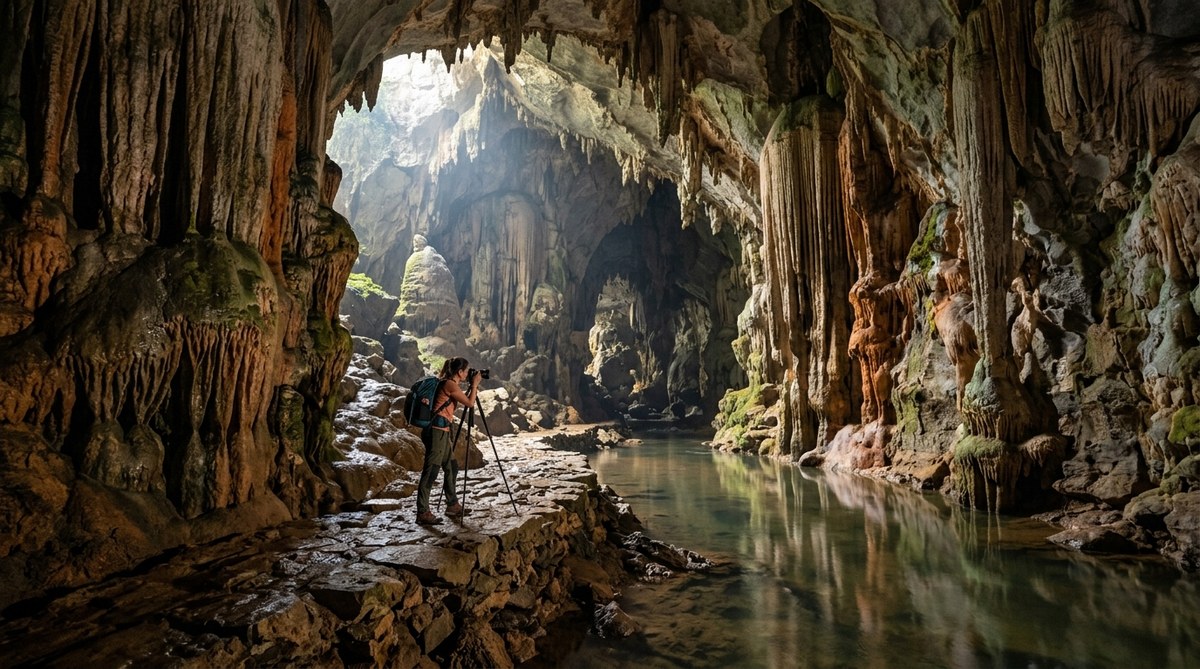
You are standing at the mouth of a cave in central Vietnam. The humidity hits your face like a warm blanket. Inside, a shaft of morning light cuts through the darkness, illuminating a pool of emerald water. A giant stalactite drips slowly. You are the only person here.
This is the reality of Vietnam hidden gem cave photography. While most travelers queue for hours at Son Doong or shuffle through crowded show caves, a quieter world waits for those who know where to look. These are the caves that don’t make the cover of National Geographic. They are better.
Vietnam’s lesser-known limestone caves offer photographers dramatic light beams, untouched formations, and zero crowds. Success requires planning around seasonal light angles, using a tripod for long exposures, carrying a wide-angle lens, and understanding local weather patterns. The payoff is portfolio-grade images without the permit hassles of famous caves.
Why These Caves Are a Photographer’s Dream
Limestone caves form over millions of years. Water carves through soluble rock, creating chambers, tunnels, and skylights. In Vietnam, the karst landscape stretches from Ha Long Bay down to Phong Nha. Most photographers chase the famous names. The hidden gems sit twenty minutes off the main road, often unmarked.
What makes them special for photography?
First, the light. Many lesser-visited caves have collapsed ceilings that let in shafts of sunlight. These beams are unpredictable. They shift with the season and time of day. When you catch one, the effect is pure magic. Dust motes dance in the light. Stalactites glow amber.
Second, the scale. Small caves mean you can fill the frame with detail. You are not trying to capture a cathedral-sized chamber that looks tiny in a photo. You are working with intimate spaces that reward close composition.
Third, the silence. No tour groups shuffling behind you. No guides rushing you along. You can set up a tripod, wait for the light, and take your time.
Where to Find Vietnam’s Hidden Cave Gems
These locations require a bit of effort. That is the point. The harder they are to reach, the fewer people you will see.
Hang Va and Hang En (Quang Binh Province)
These sit near the famous Son Doong but require a separate permit. Hang En is the third largest cave in the world. It has a massive opening that lets in morning light. The beach inside the cave is surreal. Hang Va is smaller but has extraordinary calcite formations that look like alien eggs.
Tu Lan Cave System (Quang Binh)
A series of interconnected caves that most tourists skip. You can visit multiple caves in one day. The pools inside are clear blue. The light beams in the dry season are spectacular.
Phong Nha Cave (the lesser-used entrance)
Phong Nha is famous, but most visitors take the boat tour through the main river entrance. The real magic is the dry entrance on the other side. You need a local guide. The formations here are untouched.
Dark Cave (Hang Toi)
This is a zipline and mud bath destination for tourists. Go early in the morning before the crowds arrive. The interior is dark and moody. Use a headlamp and long exposure to capture the textures.
Mo So Cave (Quang Binh)
A hidden gem even among locals. The cave has multiple chambers with skylights. The best time is between 9 AM and 11 AM when the sun is high enough to penetrate the openings.
Camera Gear for Cave Photography
You do not need a full studio setup. But you do need the right tools.
- A sturdy tripod. Carbon fiber is light enough to carry. Metal is more stable in water.
- A wide-angle lens. 16-35mm or similar. You need to capture the full scene.
- A fast prime lens. 24mm f/1.4 or 35mm f/1.8 for low light shots without a tripod.
- A remote shutter release. This prevents camera shake during long exposures.
- A headlamp with a red light mode. Red light preserves your night vision.
- Lens cloths. Caves are dusty and humid. You will clean your lens constantly.
For a deeper look at gear choices, read our guide on choosing the perfect camera gear for capturing Asia’s stunning landscapes.
How to Shoot in Low Light Conditions
Caves are dark. Your camera needs help. Here is a practical process.
- Set your camera to manual mode. Aperture priority will not work well in mixed lighting.
- Choose an aperture of f/8 to f/11 for maximum depth of field. You want the foreground and background sharp.
- Set your ISO to 100 to minimize noise. Caves are static. You have time.
- Use a shutter speed of 2 to 30 seconds depending on the light. Bracket your exposures by two stops.
- Focus manually using live view. Zoom in on a distant stalactite and adjust until sharp.
- Use a two-second delay on the shutter to avoid vibration from pressing the button.
For more on working with available light, check out mastering low light photography techniques in Asian landscapes.
Common Mistakes and How to Avoid Them
| Mistake | Why It Happens | Fix |
|---|---|---|
| Blurry images | Handholding in low light | Use a tripod and remote shutter |
| Overexposed light beams | Camera meter gets confused | Spot meter on the brightest area |
| Flat colors | Auto white balance | Set white balance to “daylight” or 5500K |
| Dust spots on sensor | Changing lenses in humid caves | Change lenses inside a plastic bag |
| Missed light beams | Wrong time of day | Scout the cave at different hours first |
The Best Time of Year for Cave Photography
Vietnam has two main seasons. The dry season runs from March to August. The wet season runs from September to February.
For cave photography, the dry season is better. Water levels are lower. You can access more chambers. The air is less humid, which means less fog on your lens.
The best months are April, May, and June. The sun is high enough to create dramatic light beams. The rains have not started yet. Morning temperatures are comfortable.
If you visit in the wet season, focus on caves with large entrances. The light is softer and more diffused. This works well for moody, atmospheric shots. Just watch for flash floods. Never enter a cave if heavy rain is forecast.
For more on planning your timing, see planning your golden hour shots across Southeast Asia by season.
Composition Tips for Cave Photography
Caves are three-dimensional spaces. Your camera flattens them. You need to create depth.
- Use leading lines. Stalactites, flowstone, and cave walls all point toward the center of the frame.
- Include a human figure for scale. Have your guide stand near a large formation. This instantly shows the size.
- Shoot from low angles. Place the camera near the ground. This makes the cave feel larger.
- Frame the light beam. Position yourself so the beam enters from the top third of the frame.
- Look for reflections. Pools of water in caves create perfect mirror images.
“The best cave photos are not about the cave itself. They are about the relationship between light and darkness. Wait for the light to tell the story.” — Nguyen Van Hai, cave guide and photographer based in Phong Nha.
Editing Your Cave Photos
Cave images often need post-processing. The raw files look flat and dark. That is normal.
Start with exposure. Bring up the shadows to reveal details in the dark areas. Be careful not to clip the highlights in the light beams.
Adjust white balance. Caves have mixed light sources. Your headlamp adds warm tones. The sky through the entrance adds cool tones. Find a balance that looks natural.
Increase contrast. Caves need punch. Use a contrast curve or the clarity slider. Do not overdo it. The goal is to mimic what your eyes saw, not to create a fantasy.
Remove dust spots. Use the spot healing tool. Check your image at 100% zoom.
For a full editing workflow, see mastering Asian landscape photography edits for stunning results.
Practical Tips for Your Trip
- Hire a local guide. They know the caves and the weather patterns. They also know which paths are safe after rain.
- Carry at least two liters of water. Cave hiking is strenuous. You will sweat.
- Wear sturdy shoes with good grip. Cave floors are slippery.
- Bring a dry bag for your camera. You will cross streams.
- Tell someone your plan. Cell service is unreliable in remote areas.
- Respect the formations. Do not touch stalactites. They grow one centimeter every hundred years.
Your Next Steps for Vietnam Hidden Gem Cave Photography
The best cave photos come from patience and preparation. You do not need a famous location. You need good light, a steady tripod, and the willingness to walk a little further than everyone else.
Start with Hang Va or the Tu Lan system. Go in April or May. Hire a guide from Phong Nha town. Pack your gear carefully. Wake up early.
The caves are waiting. They have been forming for millions of years. They will look exactly the same tomorrow as they did yesterday. The only thing that changes is the light. Be there when it is right.
For more on working with natural light in Asia, read essential tips for capturing stunning Asia travel photos during golden hour.
Now get out there and make some images that will last a lifetime. Your camera is packed. Your tripod is ready. The caves are calling.