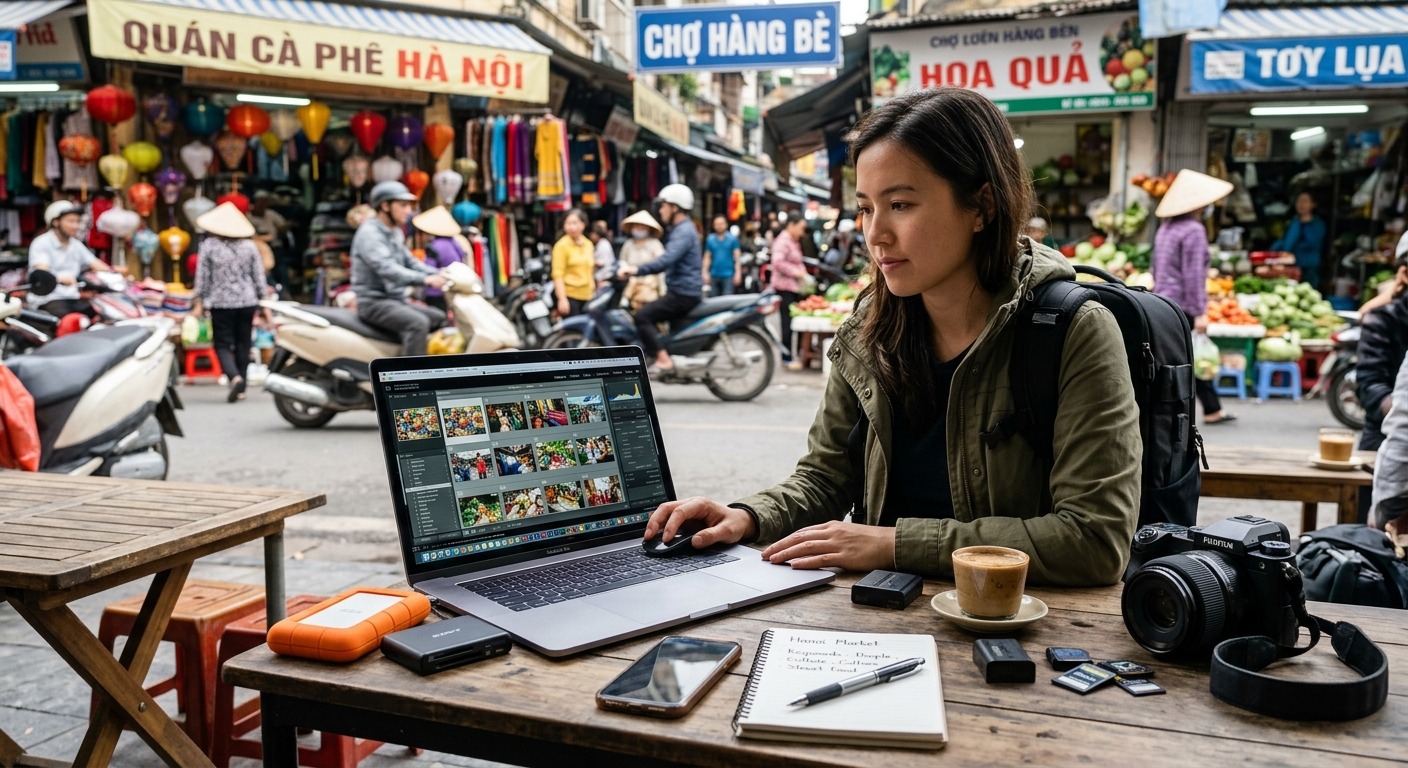
You land back at your guesthouse at 6 a.m., boots still muddy from a pre-dawn wade through the flooded terraces in Yuanyang. The cards in your vest pocket hold around 1,400 frames. You are exhausted, but there is a specific kind of anticipation that only photographers know: the shoot is over, but the real work is about to start. Getting those frames off your cards and in front of stock buyers requires a repeatable process. Done well, that process turns a memorable Asia trip into a library of images that earns long after you have moved on to the next destination.
Post-Trip Stock Prep: Three Things to Know
- Accurate, location-specific captions and layered keywords make Asian landscape and wildlife images far more searchable to stock buyers.
- Every major stock platform enforces strict pixel-dimension and colour space requirements, and a batch resizer removes the risk of manual export errors.
- Misty rice terraces, wildlife close-ups, and golden-hour mountain imagery consistently rank among the strongest-performing Asian nature categories on stock sites.
The First Hours Back: Culling Your Best Frames
After any extended Asia trip, you will likely return with several thousand raw files. Culling is the first task, and doing it while the trip is fresh in your mind matters enormously. That freshness becomes the raw material for your captions later.
Use a star or colour flag system in Lightroom or Capture One to separate definite selects from the maybes. Be ruthless. Stock agencies receive enormous volumes of images daily, and reviewers reject anything that misses a clear technical bar. If a shot carries even slight focus issues on the main subject, cut it now rather than spending editing time on something destined for rejection.
Pay close attention to frames where the lighting was genuinely exceptional. Golden-hour images from the Banaue rice terraces in the Philippines, or blue-hour mist lifting off the karst peaks around Guilin in China, carry an emotional weight that buyers notice immediately. Those are your A-list selects, and they deserve the bulk of your post-processing attention.
Once your selects are flagged, run basic editing passes. Correct exposure, check white balance for accuracy, and remove any sensor dust that could trigger a technical rejection. Natural colour rendition matters on stock platforms. Buyers of landscape and wildlife imagery typically need shots that read as real and unmanipulated rather than heavily processed composites.
Writing Captions That Tell the Whole Story
A caption is not an afterthought. It is the text a buyer reads when deciding whether your image fits their project. A strong caption includes the subject, a specific location, the time of day or season if relevant, and any contextual detail a buyer cannot see in the image itself.
“Mountain at sunset” is nearly worthless as a caption. “Terraced rice fields at sunset in Yuanyang County, Yunnan Province, China, during the winter flooding season” is immediately actionable. Buyers searching for editorial or commercial content about a specific region need that level of specificity to justify a license.
The IPTC defines the metadata fields that professional photographers embed into image files, covering caption, credit, copyright, and location data. Photographers who align their Lightroom exports with established photo metadata standards find that stock platforms read those embedded fields automatically on upload, cutting repetitive data entry significantly across large submission batches.
Write captions while the trip is fresh. You will remember that the egret you photographed was feeding at a freshwater marsh near Khao Sam Roi Yot in Thailand, not just “a bird in a wetland.” That precision transfers directly into searchability and, over time, into sales.
Location Keywords That Connect Buyers to Your Images
Keywords are how buyers find your images. A travel photographer returning from Asia needs to think in layers: continent, country, region, specific location, subject, mood, season, and colour. One-word or one-layer keyword sets miss large portions of potential buyers.
For an image of a proboscis monkey photographed in Bako National Park in Borneo, your keyword list might include Borneo, Malaysia, Sarawak, Bako National Park, proboscis monkey, wildlife, primate, rainforest, tropical, and endangered species. That layered approach captures buyers searching at every level of specificity, from broad travel content to niche conservation editorial.
Here is a practical framework for building keyword layers on Asian nature images:
- Geographic: continent, country, island or region (Bali, Kalimantan, Hokkaido), specific park or reserve name
- Subject: species name in both common and scientific form where applicable, habitat type, geological feature
- Mood and light: golden hour, misty, overcast, monsoon season, silhouette, backlit, long exposure
- Season and timing: wet season, spring rice planting, autumn foliage, migratory period, flowering season
- Colour: green, terracotta, grey, amber (design buyers frequently search by palette for layout work)
A few hundred images all needing this treatment sounds like an enormous task. Batch-copy your keyword set across images shot in the same location, then refine per subject. Lightroom’s sync metadata function and Capture One’s batch edit tools both handle this efficiently once your master keyword list is ready. Invest an hour building that list at the start of each trip’s post-processing phase and it pays back repeatedly.
Getting Your Files Ready for Stock Platforms
This is where photographers lose hours. Every major stock platform has its own requirements for file size, resolution, pixel dimensions, and colour space. Shutterstock, Adobe Stock, Getty Images, and Alamy each publish separate submission specifications that do not align with each other in every detail.
The standard minimum for most platforms sits at around 4 megapixels, but many prefer files of 15 megapixels or more for editorial and commercial licensing at print scale. Colour space must typically be sRGB rather than Adobe RGB, even though you likely shot and edited in Adobe RGB for a wider gamut. That means converting and exporting your files specifically for submission, not handing over master edits directly.
Manual Photoshop exports work, but they are slow when processing several hundred images across multiple platform specifications. Each platform requires a separate export preset, and it is easy to cross-wire them under deadline pressure. A dedicated stock photo resizer handles batch resizing and dimension targeting without the risk of exporting the wrong specification to the wrong platform, which is exactly the kind of error that gets noticed only after a batch rejection wastes your upload time.
Name your files logically before uploading. Many photographers use a convention such as CountryLocation_Subject_DateCode. This keeps your archive navigable and helps considerably if a platform asks you to locate a specific file months after the initial submission.
Why Pixel Dimensions Become a Gatekeeper
Stock platforms do not just want large files. They want files meeting specific minimum pixel dimensions, and they will auto-reject anything that falls short, regardless of how strong the composition is. A 20-megapixel image from a modern mirrorless camera at full resolution will clear every platform’s threshold with room to spare. But aggressive cropping in post to tighten a wildlife frame can drop you below the minimum. Always check the pixel dimensions of heavily cropped images before adding them to a submission batch.
Colour space rejection is a quieter trap. A file tagged as Adobe RGB is rejected outright by some platforms. Others display it with shifted, washed-out colours that cause a buyer to pass on an otherwise strong image. Convert to sRGB on export, every time, without exception. Build it into your export preset so it never becomes a manual step.
Asian Nature Imagery That Consistently Sells
Knowing which categories perform well on stock helps you prioritise your editing and submission queue after returning from a trip.
Terraced rice fields at any quality of light sell strongly, particularly when they convey a sense of scale or include human figures at work. Buyers use these images for travel features, tourism campaigns, food-origin stories, and environmental journalism. Images from Yuanyang in China, Banaue in the Philippines, and the Jatiluwih terraces in Bali appear across a wide range of commercial and editorial contexts year after year.
Wildlife close-ups with clean, uncluttered backgrounds and sharp focus on the eyes perform strongly across platforms. Asia’s biodiversity gives photographers an extraordinary range to draw from. Borneo orangutans, snow leopards photographed across the high Himalayas, red-crowned cranes from Hokkaido in Japan, and proboscis monkeys from Malaysian Borneo all carry significant buyer demand. Editorial buyers covering conservation and environmental topics return to these categories with regularity.
Golden-hour mountain shots from places like Tiger’s Nest in Bhutan, the Himalayan foothills near Manali, or the volcanic peaks of Java and Sumatra hold a timeless commercial appeal. The warm light, strong silhouettes, and sense of isolation make them versatile for travel publishing, wellness brands, and adventure tourism campaigns across many different markets.
Misty forests and waterfall images from Alishan in Taiwan, the cloud forests of Cameron Highlands in Malaysia, or the beech forests of South Korea’s Odaesan National Park hold steady demand for editorial and environmental use. These images carry a quality of stillness that buyers return to repeatedly, particularly for long-form magazine features and nature documentary tie-ins.
When Your Images Finally Start Working for You
The workflow described here is not the part of photography that draws anyone into the craft. It happens under poor lighting, with cold coffee nearby and a growing to-do list on screen. But it is precisely the part that determines whether your best frames from a journey across Asia actually reach buyers, or gather quiet dust on a portable drive.
Caption carefully. Build keywords with genuine intention. Export every file to the correct specification. Those three disciplines, applied consistently after each trip, compound over time in a way that single-image viral luck never can. A library of 300 well-tagged, correctly formatted Asian landscape and wildlife images generates passive income that a beautiful but poorly labelled folder never will.
The destinations across Asia are what draw you out at 4 a.m. with a tripod over your shoulder and a head full of frame ideas. The post-production workflow is what makes those early mornings count for something beyond the experience itself, turning them into images that keep earning long after the memory of the mud on your boots has faded.