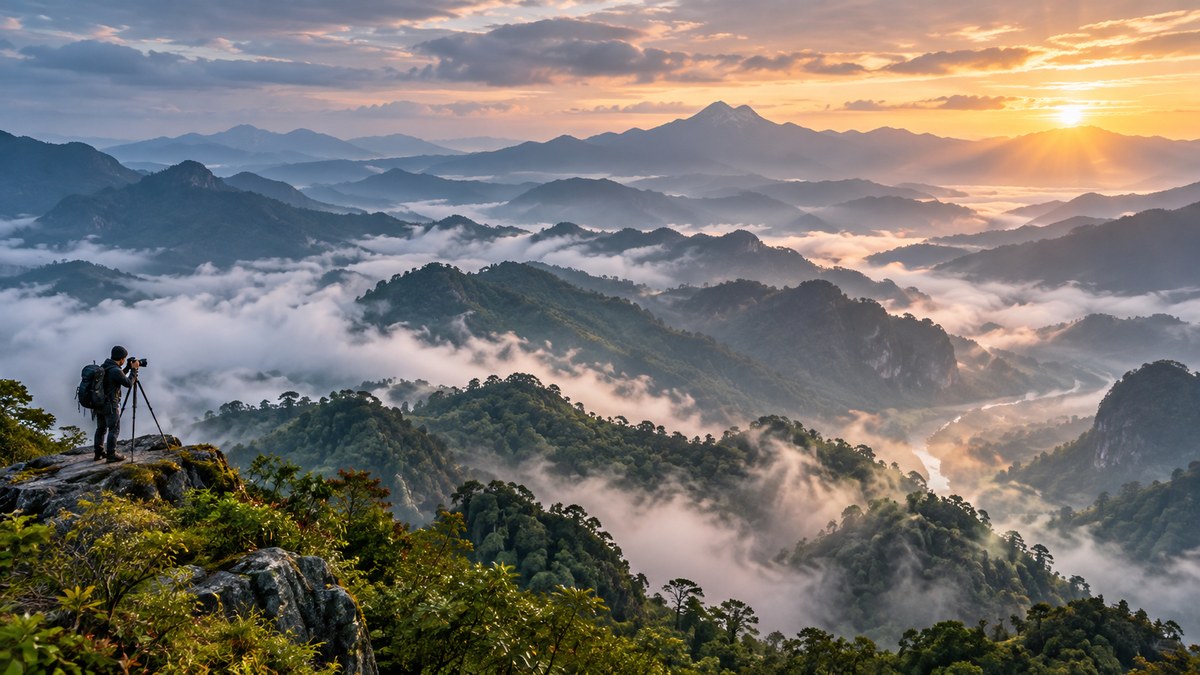
The first time you see mist pour through a valley in northern Vietnam, it feels like the landscape is breathing. One moment a ridge of karst mountains stands sharp against the sky. The next, a slow tide of fog swallows everything, leaving only the tips of trees and the distant call of birds. That is the magic of Asia’s misty highlands. It is not a scene you can force. You wait for it. You prepare for it. And when it arrives, you have maybe ten minutes to capture it before the light shifts.
Asia misty highlands photography 2026 is about preparation, timing, and patience. Success depends on scouting locations during the wet season, using a telephoto lens to compress fog layers, and shooting in RAW to preserve tonal range. The best shots happen at sunrise, often from a high vantage point looking down into a valley. Avoid common mistakes like overexposing the mist or using a polarizer that kills the haze. This guide covers gear, technique, and the top highland destinations for your 2026 trip.
Why Misty Highlands Demand a Different Approach
Mist is not just weather. It is a dynamic light modifier. It softens edges, diffuses sunlight, and creates natural negative space. In the highlands of Asia, fog often settles in valleys overnight and burns off by mid-morning. That narrow window between dawn and 9 a.m. is your prime time.
Many photographers treat mist as a problem. They try to shoot through it with a polarizing filter or boost contrast in post, stripping away the very quality that makes the scene special. The better approach is to work with the mist, not against it. Use it as a foreground element. Let it separate layers in your composition. A distant mountain range becomes a series of grey and blue bands, each one fading lighter as it recedes. That is the ethereal look you are after.
The 5 Best Highland Destinations for 2026
Not every mountain range in Asia delivers good mist. You need the right combination of elevation, humidity, and seasonal weather patterns. These five locations are proven performers for Asia misty highlands photography 2026.
- Sapa, Vietnam — The rice terraces here are famous, but the real show happens when fog rolls in from the Hoang Lien Son range. Stay in a homestay at the valley floor and hike up before sunrise.
- Banaue, Philippines — The Ifugao rice terraces are older than the Banaue itself. Mist collects in the amphitheater of the mountains, creating dramatic depth. Visit between December and February.
- Chiang Rai, Thailand — Doi Pha Hom Pok is not as crowded as Doi Inthanon. The mist here hangs low over tea plantations and pine forests. A 70-200mm lens works beautifully for compressing those layers.
- Gunung Rinjani, Indonesia — The crater lake at Segara Anak is often shrouded in morning mist. You need a permit and a guide, but the payoff is a landscape that looks like a volcanic dreamscape.
- Yunnan, China — Yu Long Shan (Jade Dragon Mountain) near Shangri-La offers high altitude mist that glows gold at sunrise. The alpine meadows add texture to the foreground.
Each of these locations rewards early risers. If you arrive at 10 a.m., the mist will already be gone. Plan to be on location by 5 a.m. at the latest.
Gear Checklist for Misty Conditions
Your gear choices matter more in fog than in clear conditions. Here is a practical list of what to pack for Asia misty highlands photography 2026.
- Camera body with good dynamic range. Mist compresses the tonal range of a scene. A camera that handles 14+ stops of dynamic range lets you recover highlights in the fog and shadows in the foreground.
- Telephoto zoom (70-200mm or 100-400mm). Wide angles are tempting, but a telephoto lens compresses layers of mist and mountain, creating that stacked, painterly effect.
- Tripod with spiked feet. Highland soil can be muddy or loose. Spiked feet grip better than rubber ones.
- Lens cloths and a microfiber towel. Fog condenses on glass. You will be wiping your front element constantly.
- Remote shutter release. Even a slight vibration from pressing the shutter can blur a long exposure of mist moving through a valley.
- Weather sealed body and lens. Mist is moisture. A non-sealed camera can stop working after 20 minutes in dense fog.
| Gear Item | Purpose | Misty Condition Benefit |
|---|---|---|
| Telephoto lens | Compresses fog layers | Creates depth without distortion |
| Tripod with spikes | Stable on wet ground | Prevents camera shake in low light |
| Lens cloth | Clears condensation | Keeps images sharp |
| Remote shutter | Reduces vibration | Essential for long exposures |
| Weather sealed body | Resists moisture | Avoids shutdown in humid fog |
Three Techniques for Capturing Mist
You can stand in the perfect spot with the right gear and still walk away with flat images. The difference is technique. Here are three methods that work consistently.
1. Expose for the Highlights, Recover the Shadows
Mist tricks your camera’s light meter. The fog is bright, but the foreground is dark. If you let the camera decide exposure, it will try to average the scene, often blowing out the mist to pure white. Instead, use spot metering on the brightest part of the mist. Then underexpose by one stop. Check your histogram. The highlights should not touch the right edge. You can lift the shadows in post without losing the mist’s texture.
2. Use a Negative Exposure Compensation
Set your exposure compensation to -0.7 or -1.0 EV. This preserves the detail in the fog and gives you a moodier image. Many beginners overexpose mist because they want the scene to look bright and airy. But the best mist shots feel mysterious. A darker exposure keeps that feeling intact.
3. Focus Manually on the Middle Layer
Autofocus can hunt in fog because there is not enough contrast for the sensor to lock onto. Switch to manual focus. Use live view and zoom in on a tree or rock in the middle distance. That is your focal point. If you focus on the foreground, the misty background will be too soft. If you focus on the far mountains, the foreground loses definition. The middle layer balances both.
“Mist is the one element that can make an ordinary landscape look extraordinary. But you have to treat it like a living thing. It moves. It thins. It thickens. You cannot rush it. You just have to be ready.” — Michael Yamashita, National Geographic photographer
Common Mistakes and How to Avoid Them
Even experienced photographers make these errors when shooting misty highlands. Here is a table of the top mistakes and their fixes.
| Mistake | Why It Happens | Fix |
|---|---|---|
| Overexposed mist | Camera meter reads fog as neutral grey | Use -1 EV compensation |
| Flat, lifeless colors | Mist desaturates the scene | Shoot in RAW and boost vibrance in post |
| Soft, blurry images | Autofocus hunts in low contrast | Switch to manual focus |
| Condensation on lens | Warm camera meets cold fog | Acclimate gear in a sealed bag before shooting |
| Boring composition | Wide angle captures too much empty space | Use a telephoto lens to isolate layers |
| Lost shadow detail | Mist is bright, foreground is dark | Expose for highlights, lift shadows in editing |
Planning Your 2026 Trip Around the Weather
Asia misty highlands photography 2026 requires timing. You cannot just show up in July and expect fog. Mist forms when warm, moist air meets cooler temperatures at higher elevations. That usually happens during the rainy season or the transition months between dry and wet.
- Northern Vietnam and Laos: Best mist from October to March. The dry season has clear skies, but the transitional months of October and November produce the heaviest morning fog.
- Philippines (Banaue): December to February. The northeast monsoon pushes moist air against the mountains.
- Northern Thailand: November to February. Cool mornings and warm days create ideal fog conditions.
- Indonesia (Rinjani): April to October. The dry season is safer for hiking, but mist is more consistent in June and July.
- Southwest China (Yunnan): Year round, but the heaviest mist occurs from September to November.
Check local weather forecasts for “fog” or “mist” specifically. General rain forecasts are less useful. Look for mornings with high humidity and light wind. Strong wind will blow the mist away before sunrise.
Composition Tips for Ethereal Results
Composition in misty conditions follows the same rules as any landscape, but with one twist: you have fewer elements to work with. That is a good thing. Mist simplifies the frame.
- Use the rule of thirds for layers. Place the foreground in the bottom third, the mist in the middle third, and the mountain tops in the top third.
- Find a leading line. A dirt path, a row of tea bushes, or a stone wall that disappears into the fog draws the viewer’s eye through the image.
- Include a human element. A farmer walking through the mist, a lone tree, or a terraced hillside gives scale. Without a reference point, the mist can feel abstract.
- Shoot both horizontal and vertical. Vertical compositions work well when mist stacks in layers. Horizontal shots suit wide valleys.
For more guidance on framing, check out our guide on composition strategies for Asian cultural scenes. The principles apply just as well to landscapes.
Editing Misty Photos Without Losing the Mood
Post processing is where many photographers ruin their mist shots. They push clarity and texture too high, which creates halos around the fog. They boost saturation, turning the mist an unnatural blue. Here is a better workflow.
- Start with a flat RAW file. Do not apply a preset. Misty images need gentle handling.
- Adjust white balance to cool but not cold. A temperature between 5500K and 6500K works well. Avoid going below 5000K unless you want a blue cast.
- Increase exposure slightly, but only for the midtones. Use a tone curve to lift the midtones without touching the highlights.
- Add contrast with the dehaze slider at +10 or +15. More than that will make the mist look dirty.
- Use a graduated filter on the sky. If the sky is brighter than the mist, darken it by half a stop to keep the focus on the fog.
For a full editing walkthrough, see our master class on Asian landscape photography edits.
The Best Time of Day for Mist Photography
Sunrise is the undisputed champion. Mist is densest in the hour after dawn, before the sun has enough strength to burn it off. But there is a second window that many photographers miss: the golden hour before sunset. On days when the humidity is high and the temperature drops, mist can reform in the late afternoon. It is thinner than morning mist, but it catches the warm side light beautifully.
Avoid shooting mist at noon. The overhead sun flattens the fog and eliminates the depth you are trying to create.
Staying Safe in the Highlands
Misty conditions reduce visibility. A trail that is easy to follow in clear weather becomes treacherous in fog. Here are a few safety tips for Asia misty highlands photography 2026.
- Carry a GPS or offline map. Cell service is unreliable in many highland areas.
- Wear waterproof boots. Wet grass and mud are slippery.
- Bring a headlamp. You will be hiking before sunrise and after sunset.
- Tell someone your route. If you get lost in fog, it can take hours to find you.
- Pack extra batteries. Cold mist drains battery life. Keep spares in an inner pocket.
Why 2026 Is a Great Year for This Project
Travel to Asia’s highlands is more accessible now than it was five years ago. New roads, improved homestays, and better flight connections mean you can reach remote areas with less hassle. At the same time, many of these locations are still uncrowded. The misty highlands have not been overrun by Instagram tourists. You can still find a quiet ridge to yourself.
If you have been planning a trip to photograph Asia’s misty landscapes, 2026 is the year to go. The conditions are reliable. The gear is better. And the destinations are ready for you.
Putting It All Together for Your 2026 Shoot
Pack your bag. Check the seasonal mist forecasts. Book a homestay near a highland valley. Wake up at 4 a.m. Hike in the dark. Set up your tripod. Wait for the fog to roll in. When it does, breathe slowly. Compose your shot. Expose for the highlights. Focus on the middle layer. Take the photo. Then take another one ten minutes later, because the light will have changed. That is the process. It is not complicated, but it requires discipline. The reward is an image that feels like a memory from a dream. And that is worth every early morning.